Michael Dennis – poems for jessica-flynn

In my last post, a reference was made to Michelle Desbarats’ poem “Peas” appearing in a shop window in the Glebe. This seems like a good moment to talk about another Ottawa poet who resided temporarily in a Glebe window.

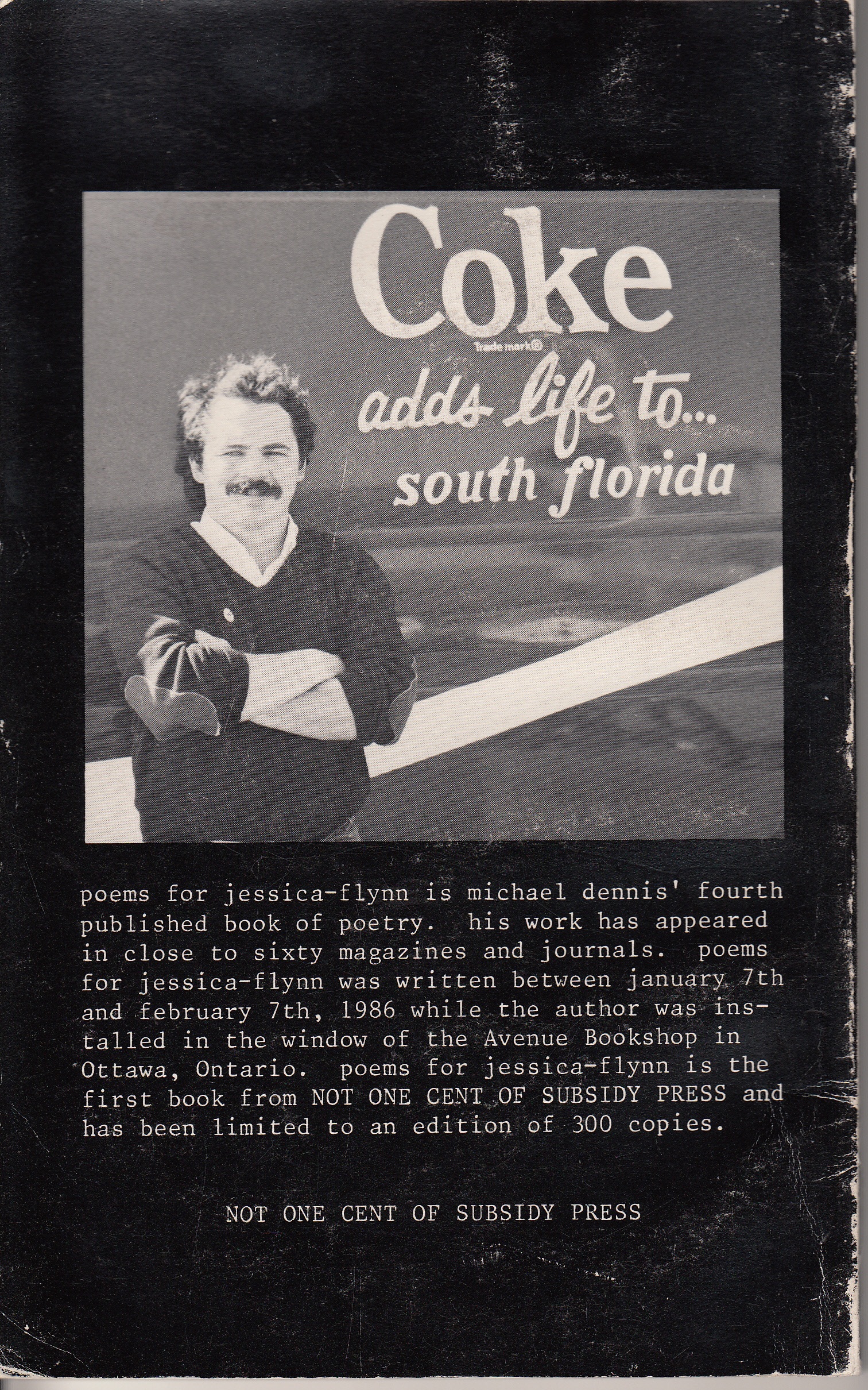
Michael Dennis’ 1986 collection poems for jessica-flynn (Ottawa: Not One Cent of Subsidy Press) was written during a one month “residency” in the storefront window of the Avenue Bookshop on Fourth. According to the back of the book, it “was written between January 7th and February 7th, 1986 while the author was installed in the window.” The Avenue Bookshop was run by Rhys Knott, who also published the book.

Front Cover
Back Cover

In a career notable for its stubborn belief in writing a sort of poetry that is generally unfashionable and unlikely to yield awards or serious critical attention, Dennis has persisted. In a recent excellent interview with Bardia Sinaee, Dennis addressed the comparisons to Bukowski he is typically met with, as well as his lifelong commitment to writing:

Well the comparisons to Bukowski, I think, have more to do with the choice of content and approach to poetry, but there’s no real comparison to be made in terms of lifestyle. Other than [that] I embodied the idea of living as a poet and being a poet at a very early age, and I’ve lived in poverty.

His most recent trade collection, the excellent Coming Ashore on Fire (Ottawa: Burnt Wine, 2009), includes several poems that address his poetic career. Take these lines from “stealing from Bukowski” for example:

I publish in small magazines in small editions

and short press runs

mostly the critics ignore me

the others range from polite indifference

to ranting diatribe about my plebeian nature

the lack of music and grace

space

the young poets

they come to my door

so I pour them a glass

put Nyro or the Trane on low

listen to what they have to say

read their poems and then tell them

space

it will not feed the cat

there is no gravy

no garlands or bright lights

if you have to write you will

read everything

make good choices

about what to read twice

space

I tell them that writing isn’t as important

as being a good person

space

they give me that look

like I’m holding something back

and then, like my critics

they leave unsatisfied

as well

Sinaee also points to a wonderful piece by Maggie Helwig on Dennis from the Fall of 1986 in Quarry. Helwig writes:

Dennis never explicitly speaks of the terrible human reflex that rejects the possibility of love, but it is one of the themes that runs through his work. The craving for love is present, the potential joy, as well as the tragedy of love’s loss. These are familiar. But its not so common to write a poem entitled “it bothers me that skin can be so inviting,” which calls our attention to the pain and even the anger we feel at “the invitations of skin.” Perhaps only a strongly compassionate man can admit — on behalf of us all — how much he can wish to run away from love.

Helwig’s description of Dennis’ work from twenty six years ago could still be applied to the poems he is producing today. jessica-flynn was apparently originally to be titled Lunacy and Sorrow. These two words could perhaps be bluntly applied to his entire body of work, if one can also recognize the humour embedded in such a title.

jessica-flynn is one of his classic books. The store window is a notable presence in a series of eleven poems scattered throughout the book that declare their positions in space: “1st in a series of poems from a bookstore window,” “2nd in a series of poems from a bookstore window,” etc. These poems embody much of what makes Dennis an exciting poet. They are firmly embedded in his surrounding streets; they are without ornament; they are primarily lyric, almost stubbornly so; they are bluntly honest (or at least present themselves as being so); there is also an element of humour that is easy to overlook (especially when readings of his work focus on lazy comparisons to Bukowski and others).

3rd in a series of poems from a bookstore window

it is the second day of this project

and I’m back in the window

only this time I’m wearing sunglasses

and I know they look silly

really

but what else could I do

I’m looking directly into the sun

and it’s more than this poor man can stand

space

now when people walk by

they see me wearing purple sunglasses

with almost mirror type lenses

and they think I’m doubly stupid

space

as a matter of fact

there is a gentleman standing at the window now

he is reading the typed page

that is taped to the glass

and wondering what sort of idiot

would sit in a window

space

now he is reading the scattered poems

that litter the floor

and alternately smiling and frowning

generally having himself a good time

but then wondering

what the point of the venture is

wondering as he stops, looks, reads

There is experimentation in this book that is unique in his body of work. Several concrete poems built within the constraints of the typewriter stand out. Forgive the terrible scans below, I lose my nerve for fear of breaking the spine. The below scans are from This Day Full of Promise, which is less brittle than jessica-flynn.

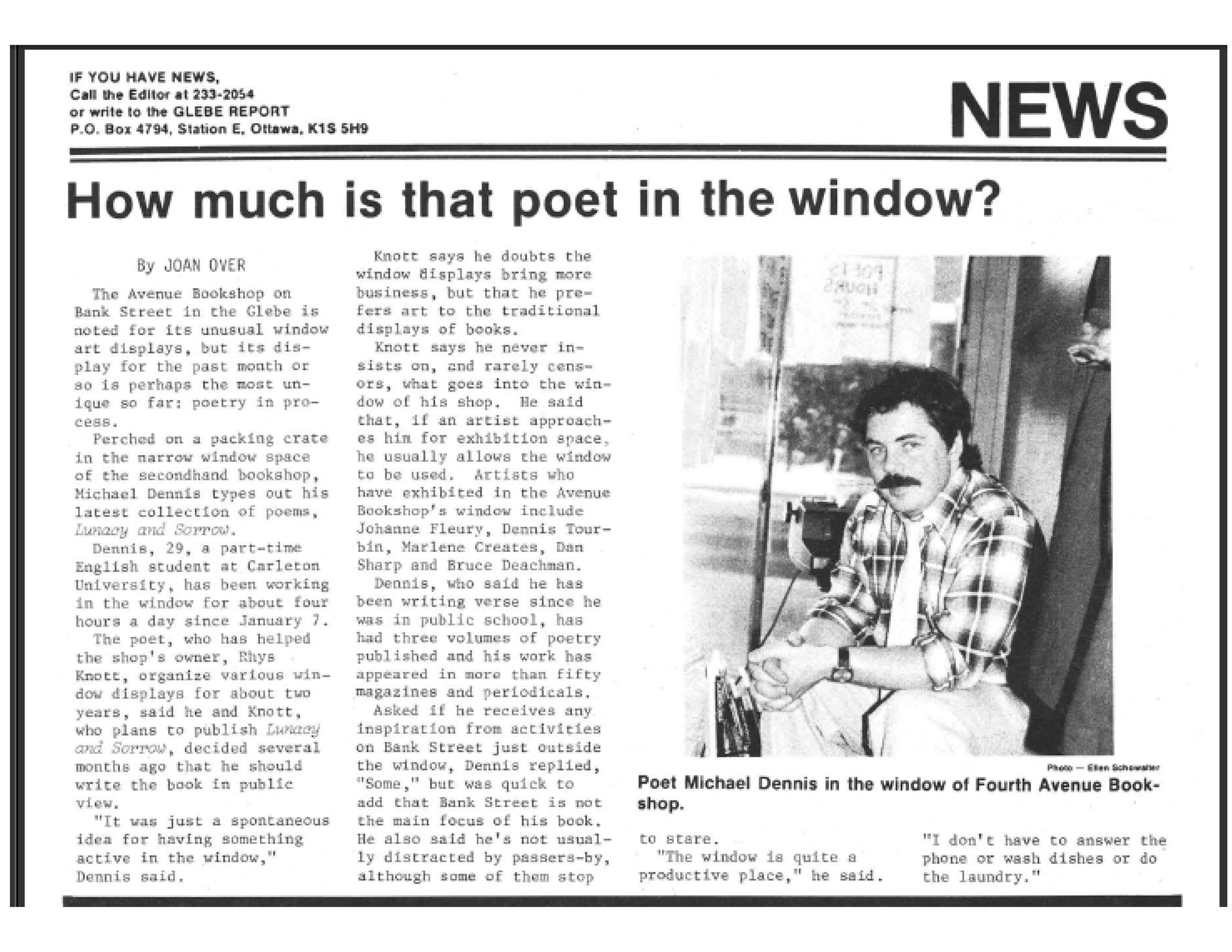
An article from the Glebe Report in February 1986 profiled Dennis while installed in the window. Explaining the project to Joan Over, Dennis remarked “it was just a spontaneous idea for having something active in the window.” The working conditions, based on this photo, are poorer than I imagined. Dennis is crammed into a narrow space. A barely visible sign reads “Poets Hours” above his shoulder. The article positions Dennis’ project in a series of curated artist installations at the store. Dennis co-ordinated a series of exhibitions in the window from various visual artists, including Johanne Fleury, Dennis Tourbin, Marlene Creates, Dan Sharp and Bruce Deachman. Dennis’ project was the final installation.
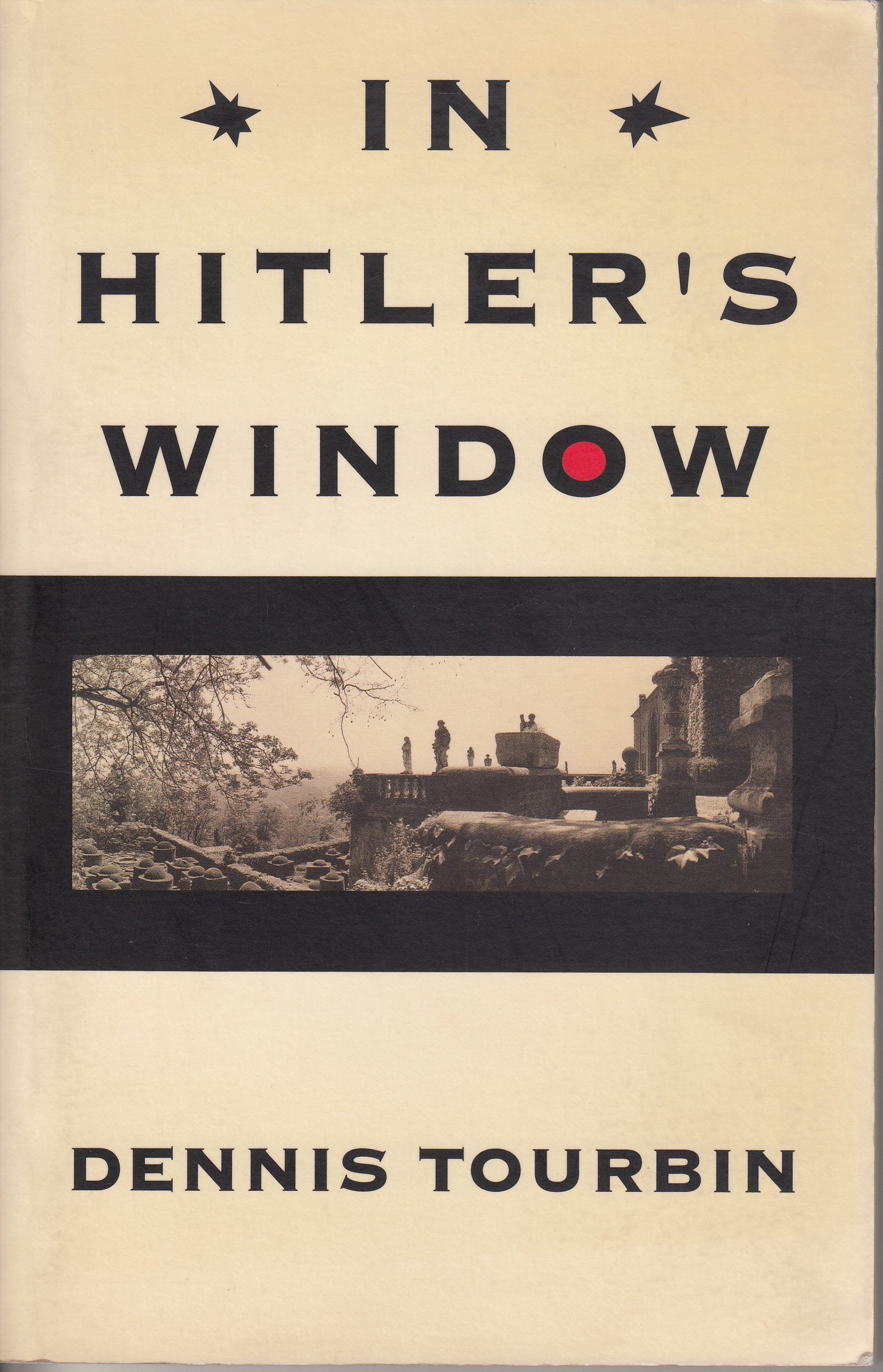
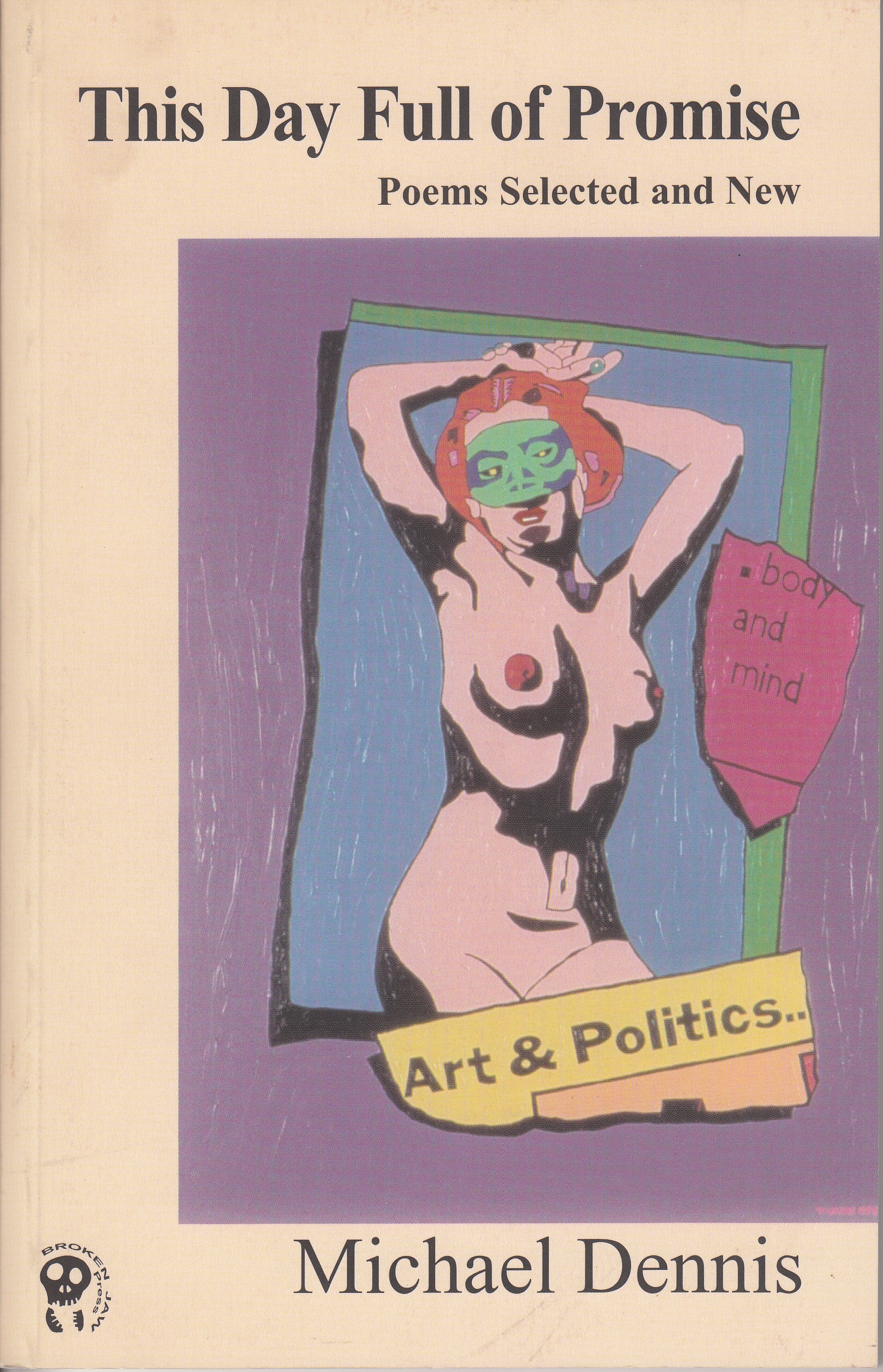
A visit to the Dennis household in Ottawa evidences his interactions with these and innumerable other artists. It is a house bursting with books and art: sculptures, paintings, drawings, photographs, various installation items. It is a story of a life lived in the service of art. He recalls bartering meals and odd jobs in exchange for various pieces. These interactions can be traced in other places as well. Tourbin’s art graces the cover of Dennis’ 2002 selected poems This Day Full of Promise (Fredericton: Broken Jaw Press). Tourbin was a poet himself. His excellent book In Hitler’s Window (Ottawa: The Tellem Press, 1991) includes the poem “Brussels (First Version) dedicated to “Mike Dennis.” Tourbin, who died in 1998, will have an exhibition of his work this Fall at the Ottawa Art Gallery starting at the end of August.
The project was reproduced one decade later when rob mclennan spent a month sitting in the window of Octopus Books while writing his chapbook we live at the end of the twentieth century (Ottawa: above/ground press, 1996). This tradition can be traced in a further spin-off to iterations of Joe Blades’ “casemate poems,” written during various public residences in Fredericton, and collected in the recent Casemate Poems (Collected) (Ottawa: Chaudiere Books, 2011). Note also Blades’ Prison Songs and Storefront Poetry (Victoria BC: Ekstasis Editions, 2010) written partly “during a storefront residency in The Rabbit Hole Book Store, Grande Prairie, Alberta, September 2008.”

Following this project, Dennis went on to write a three-day novel in a bookstore in Peterborough (most likely in 1988). At one time a scan of an article from a Peterborough newspaper existed online to document this. Look for a future update to this post with a scan of that article once it is discovered.

This Day Full of Promise was a welcome selection of Dennis’ work, but at only 84 pages it is a decidedly preliminary volume given that he has been publishing since 1979 and has produced several dozen books and chapbooks. He is due a proper selection, something representative of his accomplishments, in some obscenely gorgeous format (since Bukowski has already come up, think Black Sparrow publishing Bukowski in his prime). I have had the privilege of twice publishing Michael through Apt. 9 Press—the chapbook how are you she innocently asked (2010) and the broadside there was a man who loved to murder (2011)—and hope to have the opportunity to do so again. Michael has shown a remarkable commitment to the world of small press publishing throughout his career, and his willingness to publish with tiny outfits like Apt. 9 is a testament to his support for new generations of writers and publishers. His reading at the inaugural VerseFest in 2011 was supposedly his final public reading (there was a video of this reading on the Versefest website, but I can’t locate it anymore). We can only hope that he’ll give another. He is one of the best readers in the country—disarming, funny and devastating in turn, unadorned—his is a model to aspire to.
Ask Dennis about the jessica-flynn project and he’ll bring up the multiple bookstores that then existed in the Glebe. Today those numbers have dwindled and are in threat of declining further. Ottawa has lost some wonderful independent bookstores in recent years, with others engaged in a constant struggle. Black Squirrel Books north of the Queensway on Bank is a welcome new addition. Octopus Books has also opened a second location at the exciting Under One Roof space (go visit!). poems for jessica-flynn evokes sadness in hindsight for the stores that have been lost. Get out to an independent bookstore, and stop in at the small press book fair on June 30. It will be a sad day if we find ourselves with only Chapters and Indigo remaining, where in Ottawa, at least, “Literature” is consigned to the second floor to make room for increased stocks of pillows, scented candles, and other items necessary to a vibrant, fertile literary community in this country. With the recent news of LPG losing federal funding, it is more urgent than ever that you buy books from these presses. Go to your local, order something from the LPG catalogue, and make it a habit.  Things may look very poor a year or two from now if we don’t act now to support these vital community spaces.

11th in a series of poems from a bookstore window

I have been sitting behind the glass

for almost three weeks now

and today someone wrote me a note

and left it on the window

I was out for a few minutes

to get a cheeseburger

the note said that she was unsure

whether I was watching them

or they were watching me

I’m not sure either

except that now I know

at least one person

is watching

Michelle Desbarats: A (sort-of) Interim Finding Aid

Michelle Desbarats is a widely appreciated, if arguably under-published, poet in Ottawa. Her first and only trade collection, Last Child to Come Inside, was published in 1998 by the Harbinger Poetry Series at the Carleton University Press. For years now her working biography for readings, magazines, and anthology appearances has declared some variation of the statement that she is presently working on a second manuscript/collection. We should only be so lucky to see new work from her available in print in the near future. In the meantime, I wanted to point to some of her material scattered in a small handful of other places from the last fifteen years or so.

Michelle’s work is quiet, unassuming, often hilarious, always controlled, and deeply thought-provoking. In addition, she is simply one of the nicest women you will have the chance to meet. Take this short poem, “If,” a favourite at her readings for one example:

If

If you don’t know what something

eats, try feeding it anything and

see if it starts to die.

“Peas” is another oft-cited favourite. During the two years I spent working at Octopus Books from 2009-2011, it was pasted in the window of the grocery store between Third and Second in a display of “Glebe Poets.” It always gave me a smile; the poem seemed somehow a bit too perversely dark to be in the window of a store that sold peas.

Peas

I like the idea of eating peas

after they’ve been used to kill someone

because it just goes without saying

it would take a lot of peas

to snuff someone,

finally after a constant

bombardment, they go crazy, die

and I like peas, sitting down

with a whole mound of them, hot

butter making them slippery.

Maybe someone could kill someone

with one pea shot hard and fast to

a crucial area on the neck

or forehead

one deadly pea,

but I wouldn’t be interested in

getting to know that person,

they wouldn’t have a sense of the

abundance of things.

She had a chapbook published the same year as Last Child to Come Inside through above/ground press titled Eve’n Adam (1998).

later on she said that the little things counted

every little thing, they all mattered

he said no, they did not, he said that was a way

to insanity

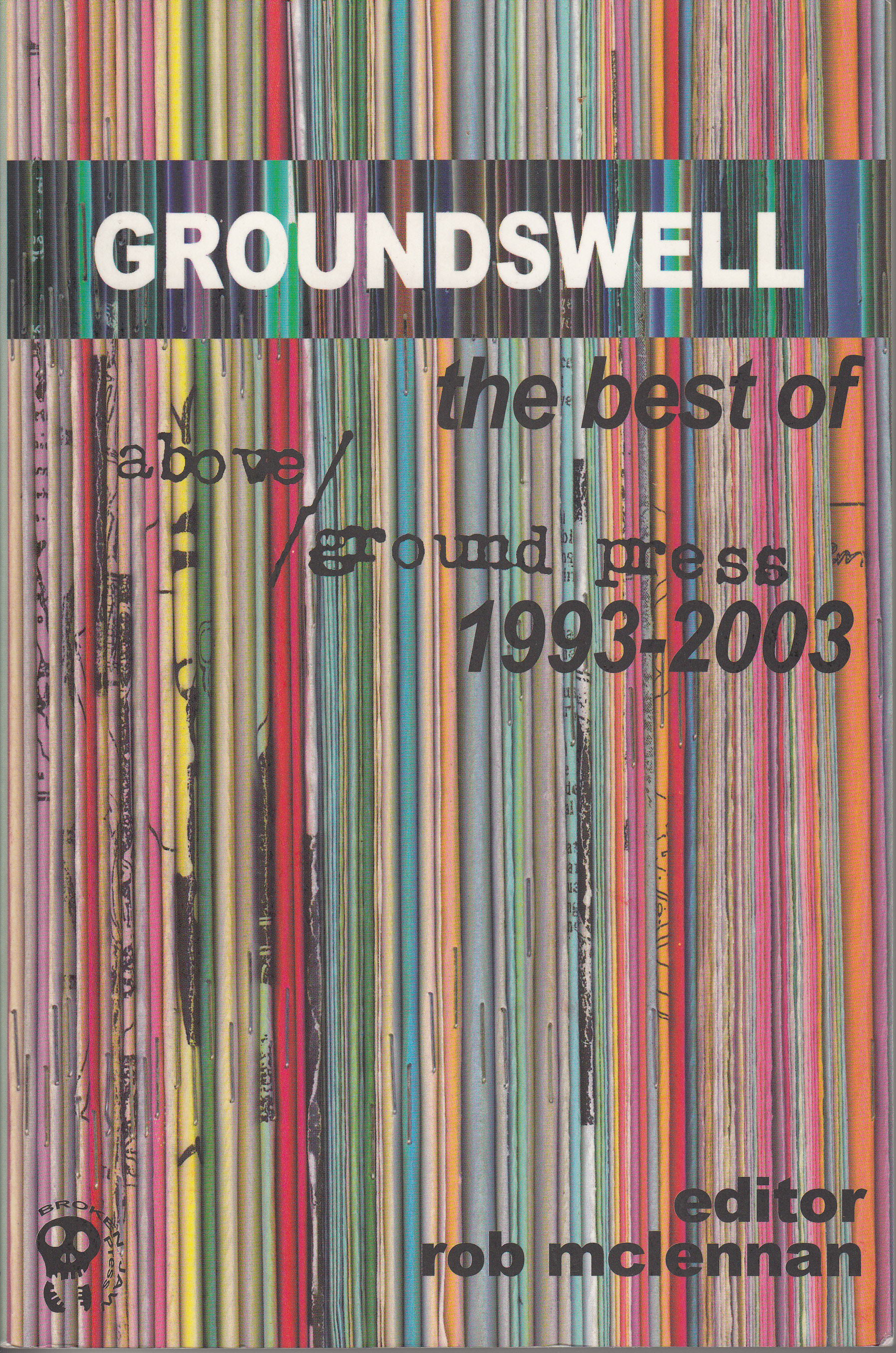
I don’t know if this is still in print, but the full-text of the chapbook is available in the anthology Groundswell: the best of above/ground press 1993-2003. This is a great anthology, and a great document of ten years of one of the most astonishingly active chapbook presses in Canada. rob can usually be counted on to have a few copies for sale at the Ottawa small press book fair (coming up on June 30). You could likely even send rob an email and he’d be sure to bring one along if you were interested.

In 1997, one year before Last Child to Come Inside, Michelle appeared in the anthology Speak! Six OmniGothic NeoFuturists (Fredericton: Broken Jaw Press, 1997). I found this book in a small shop in Halifax for $6.50. It seemed an appropriate book to find on the East Coast given that it was published by Broken Jaw (who, incidentally, also published Groundswell). The other “OmniGothic NeoFuturists” are Jim Larwill, Craig Carpenter, Sean Johnston, Rocco Paoletti, and Malcolm Todd. Carpenter’s forward identifies the NeoFuturists as simply a local writing group who “although intrigued by nomenclature . . . have no set theory of poetry.” Jim Larwill is the only other of the group that I know immediately. I recall hearing him read for the first time at TREE in an open-set several years ago where he identified himself immediately as an OmniGothic NeoFuturist. Larwill has done some important and interesting things over his career as a poet (several minutes of a recent reading can be seen over at Pesbo). His son, Alastair Larwill, is becoming active these days as well, performing in various iterations of jwcurry’s Messagio Galore, giving his own sound poetry performances and, I believe, currently running the Sasquatch Reading Series.

Michelle has fifteen poems in Speak!. According to the acknowledgements in Last Child to Come Inside, only “Choosing a Counter” is repeated in both collections.  Her biography declares that she is working on a manuscript titled “More Like Us”—perhaps this became Last Child to Come Inside?

She had a poem included in the second run of the OC Transpo Transpoetry project in 2006 along with Stephen Brockwell and others. Her poem was “Skating”:

Skating

It only happens rarely that the line between
fall and winter is a single sheet
snap frozen on the lake no snow or
wind to mar the surface. Trees black-feather
the low border of grey sky. The ice a clear glass
and the shallow pebbled bottom of the
lake passing below me as if I’m flying.
The sudden darkness of this land dropping away,
my breath catching, and fish appearing beneath my feet,
a muscled brightness that I begin to follow.

Michelle can also be found in Decalogue: Ten Ottawa Poets (Ottawa: Chaudiere, 2006) with nine poems under the title “Drift.”

The anthology is built in such a way that it reads like a collection of chapbooks. Each of the ten poets is given 10-20 pages under a title.

Waiting

What people do to pass the time

between when things happen of account,

those long lonely nights and

the hands must do something

with sharp instruments onto

surfaces; incise micro-thin lines

called decoration that recount

tales of past adventure.

Beneath only the light of stars, maybe a

moon, expanses used to

lay down history and then

the night’s ink rubbed in

so while they sleep you can read

what you’ve drawn and see

the great ships again, the vast

whales and oceans,

then leave

for others to find and polish

your scrimshaw people.

Michelle was also a finalist in the CBC Literary Awards in 2005, though I’m unable to find a useful link for that year of the contest.

This material collected is likely between thirty and forty pages of poems in addition to Last Child to Come Inside. This represents only what I was able to find on my bookshelves immediately. I suspect there is more to be found. Leave a comment or send me an email if you have other material and I’ll amend it to this post.

While there are many people who desperately want more new work from Michelle, this is enough to recognize that she has not been silent. She reads fairly regularly in Ottawa, she teaches a poetry workshop at Carleton University occasionally, and also likely appears at least irregularly in literary magazines when editors are able to successfully get new work from her. The point is, we have more than enough of Michelle’s work to recognize how lucky we are to have any at all. We can only hope to see more in the future, but to have as much as we already do is a wonderful thing. Go seek it out!

Jay Macpherson, Emblem Books

Jay Macpherson died earlier this year (21 March 2012) at the age of 80. Her death was met with a surprising silence in its immediate wake (with a handful of exceptions). Macpherson is known primarily as a poet. Her reputation is built on a small number of collections in the 1950s, culminating in a Governor General’s Award in 1958 for The Boatman.

My own research interests have turned up her name in the margins of a variety of fantastic projects in the history of modern Canadian poetry. She was an early reader at the Contact Poetry Reading Series, appearing on 13 November 1957, generating some of the earliest national press that the series received in the Globe and Mail; Macpherson is described as being “considered by many Canadians our finest young poet” (“Arts in Toronto Spurting Ahead at a Great Pace.” 12 November 1957. p.13).

In an Ottawa connection, she completed part of her high school education at Glebe Collegiate.

More interesting, and more relevant for this blog, she started a small chapbook press in 1954 called Emblem Books. According to the One Zero Zero virtual library of English Canadian Small Presses, Emblem ran from 1954-1962, producing eight books. Authors include Macpherson herself, Dorothy Livesay, Daryl Hine, Violet Anderson, Heather Spears, Dorothy Roberts, Alden Nowlan and Al Purdy. The Nowlan and Purdy books, Wind in a Rocky Country (1960) and The Blur in Between (1962) respectively, were designed and published by Robert Rosewarne, who we have already discussed here.

These two books are surely among the most beautiful produced in Canada in the 20th century. To my mind, they stand alongside the two books of poems produced by Avrom Isaacs’ Gallery Editions. A footnote from my M.A. research describes Gallery Editions as follows:

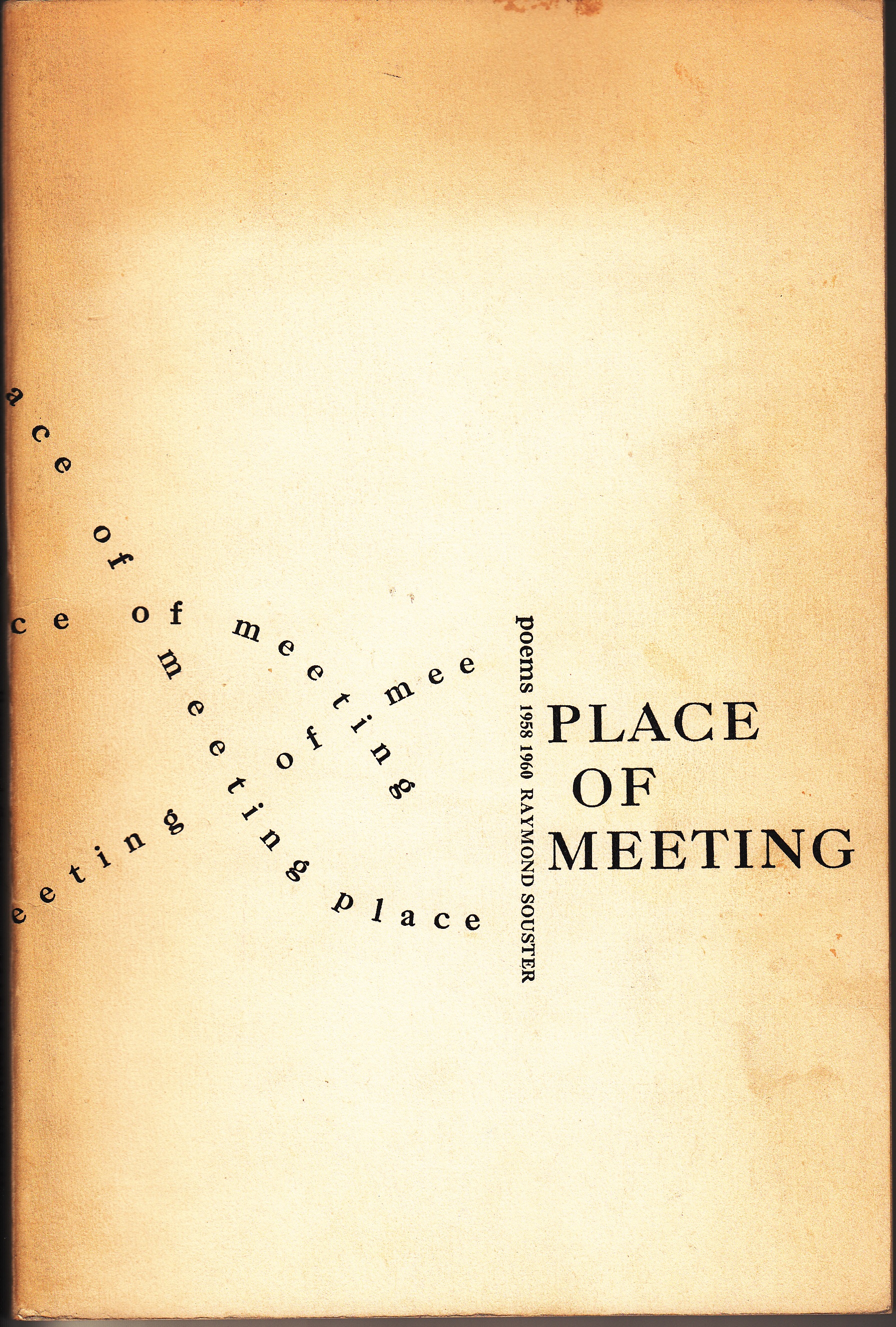
Avrom Isaacs’ Gallery Editions Press is one of the tangible products of the reading series. Although it only existed for a few years (1960-1962), Gallery Editions produced three books: Eyes Without a Face (1960), poems by Kenneth McRobbie with art by Graham Coughtry, Place of Meeting (1962), poems by Raymond Souster with art by Michael Snow, and Sketch Book: Canadian and European Sketches by Tony Urquhart (1962). Michael Torosian, writing in Toronto Suite, states “they are among the most elegant Canadian books of their day” (66). George Bowering, in an insightful review in The Canadian Forum, takes care to connect the books with their Gallery source: “I have never seen the Isaacs Gallery on Yonge Street except in photographs, but judging from the finesse with which that establishment has moved into the publishing business, I would be prepared to argue in their favour at the drop of a beret” (44). The books remain valuable documents of the interaction that occurred between poets and artists in the Greenwich and Isaacs Galleries.

Raymond Souster, Place of Meeting
Kenneth McRobbie, Eyes Without a Face

I cannot scan the insides of either of these two without damaging the spines. If you have an opportunity, flip through both to truly understand their remarkable beauty.

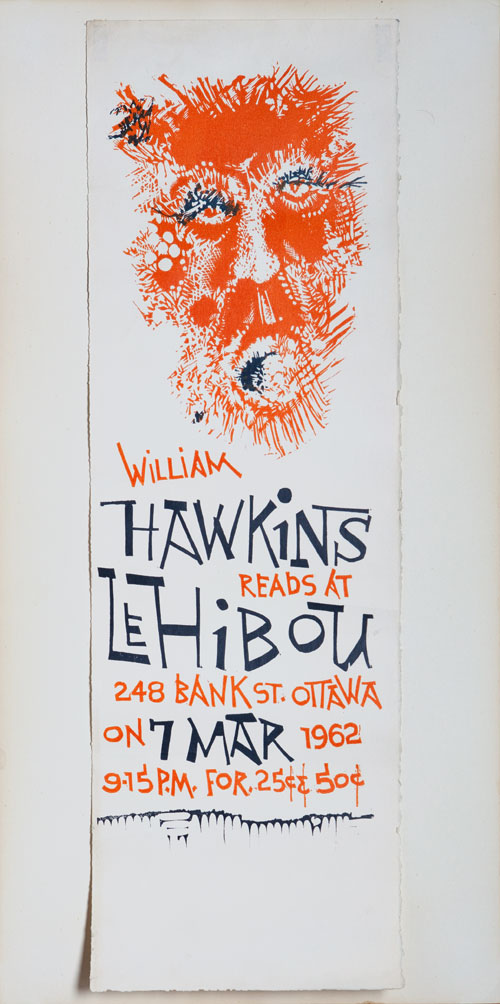
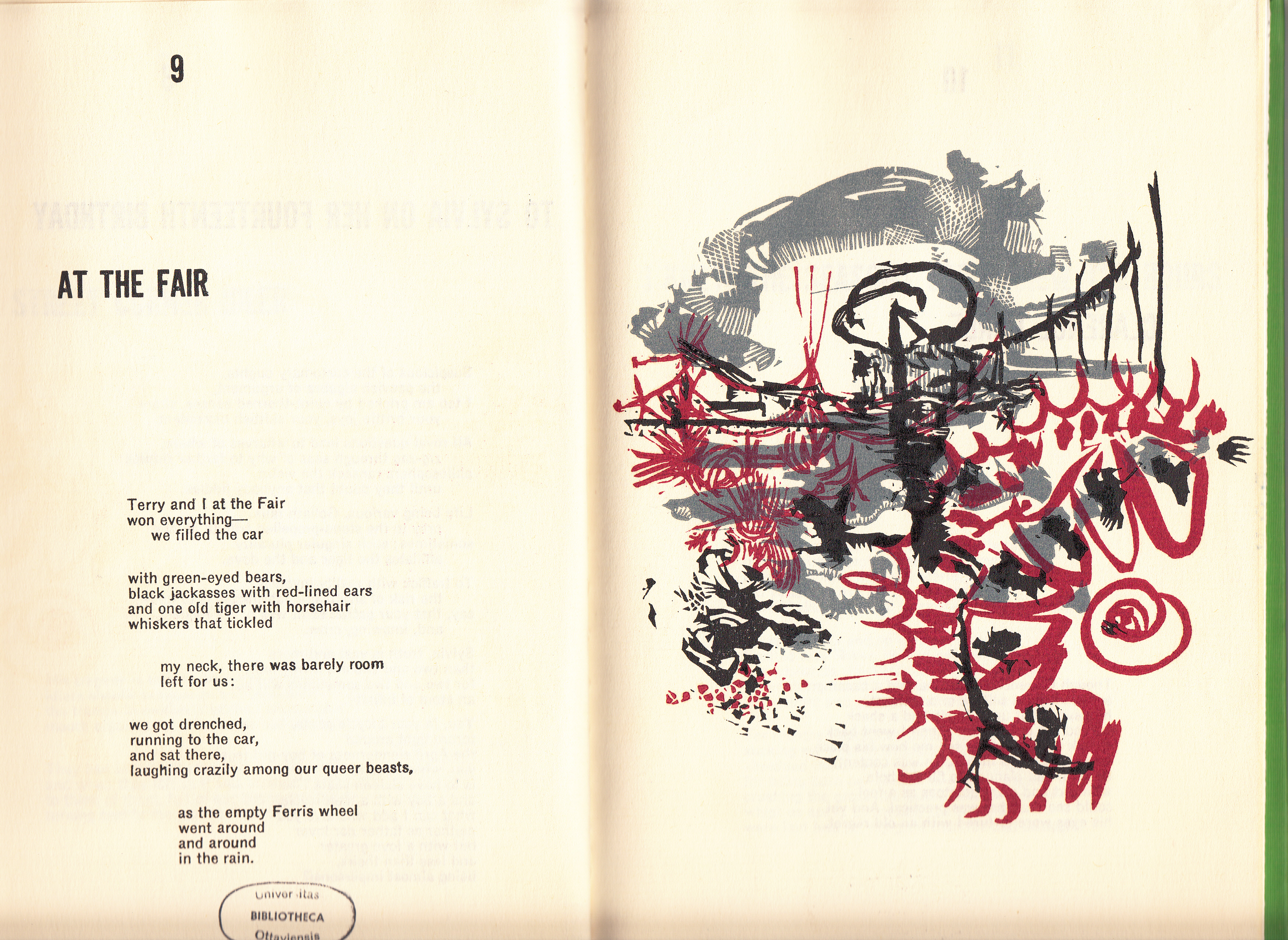
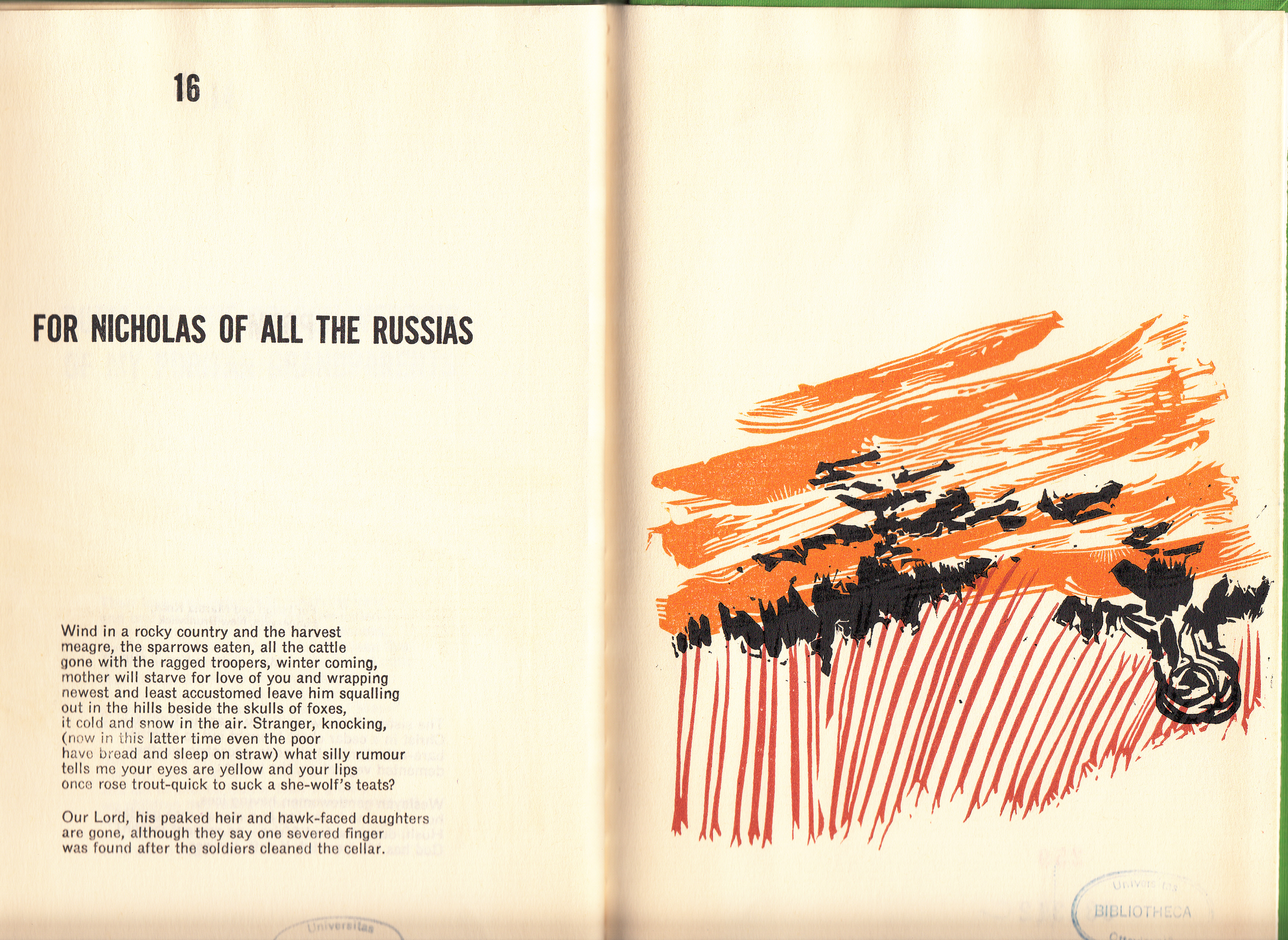
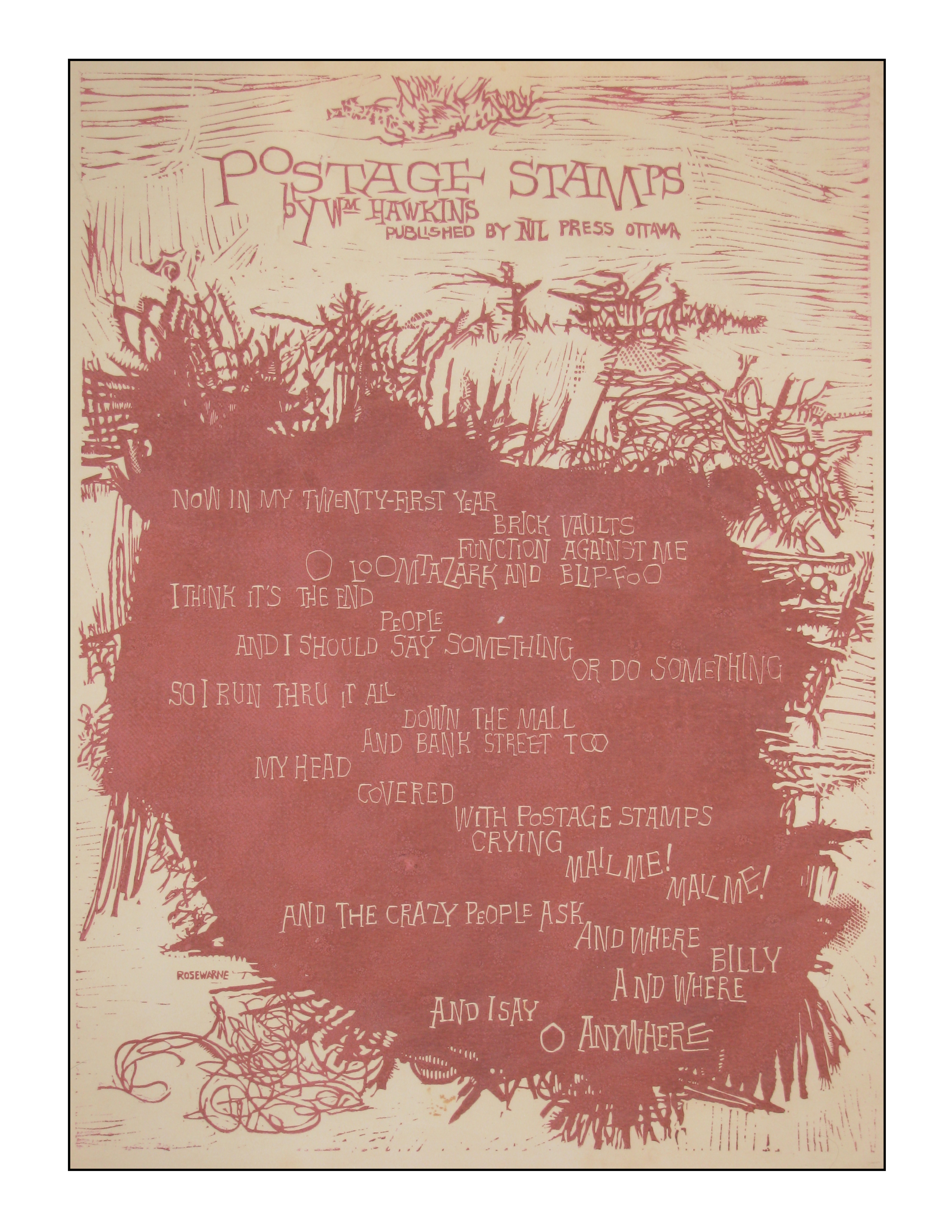
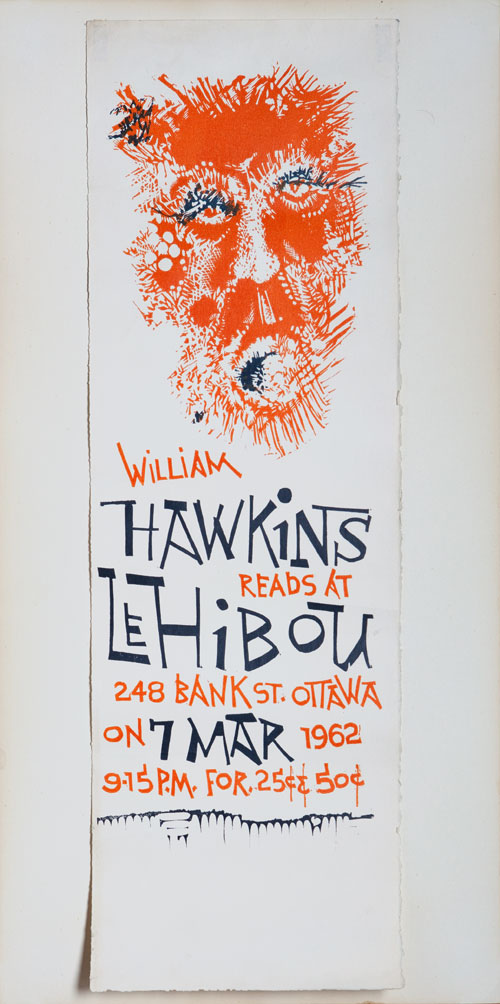
Rosewarne’s work on these two Emblem books is astonishing. He pairs Purdy and Nowlan’s poems with the sort of abstracted, colourful images that we have already seen in his work with Bill Hawkins. Below is a poster he designed for a reading by Hawkins in 1962.

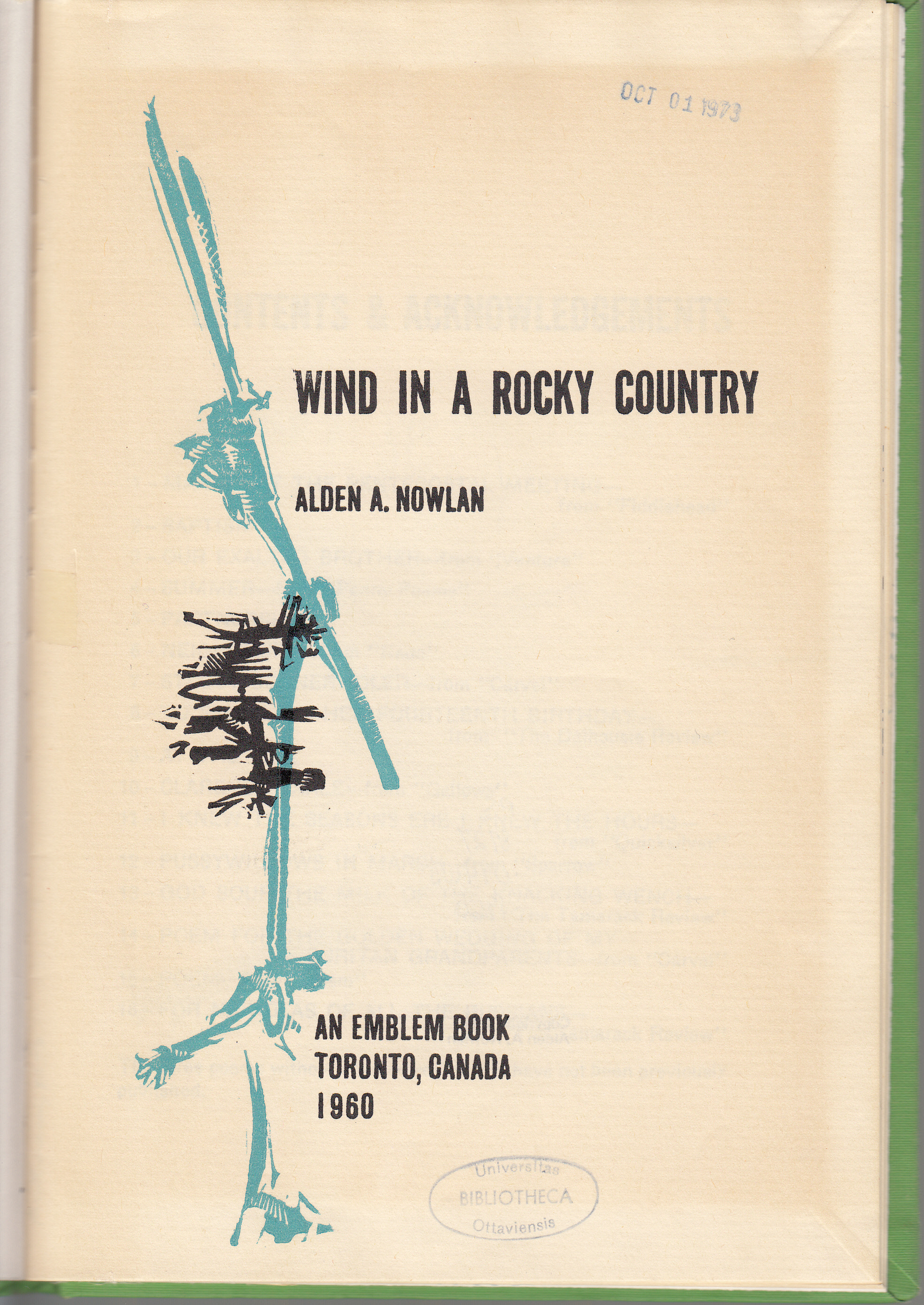
I’ll reproduce, without comment, a handful of images from inside each book below. My scanner is not always large enough to accommodate the entire spread, apologies where pages are cut off. I have tried to keep at least the images intact.

Nowlan, Alden A. Wind in a Rocky Country. Toronto: An Emblem Book, 1960.

Purdy, Alfred. The Blur in Between: Poems 1960-1961. Toronto: Emblem Books, 1962. [The edition I am using for this, borrowed from the University of Ottawa Library, has 1962 struck out, replaced with 1963].

The Purdy is especially notable for Rosewarne’s work. The Nowlan book does not acknowledge Rosewarne’s contribution. The Purdy book lists him on the title page, as well as includes further information on the colophon:

This book was published in one edition of 300 copies. It was designed by R.V. Rosewarne. The text was hand-set by Axel Harvey in 10 point Light Gothic leaded with a strip of light cardboard. The book was then hand printed on a press of the Washington variety by The Blue R Hand Press (Ottawa Canada).

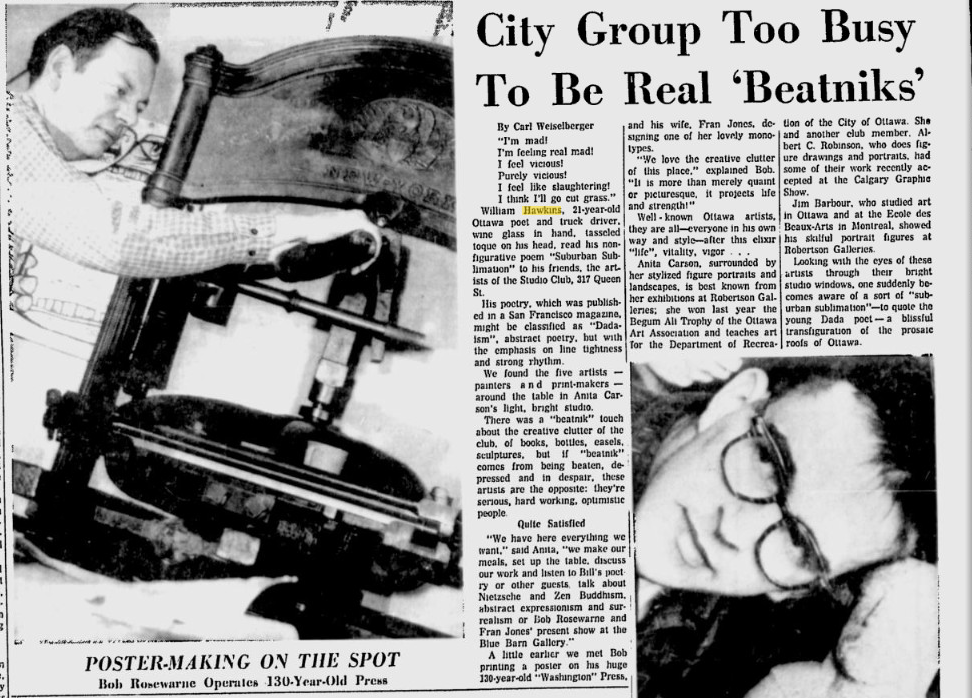
The Washington press in question is surely (without any proof) the same one used by Rosewarne’s Nil Press to produce the Hawkins poster poems. Rosewarne is operating the press in the detail from an Ottawa Citizen article below. These two books are contemporary with the poster poems, and it is difficult to imagine Rosewarne having access to two different Washington presses in Ottawa in these years. Seeing these, it is a shame that Rosewarne did not produce a series of chapbooks under his own imprint.

I have a soft spot for poets who print and distribute work by others. It is important work and is largely unheralded, certainly rarely acknowledged in a way commensurate with the time and labour invested. When you read and remember Macpherson, think of Emblem Books as well.

[I do not own the rights to Emblem Books. I have reproduced the images above with respect and admiration for the work of Macpherson and Rosewarne. They represent only a small portion of larger books. I will gladly remove the images if the estate of either requests it. I encourage everyone with the time and means to seek out these books to further understand the work of both.]

Diversity and Representation

I’m late to this conversation.

On May 4, Natalie Zina Walschots published a captivating post on her blog regarding the disparity between the numbers of books by men and women reviewed in the National Post in the previous year and a half. Just over a year ago, Sina Queyras wrote passionately about gender bias in contemporary literary cultures. rob mclennan subsequently weighed in on his own experience as a publisher and reviewer. These three barely scratch the surface of this conversation. The comment streams provide some further depth, and there are endless articles to be tracked down in addition.

This is an issue I’m acutely self-conscious of as a publisher. My own Apt. 9 Press skews male–of 14 authors I’ve published, only 4 have been female. In keeping with what others have said, this in part reflects my experience of soliciting and receiving submissions. I’ve had greater success actually getting manuscripts from the men I approach. It certainly does not reflect my reading, and does not reflect the gender balance of my wish list. Nonetheless, it is a fact of the current state of my publishing project. I hope over the next several years of the life of the press that this will balance out (of the three titles coming along in the Fall, for example, two are by women).

The press has been inactive for the last ten months or so, and it has given me a chance to reflect on this disparity. What I love about these conversations, debates and ideas is that a discussion of a particular marginalized and under-represented group of people can be a good first step towards discussing the problems of marginalization and under-representation more broadly. To discuss diversity and variety primarily, or even exclusively, in terms of gender is reductive. A list with a perfect ratio of men to women is not necessarily more richly diverse than Michael Lista’s body of reviews that prompted the current iteration of this discussion (I won’t comment directly on Lista here, I have not read each of his reviews). I feel that my own Apt. 9, despite skewing male, presents a varied and diverse body of work. I have published first chapbooks by writers, chapbooks by writers who have been publishing for decades, young and old, queer and straight, poetry/fiction/non-fiction (to say nothing of the diversity of forms and styles within these types of writing), women and men.

Addressing the gender disparity clearly evident in how books are reviewed in this country is a productive, worthwhile project that we should all be engaged with. I feel that we should also consider other terms of disparity. rob mclennan gestures towards the geographic characteristics of his own work, discussing his Canadian vs. Non-Canadian numbers. I admire work being done at The Bull Calf Review where they publish “Retrospective Reviews,” discussing important books from previous years. An increased number of reviewers writing from an increased number of critical positions would also be valuable; as in my academic experience, it quickly grows boring when everyone agrees. Forms of publishing also come into play. It is hard to imagine it happening, but wouldn’t it be wonderful to see a chapbook or two reviewed in a national forum?

It’s an impossible project, of course. We can’t balance perfectly the endless configurations of different markers of identity that determine how books are categorized, published, reviewed. It is possible, though, to work individually, to be conscious of one’s habits, to resist those habits, to seek out new, interesting and challenging writing. I suspect we all do this already in our personal reading, and variety is surely a goal of each of our writing projects.

Yes, I intend to review and publish more writing by women. I also intend to review and publish more varied writing under a whole host of other categories.

As Walschots list of poetry books by Canadian women since 2010 shows, there is no shortage of wonderful writing and publishing being done by women in this country, which is an excellent place to start and certainly was not always the case. I’ve been reading Dean Irvine’s phenomenal Editing Modernity: Women and Little Magazine Cultures in Canada, 1916-1956. Discussing Alan Crawley’s work editing Contemporary Verse from 1941-1952, Irvine touches on a historical version of this same discussion. I’m going to quote two full paragraphs, forgive their length:

Despite their common ancestry in the CAA poetry yearbooks and derivation from Poetry, Canadian Poetry Magazine and Contemporary Verse remained separated by their different commitments to the making of modernist little-magazine cultures, particularly to the issue of gender. Crawley’s personal correspondence, including editorial advice and recommendations for revision, inspired an entire generation of Canadian poets, especially women poets, to publish their poetry either in Contemporary Verse or in other little magazines. As Butling notes in her article on women poets and British Columbia little magazines, ‘Contemporary Verse is . . . significant for the number of women writers that it published. Thirty to fifty percent of the poems in every issue were by women . . . (Not until the eighties do we see such a high percentage again)’ (‘Hall’ 61-2). While she is emphatic that Contemporary Verse was not a ‘women’s magazine’ (62), Butling speculates on the possible reasons for its attractiveness to women: ‘Was it the greater prominence of women in wartime combined with the obvious presence of women contributors at t he start of the magazine, or editor Crawley’s open and supportive manner, or the non-aggressive nature of the magazine?’ (62).  Writing in 1938 to McLaren, Crawley hinted at the gender orientation of his editorial work on Contemporary Verse when he announced ‘what a feminist I am unconsciously’ (FMP).

The extent to which he practised an ‘unconscious’ feminism and fostered an emergent women’s modernism in an otherwise masculinist little-magazine culture can be measured by the significant volume of women’s modernist poetry he published in Contemporary Verse. In fact, around the mid-point of the magazine’s run, Crawley takes stock of the number of men and women poets represented not only in Contemporary Verse but also in the recent anthologies Unit of Five (1944) and Other Canadians (1947); he notes that in each case the men far outnumber the women and finds himself surprised to discover that ‘in twenty two numbers of Contemporary Verse covering a period of more than six years forty men have contributed considerably more poems than the women writers whose number is thirty’ (‘Notes’ 20). If Crawley’s initial ‘unconscious’ feminism facilitated the emergence of a respectable proportion of women poets, his statistical reflection on the magazine’s contents bespeaks a gender consciousness that makes plain his advocacy of an increased representation of women at a time when Canada’s modernist literary culture sustained its dominant masculinist character. (87-88)

Every review is valuable. Let’s write more, and more variously. Queyras provided a list of proactive steps towards achieving greater balance in these conversations. Her call to “DEMAND A MORE VIGOROUS AND DIVERSE LITERARY WEAVE” says more eloquently, powerfully and concisely what I intended with this post. So allow me to simply repeat her words:

DEMAND A MORE VIGOROUS AND DIVERSE LITERARY WEAVE.

Notes on Five Canadian Small (micro) Publishers

rob mclennan recently published a piece called “Notes on Five Canadian Small (micro) Publishers” in the Australian magazine Cordite Poetry Review. Holy cow, what a list, and my own little Apt. 9 was lucky enough to be included. The other four presses are four of the best outfits going in Canada:

AngelHousePress

The Emergency Response Unit

Nomados Literary Publishers

Greenboathouse Press

There is an awful lot that I aspire to with Apt. 9, and these four embody the great majority of it. It would be impossible to list all of the wonderful small press work being done in Canada right now (rob tries valiantly in the article, listing off a few dozen with ease). The four he points to in addition to Apt. 9 are accomplishing some of the most varied, interesting, and invested work that I know of. Please go buy their books. And buy some of rob’s from his tireless above/ground press while you’re at it. The list of presses over at Meet The Presses is another great place to start to dive into the active world of Canadian small press.

Thanks, rob!

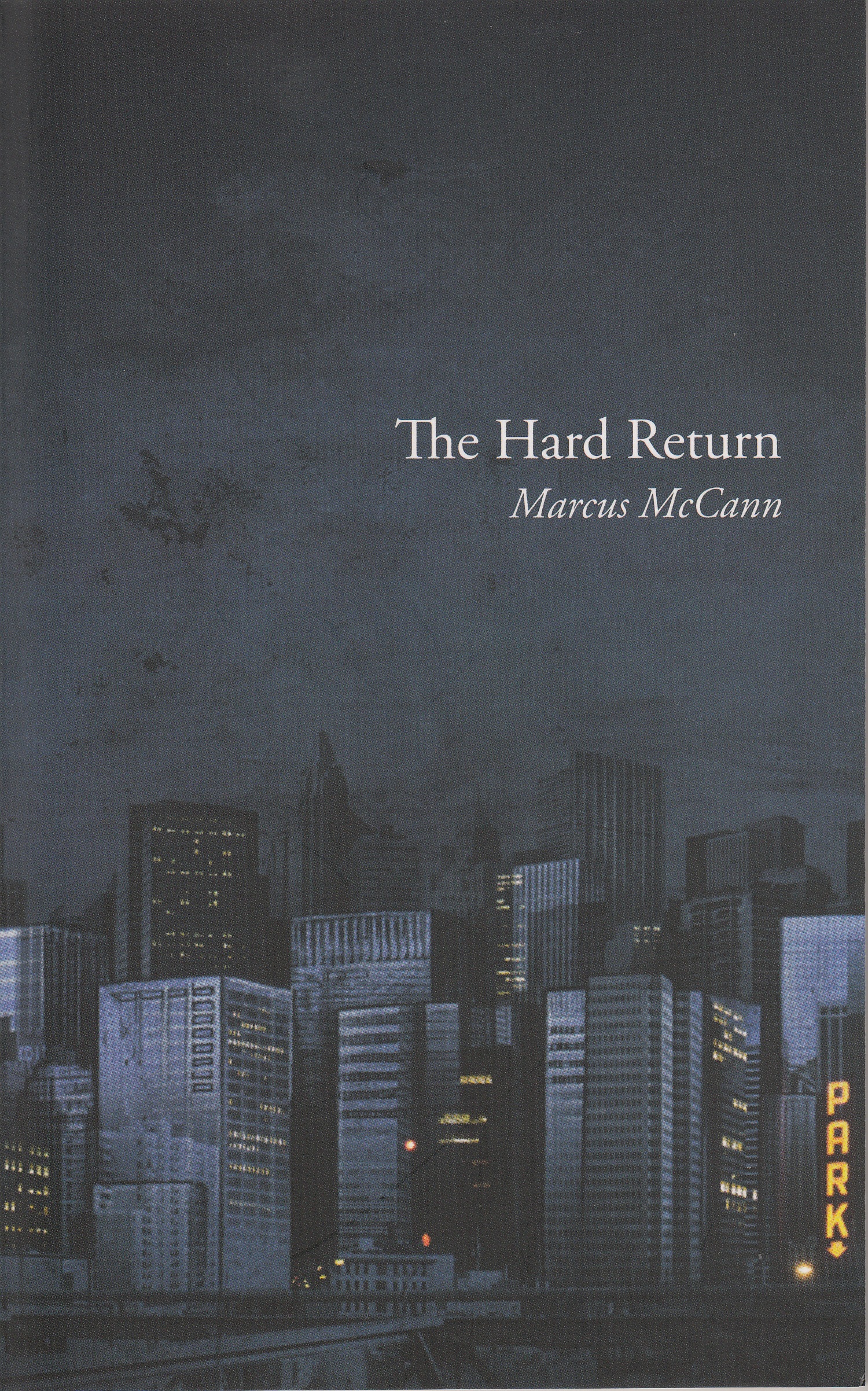
The Hard Return by Marcus McCann

Hey, I’ve got three words in a book with a spine!

I was at Octopus Books yesterday where I picked up Lisa Robertson’s new Bookthug title Nilling, as well as Marcus McCann‘s second trade collection, The Hard Return, published by Insomniac. Marcus lives in Toronto currently, but he was a longtime stalwart of Ottawa’s creative writing community. He ran the Naughty Thoughts Book Club, was one of the stable of hosts for CKCU’s Literary Landscapes, ran his own Onion Union project, published just about everywhere, and eventually saw his first trade collection Soft Where into print with Chaudiere Books. He has also published chapbooks with many of the coolest chapbook publishers in the country (above/ground, The Emergency Response Unit, Rubicon). Marcus is a good poet, and getting better. So it was simple to buy his new book yesterday.

Flipping through, three poems jumped out: “Twenty-two Toronto Poets Wake Up on the Bathroom Floor and Discuss Their Hangover”, “Twenty-two BC Poets Use Orgasm As a Metaphor for Belonging” and “Twenty-Two Ottawa Poets Fail to Agree About the Morning.” The poems perform exactly the work you would expect, pulling lines from twenty-two poets each on a particular subject. I was thrilled to find three words of my own (“becomes a corner”) tucked in among twenty-one other Ottawa poets disagreeing about the morning. McCann’s extensive notes trace the sources for each line of these three poems. I’m sandwiched in between Shane Rhodes and Stephen Brockwell, excellent company. The entire list is phenomenal, a good starting point to approach contemporary Ottawa poetry.

Twenty-Two Ottawa Poets Fail to Agree About the Morning

A humble summoning of daylight.

space

Shower spray, sharp needles,

the speed limit, the streamlined

visible and beloved. When we were leaving

the sky-hole, this metal tent (plastic

on the grass, human beings

beaks aloft with ribbon)

blood, velocity and steam:

space

it falls the way a mind

becomes a corner

now cloud, fish, river, sea

cloud cloud cloud

of sad grey computer captains, the impedimenta

soft, on leather skin.

space

No stopping to browse The Terror Shop:

on Elgin Street, very little

of iron and carbon–these stories of metal

consigned pounds of paper to recycling. That too

is a bit much. We’re related how?

space

Is this apocalypse parenthetical or parallel?

Be a saxophone disrupting sirens.

Hush baby, hush.

My poem in question is “Other Surfaces” from a very old chapbook: Remember Our Young Bones (Ottawa: In/Words, 2008).

It is somewhat horrifying to be reminded of this older work, and even more horrifying to think that Marcus had looked at it relatively recently. I remember writing and laying out this chapbook during my final summer working for the City of Ottawa in School Zone Traffic Safety in the Traffic and Parking Department (it was more exciting than it sounds!). I think the layout has held up more strongly than the poems, but I still have a soft spot for the poem Marcus plundered. Beside it in the image below is a poem that was later extended into the sequence Releasing Symmetry, published a short chapbook in January 2009.

Another interesting In/Words tangent in Marcus’ book is that he also quotes from Jacqueline Lawrence’s chapbook Surrender in “Twenty-two Ottawa Poets…” Surrender was being published just as I was becoming involved with the mag and chapbook press. I remember Peter Gibbon’s headaches over the layout. As I recall it was published jointly with Dusty Owl to coincide with a reading of Jacqueline’s. Looking back through old emails, it looks to have been published in October 2006.

When Soft Where was released I intended to write a review. It never happened, unfortunately, but I remember wanting to discuss Marcus’ public readings. I struggled with Marcus’ work until I heard him read for the first time (at a Bywords event, I believe, where I got my hands on a copy of his early chapbook Heteroskeptical, still one of the best titles I’ve heard). His is a poetry that I feel demands to be heard. Much of what he does depends on his voice, his natural rhythms. The complexity of his work comes through when he speaks it. At the time, I hadn’t read nearly enough, or variously enough, to approach Marcus’ work in an informed way. His work on the page is excellent. However, I stand by my feeling that it is only made stronger by hearing him read.  He has some launch events coming up for The Hard Return. Get out to one, buy the book, listen to Marcus. He’s a good force in Canadian poetry.

Grey Matters: The Peace Arts Anthology (Ottawa: Peace Arts Publishers, 1985)

Grey Matters: The Peace Arts Anthology

My formal literary education, as well as my small press/little mag educations, find their origins at Carleton University. I spent several years working with a little mag and chapbook press called In/Words run out of a small office on the 19th floor of Dunton Tower. At the time, it felt as though Carleton had very little literary history. Certainly, what history it had was rarely discussed. Since my time at Carleton, I’ve become increasingly aware of different things that happened in and around the school during its history. ARC Poetry Magazine was founded there in 1978 by Christopher Levenson and Michael Gnarowski. The Carleton Arts Review ran closer to the end of the century (I don’t know the years, the early 90s?). I have a copy of a magazine called Halcyon published out of the University in 1966/67. George Johnston was a longtime Professor, as was poet and Tish-editor Robert Hogg who brought Allen Ginsberg and other New York and Beat poets to read at the University in the 1960s and 1970s (incidentally, Hogg is giving a reading at the end of the month). The NFB film Ladies and Gentlemen…Mr. Leonard Cohen was shot partially at Carleton University (Cohen on stage, reading and telling jokes, was shot in Alumni Theatre). There was also the short-lived Harbinger Poetry Series published by Carleton University Press that published important first books by David O’Meara, Michelle Desbarats, Anne Le Dressay and Craig Poile. More recently, Rob Winger completed his Ph.D. and sparked new vitality in the student creative writing community with his teaching work (I was lucky enough to be in one of his Canadian long-poems of the 1970s courses). This is only a short list of what I can immediately remember.
ARC 4: “A Women’s Issue”

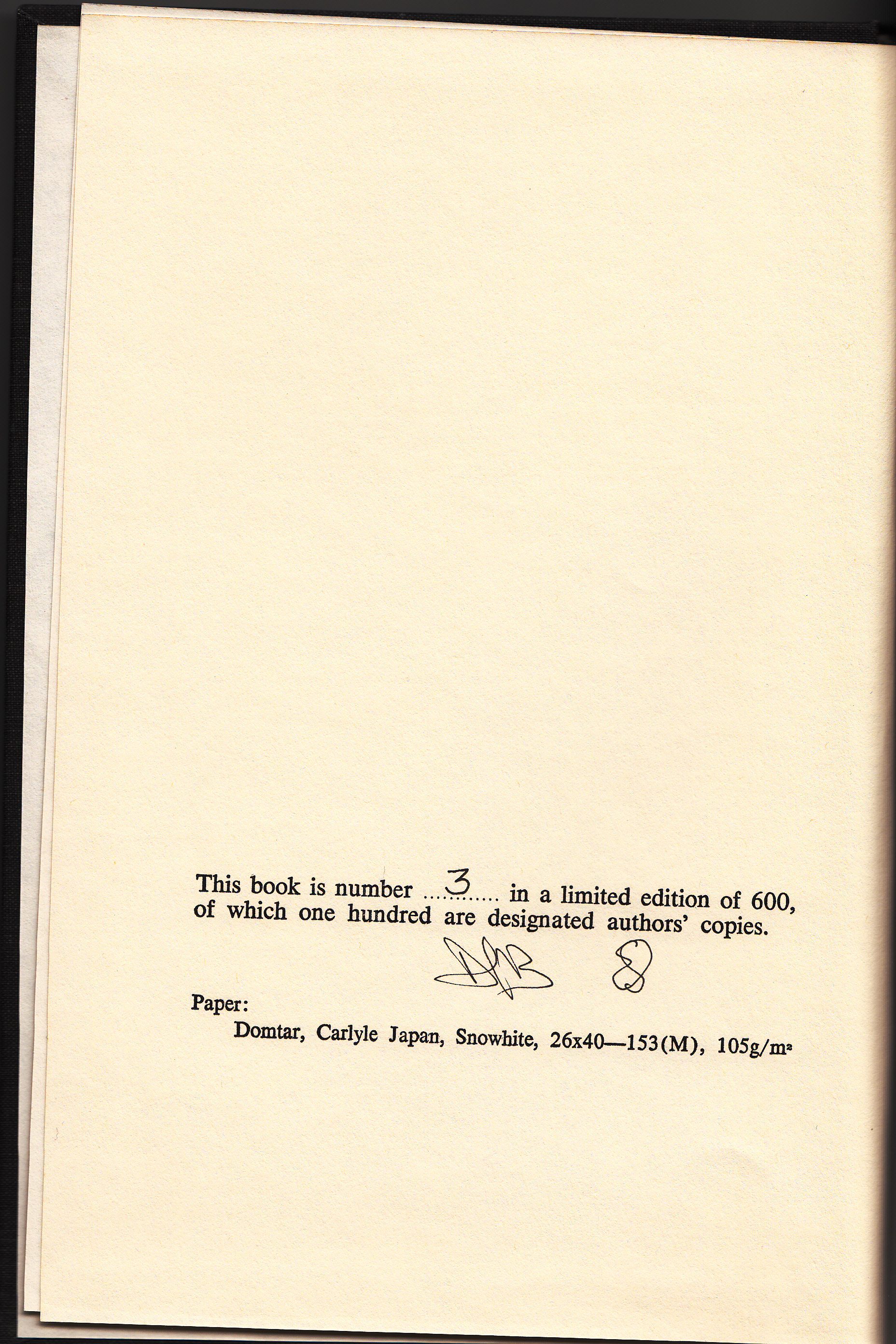
All this to arrive at a brief discussion of a small anthology from the 1980s that I purchased last year from Patrick McGahern Books before their move out of the Glebe. Grey Matters, edited by Daniel Brooks and Enda Soostar in 1985, “strives to re-define our ideas of war and peace.” Prompted by Cold War concerns, the inside flap declares “peace and disarmament are issues that must no longer remain in the political arena. Grey Matters reaches into the realm that lies between ideological poles of black and white, to offer a subtle and imaginative kind of activism that illuminates the shadow world of the human heart.” The contributors list is impressive: Margaret Laurence, Bronwen Wallace, Joy Kogawa, bpNichol, Susan McMaster, George Bowering, Robert Priest, Daphne Marlatt, Raymond Souster, among many others. Notably, personal and Apt. 9 favourite Michael Dennis has two poems in the anthology: “vapour trails in my dreams” and “did you know adolf hitler really wanted to be an architect?” Dennis was also recently a Carleton student. My copy is number “3” of 600 and signed, presumably by the editors (the initials look like DB and ES to me).

Of primary interest, however, is the material history of the book. According to the Acknowledgements page:

Grey Matters is the result of a Carleton University co-operative venture, funded by the Carleton University Student’s Association and the University Administration . . .

The production of Grey Matters was carried out on an ancient letterpress machine, which is situated in the University’s Arts Tower. More than half of the text matter was set in type byhand by the editors. The remainder was set by Linotype by Mr. Frank Eager. We received our training as printers in the early stages of this project and have only now, at the culmination of our work, begun to comprehend the complex elements of the printer’s art. What technical competence might be apparent in this edition is due mainly to the advice and assistance of Ray Luoma, Frank Eager, Joe Lachaine and Rick Bernie.

CUSA funded many of our projects at In/Words (begrudgingly, it often felt). I have far too many memories of begging for money before a tribunal bored and uninterested fellow students. Oddly, we had far fewer hoops to jump through to secure funding from University administration. Many of our projects were printed late at night, and secretly we hoped, on an ancient risograph machine in the English photocopy room of Dunton Tower (the Arts Tower mentioned above).

Dunton Tower (Photo by Jenn Huzera)

The letterpress used for Grey Matters, unfortunately, was no longer operational or located in Dunton by our time. However, I have an unproven belief that this same Chandler & Price machine is still on campus and located in the MacOdrum Library where I worked for three years during my undergrad. If anyone can prove this, or has a photo of the press, send it along! It is located on the ground floor, in the entrance to the government documents room near the elevators.

Hello, World!

Ok. So I’ve started a blog.

First, my apologies.

Second, I intend this blog to be a site to collect and document my various interactions with the literary community (most directly in Ottawa, but hopefully more broadly). Initially, I’ve gathered up some reviews and research notes previously published at Ottawa Poetry Newsletter, as well as written a brief note on the little magazine Something Else.

Ongoing research related to my academic life often turns up smaller items of interest that either do not fit into current projects, or are simply not “substantial” enough to find an existence in scholarly writing and publishing. With these sorts of items (such as Something Else) I find myself wanting to state publicly, Hey, look at this! Isn’t it cool? That is going to be one function of this blog. I’ll resist writing a diatribe here about how Ottawa’s literary history is undervalued and largely unrepresented in the dominant discourses surrounding contemporary poetry in this country. Nonetheless, it is. I intend, however modestly, to record and make visible evidence of this history that I find. If you’re interested, please check in once in a while. It would be a pleasure to have you along.

I’ll also work to write and publish reviews. Chapbooks, as ever, deserve more attention.

Finally, there will be self-promotion. I’ll try to keep this to a minimum. Please bear with me.

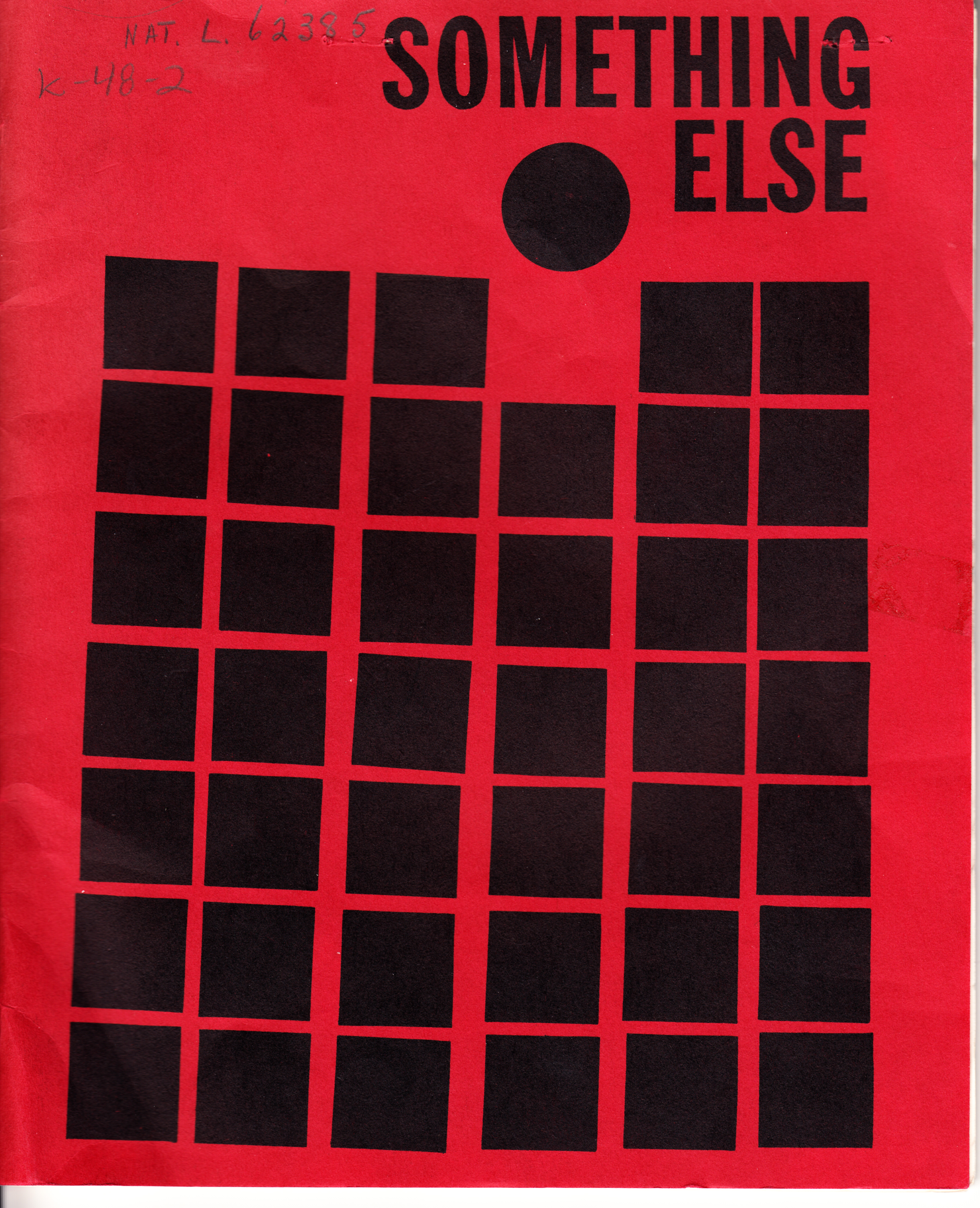
Something Else

Something Else was a short-lived Ottawa-based literary magazine. It survived for a single issue published in March 1963. I turned up a listing for it in the process of searching for previously uncollected William Hawkins poems.

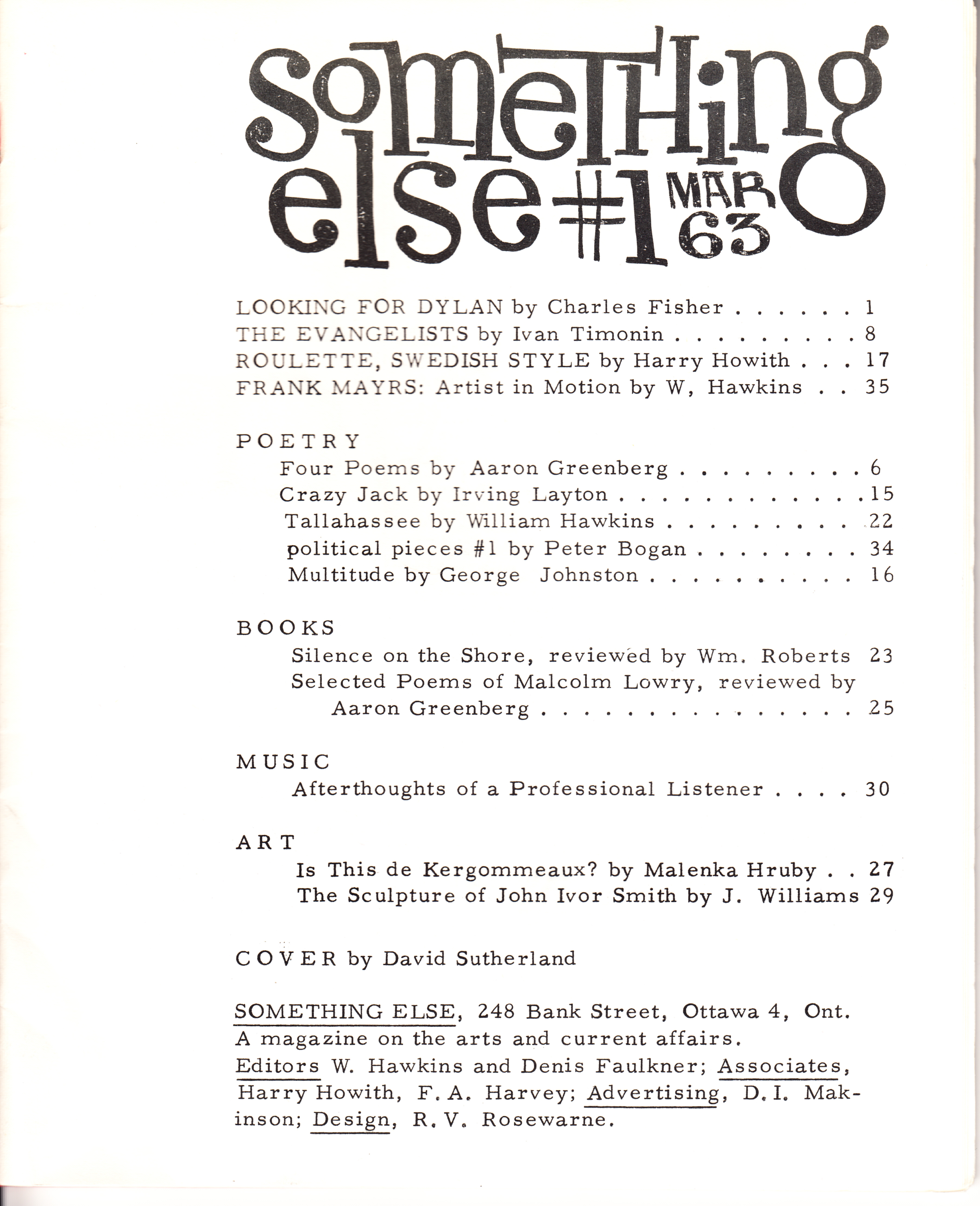
Table of Contents

Hawkins edited the mag along with Denis Faulkner. Harry Howith and F.A. Harvey are listed as “Associates” on the masthead. Howith collaborated with Hawkins on their 1965 book Two Longer Poems: The Seasons of Miss Nicky by Harry Howith and Louis Riel by William Hawkins (Toronto: Patrician Press). Something Else also lists R.V. Rosewarne as responsible for “Design.” Rosewarne was another regular Hawkins collaborator, designing and printing some of the iconic 60s poster-poems as well as running Nil Press (who published Hawkins in 1966).

The mag earned a mention in Canadian Author and Bookman 38:4 (Summer 1963):

As yet far from luxurious in presentation, but also commendable in content, is SOMETHING ELSE, a spirited newcomer to the periodical scene. The first issue, dated March 1963, is notable for “Looking for Dylan”, a rhapsodic-reminiscent piece by Charles Fisher which catches, obliquely but exactly, the beery yet somehow magnificent aura of the poet’s genius and the spirit of his time . . .

            SOMETHING ELSE is published in Ottawa, and is edited by William Hawkins and Denis Faulkner. It deserves a more attractive format (ie. a bigger budget), Like many another magazine in  Canada, it appears to be functioning not according to the laws of economics, but on faith, hope, and precious little charity. We can only with it luck and send in our three dollars (for six issues, interval not specified). Address: 248 Bank Street, Ottawa 4, Ontario.

248 Bank Street was home to one iteration of the legendary Le Hibou coffee house, host to an astonishing range of poetry readings and musicians during it tenure.

The publishing of the magazine overlaps with other publishing ventures in Ottawa of the early 1960s. Aesthetically, it bears striking resemblance to the Hawkins/Roy MacSkimming book Shoot Low Sheriff, They’re Riding Shetland Ponies!, self-published by Hawkins and MacSkimming in 1964:

Shoot Low Cover
Title Page

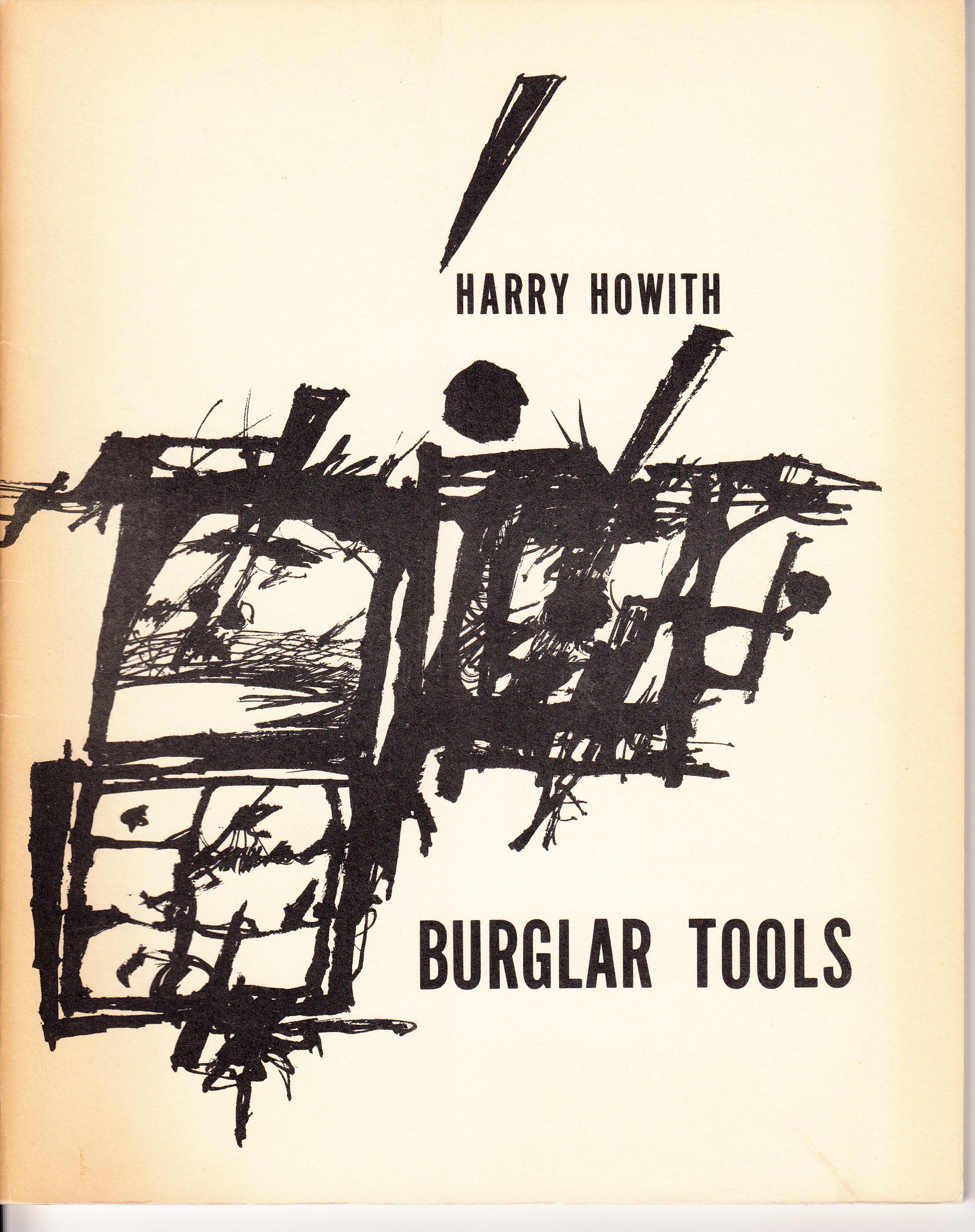
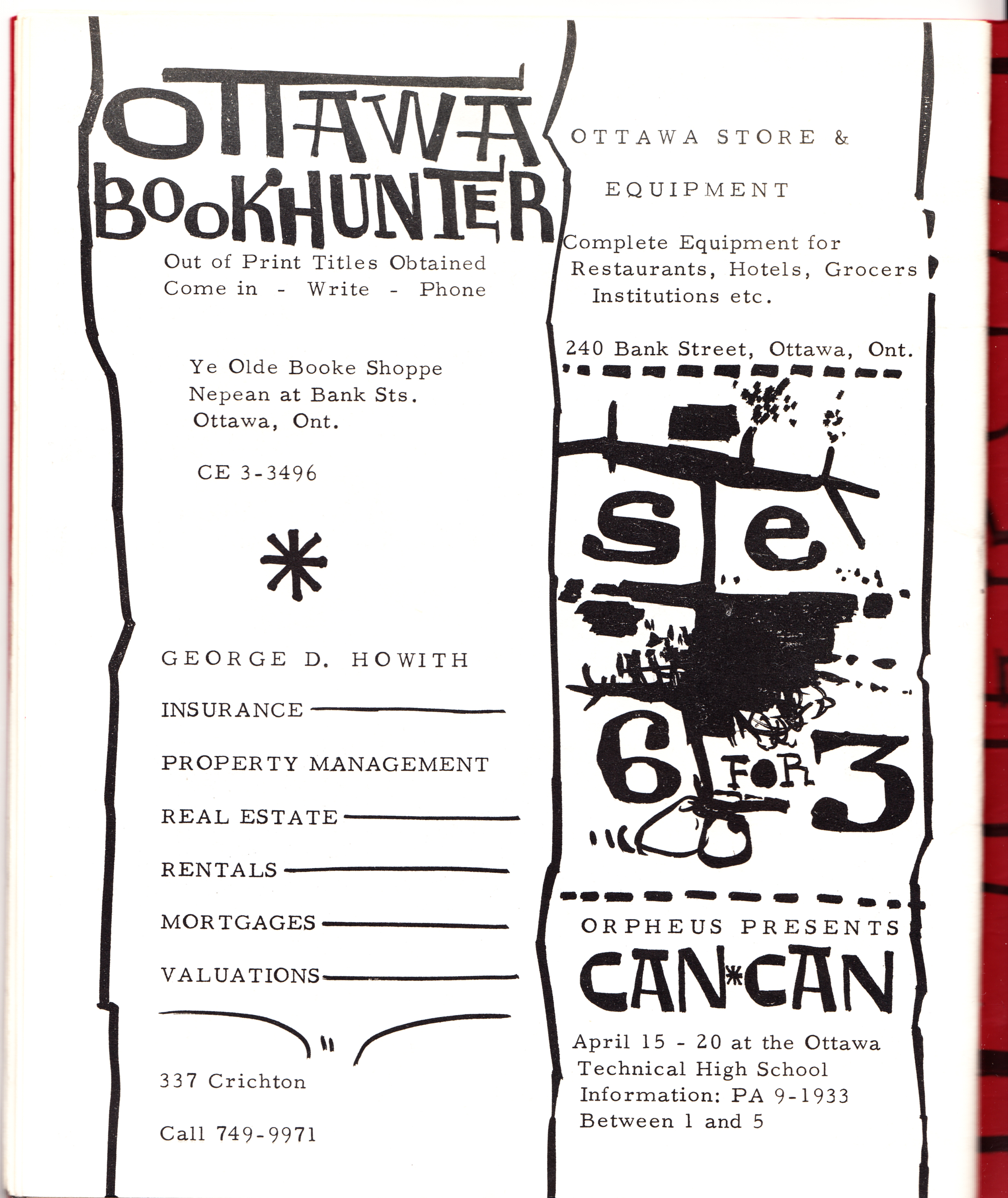
It can also be matched to Harry Howith’s Burglar Tools, published by Howith’s own short-lived small press Bytown Books in 1963. Bytown was announced in the same issue of Canadian Author and Bookman:

Bytown Books, a new Ottawa venture, is looking for short (150 pages maximum, for the present), modern manuscripts. This is not a “vanity press”, not is it, yet, a commercial publishing house. “I suppose we’re something like a co-operative”, says editor Harry Howith. “For the time being, at least, we expect to ask most authors to contribute something towards production costs. If the book sells well enough, this will be refunded. If it keeps right on selling, we’ll pay royalties. But we will not publish anything unless we believe in it.”

            Bytown Books will be published cheaply, but attractively, Mr. Howith Says. “We are most interested in contemporary poetry, but we would be glad to see prose fiction and even non-fiction. We are particularly interested in humour, satire, and polemics. No juvenile material.”

            Address: Harry Howith, Editor, Bytown Books, 191 Fourth Avenue, Ottawa 1, Ontario.

Burglar Tools Cover
Title Page

Bytown Books announced a second book, That Monocycle, The Moon by Seymour Mayne, in an issue of Louis Dudek’s Delta in 1963, but the book was never published.

Delta 23 Rear Cover

Hawkins recalls that Something Else was discontinued because it was “probably too much work.”

Between Nil Press, Bytown Books, and Something Else, 1962-1965 were amazingly fertile years for poetry (and art generally) in Ottawa. Howith would go on to be published by DC Books as well as have the distinction of writing the final book published by Contact Press (Total War, 1967). Denis Faulkner was increasingly busy with Le Hibou. Rosewarne continued his own work as an artist, as well as designed titles by Al Purdy and Alden Nowlan for Emblem Books out of Toronto [look for a future post about these two unbelievably beautiful books]. Hawkins would achieve the height of his publishing success in the late 1960s and early 1970s. The four overlapped in various forms during these years. Something Else is a remarkable document of their interactions.

Something Else Rear Cover

Review: Notes from a Cartywheel by Christine McNair

[Originally published at Ottawa Poetry Newsletter, 26 November 2011]

Notes From A Cartywheel

Christine McNair

Ottawa: AngelHousePress, November 2011

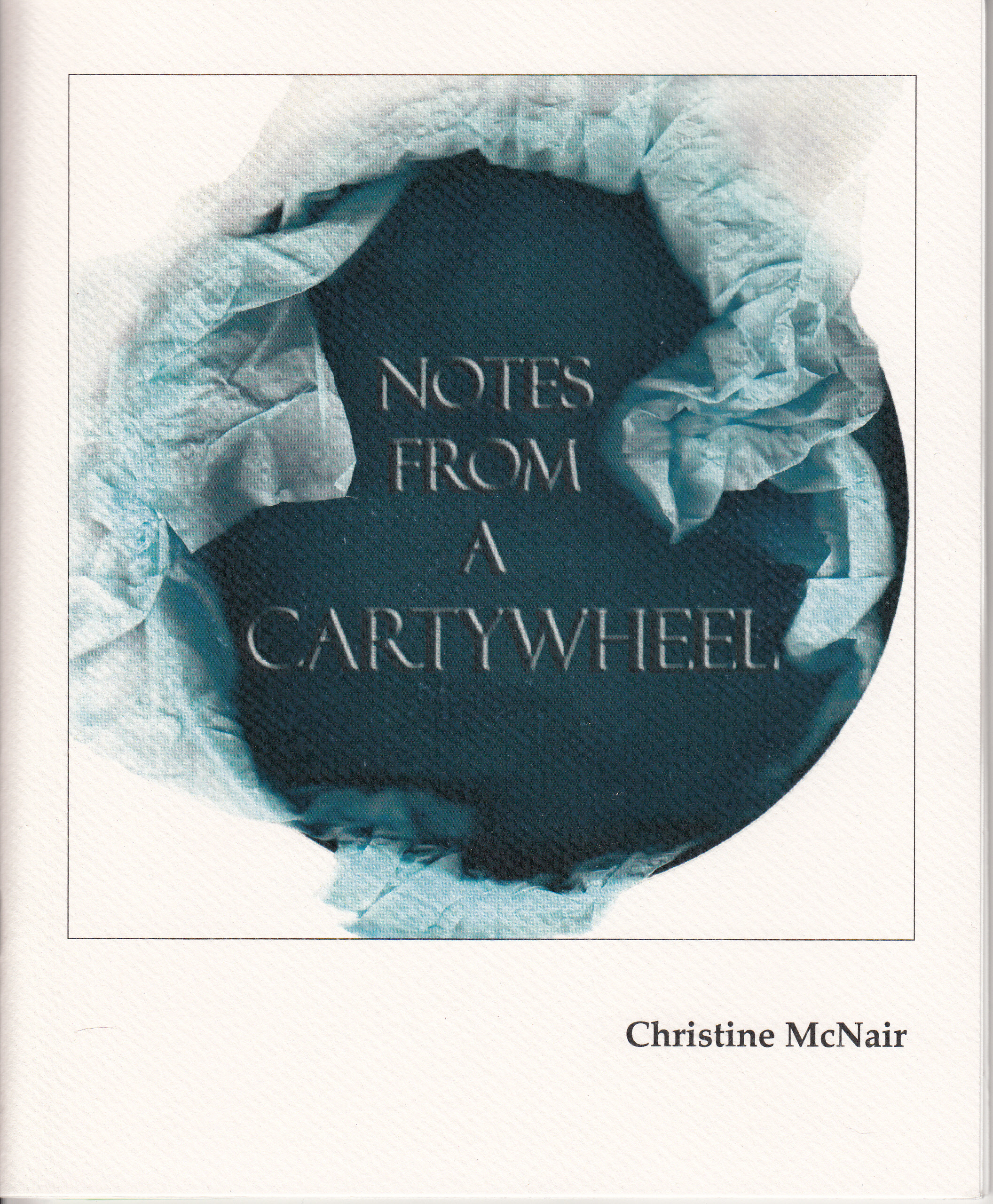
A cartwheel is a strange thing. It implies movement but also return. It is cyclical. It is repetition with change. One arrives somewhere familiar but not quite the same as where one started. The cartwheel, or cartywheel, is an object of interest for Christine McNair. From her cartywheel press, to her notes from a cartwheel blog (“here’s the part where we say what we mean & we mean what we say”), and now this chapbook, Notes From A Cartywheel (Ottawa: AngelHousePress, 2011), her exploration of the concept over the last few years has been wide and varied. She is also in the process of editing and producing an anthology focused on cartwheels. Her call for submissions draws attention to the productive capacity of the image:

cart·wheel (kärthwl, -wl)
n. 1. A handspring in which the body turns over sideways with the arms and legs spread like the spokes of a wheel. 2. Slang A large coin, such as a silver dollar.

An open call for cartwheels: poems or quite short fiction relating to the cyclic, cartwheels, cart wheels, or any variation thereof. Loose interpretations are quite acceptable. (For example: cartwheels, but also cart wheels (see: cart, vehicle for transport), cartwheel hats, saint catherine and her wheel, catherine wheels, cartwheel coronal ejections, cartwheel neurons, cartwheel galaxies, cartwheel silver dollars, anything related to the cyclic, etc, etc, etc.)

In what sense are these poems “notes” from cartwheels? The title suggests the poems are written from within cartwheels, that the perspectives are perhaps moving laterally and circularly. These poems are anything but static. The book includes a series of poems built as anagrams:

four

a cloned involution

unlaced violin onto

calved lotion union

unlaced volution on

unclad voile notion

nonactive loud lion

invocation dull one

space

lilac devotion noun

space

colonial devout in

continual dove lion

lunatic loved onion

contain unloved oil

a lucid violent noon

a novice dull notion

an uncool violent id

These exercises in rearranging are astonishing. The central line in each is bookended by variations on the initial syllables and letters. The sounds are effectively turning cartwheels around one another. Each subsequent line is familiar but altered. Origins are recalled, but the meanings and perspectives have changed. McNair reduces language to component aural (musical?) parts, and unlocks reciprocal and competing meanings in the process. She takes a simple idea and creates tremendous movement.

Notes is a book of great variety. An untitled poem arranges words and type in a grid, horizontally and vertically, establishing a field of meaning that lacks a fixed referent. “biblio non-grata” catalogues search results for “cartwheel” from amazon and chapters, a list that runs from children’s titles to obscure scientific objects. Other poems, structured as lists, are experiments in contrast: “I am frank, honest, full of vigor and ambition. I am amiable and sociable. / I have problems being open. I accept solitude” (“five”). There are prose sections focused on a character named Catherine (“I Catherine, useless entrust myself to you”). Speakers confront direction and misdirection, knowledge and ignorance: “there’s due course then there’s also a fixed lack of relative position spiral delicious over black angled highway there’s coursework to be done / you lost your maps I pinned them to your black pants you still lost them you didn’t care / I play pick-me-up with bits of this and that and those I can’t remember if we’ll get there in due course” (“ten”).

An important line in the book closes “five”: “I persevere.” The chapbook is committed to generative possibilities and contradictions of the cartwheel. It explores language through this central image, pushing as far as the words, as the letters, can bear. In “how to say sweetheart” the poem breaks down into description of the written marks of letters: “curve sharp curve curve / sharp sharp curve curve” before settling on “dot dot dot dot.” What is most admirable in the chapbook is McNair’s free exploration of a host of component parts of language and communication (sentences, images, words, syllables, written signs). She perseveres through meaning and non-meaning, privileging neither. Playful and free utterance, the joy of sound and image, are the core of Notes From A Cartywheel. The youthful exuberance of cartwheels seems an entirely apt anchor for McNair’s writing.

AngelHouse deserves acknowledgement for the production of the book. As usual, the press uses lovely paper stock and thoughtful, personal design. A series of scanned objects illustrate the poems, ranging from wooden type and coins, to polaroids and jewellery. The images extend the language of the poems, as well as assert the varied dimensions and modes of communication McNair is interested in.

McNair has been successful in recent years. She was shortlisted for the 2011 Robert Kroetsch Award for Innovative Poetry, she has seen broadsides published by AngelHouse and above/ground, her work appeared in the astoundingly beautiful anthology Dinosaur Porn (Toronto: Ferno House & The Emergency Response Unit, 2010.), she read at VERSeFest, she took part in the most recent iterations of jwcurry’s Messagio Galore (takes VII and VIII), and her first trade collection, Conflict, is forthcoming from BookThug in 2012. She is an exciting poet in Ottawa, and an active member of the community (we cannot forget her hosting duties on CKCU’s Literary Landscapes). McNair is due a trade collection. Conflict will be an exciting book. In the meantime, go buy Notes From A Cartywheel, the poet and the press are deserving.