March Miscellany

I spent a fantastic afternoon with Michael Dennis this past Saturday scanning his book covers in order to upload them to his new blog (kindly set up by Christian McPherson). Michael is just great to spend a few hours with talking poetry. He’s read more than most people alive, and he has strong opinions about it from all sorts of perspectives. It was a joy. Keep an eye on his blog going forward, he has been posting interesting micro-reviews almost daily. If you’re looking for a poetry recommendation, you could do a lot worse than trusting Michael’s instincts on the  books he reviews.

1987 - so you think you might be judas - Front

I spent a little while afterwards tracking down some links for his blog, which turned up these two great videos from July 1988. Both are part of a project (“Inset: The Video Poets”) from something larger called The Festival of the Arts that evidently took place in Ottawa. Does anyone have any further information? See Michael Dennis read a poem, and then watch Dennis Tourbin read one.

In other festival news, VERSeFest starts tonight and boy oh boy am I excited. Rob Winger, Stuart Ross, Gil McElroy, Claudia  Coutu Radmore, Christine McNair, Ken Babstock, William Hawkins, and scores of others. It promises to be wonderful as ever, this year in its third installment. Back in November I gave a talk on Raymond Souster as part of a fundraiser for the festival. I’m proud to have taken part, and now a version of the essay is available online to read in the latest issue of 17 seconds. Thanks to rob mclennan (editor) and Monique Desnoyers (designer) for their hard work on the issue. It’s a pleasure to be in there.

Odourless is apparently ramping up to go back into production, which is good news for anyone who cares about poetry and small press publishing in Canada. Catch up on what Ben Ladouceur is doing. Are you paying attention to him yet? You’d be a fool not to. There is a cool new profile on William Hawkins from rob mclennan up at Open Book: Ontario too.

See everyone at the festival.

Whatever Else: An Irving Layton Symposium | Registration Now Open

Registration is now open for the University of Ottawa Department of English’s annual Canadian Literature Symposium. The focus is on Irving Layton this year. I’ve got the privilege of helping to organize the conference with Prof. Robert Stacey this time around, and I’m incredibly excited about the three days of events that we have lined up. We have a keynote address from Brian Trehearne, papers from 17 critics, a documentary film screening from Donald Winkler, a poetry reading (details to follow), and a roundtable with Elspeth Cameron, George Elliott Clarke, and Seymour Mayne. It’s going to be excellent, and best of all registration is completely free for all graduate and undergraduate students. If you know a student interested in Canadian poetry, please share this information with them. We would love a packed house and want as many students in attendance as possible.

Full details here, program to follow shortly–Whatever Else: An Irving Layton Symposium

20130228_085115

Peter Gibbon, William Hawkins

On heels of rob mclennan’s profile of In/Words two weeks ago, poet, editor and friend Peter Gibbon has written a short memoir on his time with the magazine as well and published it on his Conduit Canada blog. Pete has a pile of smart and insightful things to say about the mag, and some hilarious memories too. You’ll also find some poems in there from Jeff Blackman, Rachael Simpson, and Pete, as well as the closest thing our In/Words generation has ever had to a family photo courtesy of the Maxfield-Blackman wedding. Go read it!

In other fantastic news, William Hawkins is being inducted into the VerseOttawa Hall of Honour as part of their inaugural round of inductees (along with Greg “Ritallin” Frankson). We love Bill here, and I’ll be reprinting a chapbook of Bill’s work that Apt. 9 published in 2010 to mark the occasion. I’ve also never heard Bill read, so it will be a thrill on March 17 when he is inducted. Be there! Hawkins Hibou Poster


rob mclennan on In/Words

20130204_130941

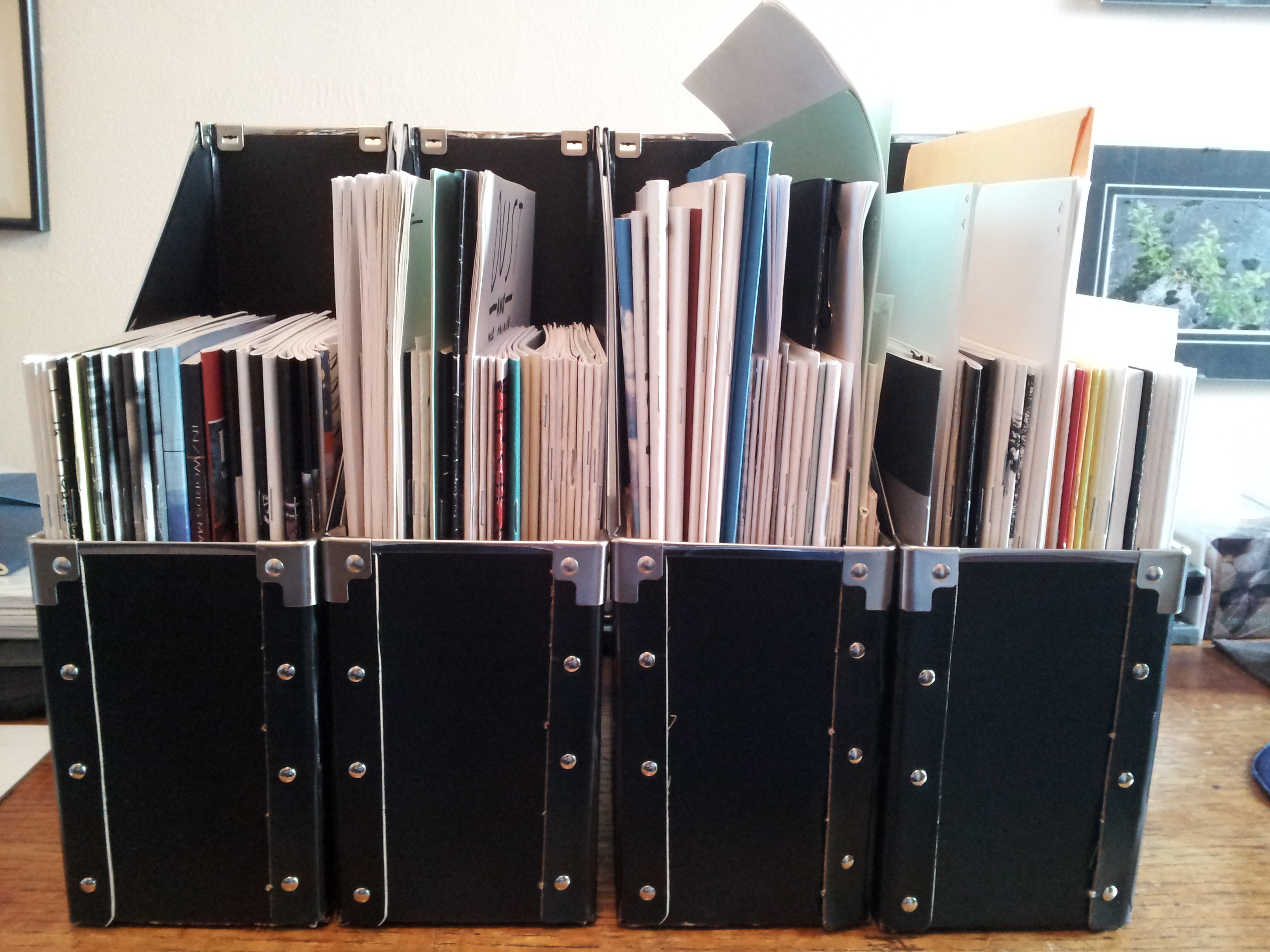
From 2006-2009 (or thereabouts), I was an editor at In/Words Magazine & Chapbook Press at Carleton University. My first published poem was in In/Words (Volume 5, Issue 3, February 2006, on the same page as Ben Ladouceur). I worked editing for the magazine, editing chapbooks, and helping to make a monthly open-mic reading series happen. We produced a huge volume of material (see the picture above of my own primary stash of In/Words and In/Words-related publications). I count myself lucky to have been a part of that community. My identity as a writer and a publisher can be traced to the first editorial meeting I attended in the summer of 2006 at Mike’s Place.

rob mclennan recently sent around a set of questions to quite a few of the editors and writers who were around during my years with the mag, and the collected answers were culled and organized by mclennan in this fantastic piece at Open Book: Ontario. My favourite part is Peter Gibbon describing our little group developing “a vicious loyalty toward each other’s writing.” Rob Winger, an influential poet and teacher for all of us in the In/Words community, chimes in at the end with some unbelievably kind words.

Thank you rob, and thank you to the consistently wonderful people at Open Book.

In/Words is still running. They have a great editorial team keeping the ship afloat, and Dave Currie has got the monthly reading series in excellent shape (building off of Justin Million’s invaluable work reshaping it). Somehow the mag is into its twelfth year, which is astonishing. If you’re in Ottawa, drop in to the Clocktower on the last Wednesday of the month.

The truly embarrassing photo below is of Amanda Besserer (left), myself (centre), and Peter Gibbon (right) in the quad at Carleton, Fall 2007 (I think?), trying to convince undergrads to pick up free literary magazines and chapbooks.

Amanda Peter Cameron

ottawater Launch

The ninth issue of ottawater launches this week. Thursday, January 24 at the Carleton Tavern (233 Armstrong). Doors at 7:00, readings at 7:30.

As I mentioned, I have two new, weird, plundered poems in there. The full issue has work from: Steven Artelle, Gary Barwin, Jeff Blackman, David Blaikie, Frances Boyle, Ronnie R. Brown, Colin Browne, Murray Citron, George Elliott Clarke, Faizal Deen, Amanda Earl, Laura Farina, Jesse Patrick Ferguson, Mark Frutkin, Brecken Hancock, Carla Hartsfield, a.m. kozak, Ben Ladouceur, Nicholas Lea, Anne Le Dressay, rob mclennan, Cath Morris, Colin Morton, Alcofribas Nasier II, Peter Norman, Abby Paige, Pearl Pirie, Nicholas Power, Wanda Praamsma, Ryan Pratt, Roland Prevost, Monty Reid, Sonia Saikaley, Dean Steadman, Lesley Strutt, Rob Thomas, Lauren Turner and Vivian Vavassis. Artwork by: Andrea Stokes, Danica Olders, Genevieve Thauvette, Guillermo Trejo, Jeremy Shane Reid, Meagan Darcy, Mike Pender Peter Shmelzer and Stephen Frew.

You can never be sure who will show up to these launches, but you can be sure that an interesting cross-section of those names will be present. I’ll be there to read briefly. Will you?


Some Links | 14 January 2013

Peter Gibbon wrote a fascinating post at the Conduit Canada blog about the Highway Book Shop that is well worth a read. Pete had been telling me about this store for years, but I was never able to get as far north as Cobalt. I regret it.

Recently John W. MacDonald posted a documentary on (mostly Ottawa) poets to Facebook that I’d never seen. Heard of Poets was filmed from January 2006 to January 2007 in Ottawa by Ben Walker and Josh Massey. It runs for a little over an hour, and showcases a fairly wide range of poets reading and speaking about poetry in their lives. The full list: Seymour Mayne, George Elliott Clarke, Mark Frutkin, Max Middle, Shane Rhodes, Oni the Haitian Sensation, AJ Levin, Jim Larwill, Pauline Michel, Terry Ann Carter, John Akpata, Drew Bernard, a.rawlings, Nicola Volpe, Melissa Upfold, Susan Robertson, Steven Brockwell, Bill Bissett, Paul Muldoon, Becky McKercher, Gustave Morin, Michael Dennis, Christopher Levenson, Danielle Gregoire, Jason Sonier, Anne Davison, jw curry, Gregory Betts, Greg, ‘Ritallin’ Frankson.

There is a great interview with Frank Newfeld on Nigel Beale’s Literary Tourist blog.

Jeff Blackman has a blog going now. Jeff is a smart and thoughtful guy, a great reader and an awesome poet. It is well worth keeping an eye on what decides to say on it.

The latest issue of ottawater is up now. I’ve got two strange, strange poems in there, plundered from Gerald Steven’s 1961 study Early Canadian Glass (that is about exactly what you think it is about). More interesting than my poems though, are all the great poems in there from other people: Gary Barwin, Jeff Blackman, Amanda Earl, Ben Ladouceur, Peter Norman, Pearl Pirie, Monty Reid, and loads of others. ottawater is always worth your time to read. Thanks as ever to rob mclennan for having me involved in it, but more importantly for continuing to do this kind of work year after year.

early canadian glass

And speaking of which, rob’s above/ground press celebrates twenty years as an active chapbook press this year. Subscribe, buy some backlist. rob publishes first chapbooks by people, he publishes final chapbooks by people, he publishes chapbooks by people who are big international names and people who are small local names. There is always something interesting in subscription packages. There were some great titles last year (Lisa Robertson, Jay MillAr and Hugh Thomas stick out in my memory, but there were dozens). I hope I can keep Apt. 9 running for twenty or more years, or that I can have at least a fraction of the commitment and energy rob has sustained over two decades.


November/December Reading Miscellany (Part Three)

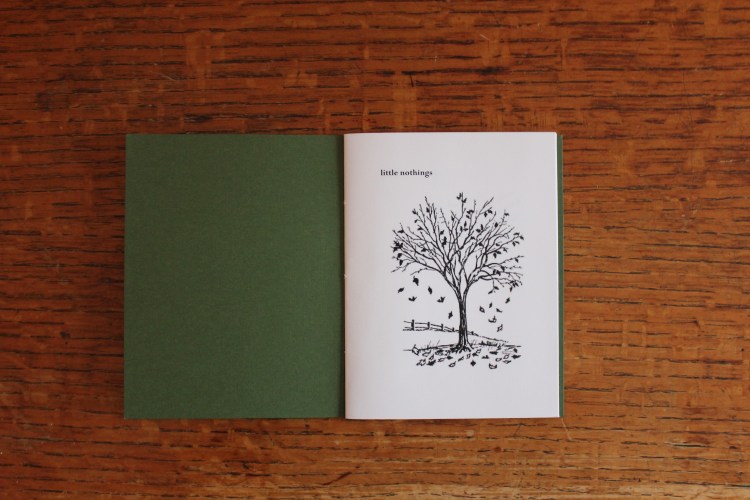
Marilyn Irwin. little nothings. Ottawa ON: Self Published [“lovingly made for the Hallowe’en edition of Carleton University’s In/Words reading series], 2012.

Marilyn Irwin has a minimalist bent that I admire. She seems to draw her poetic from visual, sound, and lyric traditions. Attentive to the materiality of the letter on the page, her work has consistently made the most sense to me when I hear her read and can trace the emphases of her speaking voice. While these poems refuse to offer immediate coherence (and why should they), there is a lyric poet underneath her experiments. This is a beautifully produced chapbook, modest and clean in its production, full of joyful and sad poems. I’m thrilled to have number 17 of 18 copies.

full ink forward

the slowing of

the spinning of

a delicate word

full ink forward

singing fingertips

what heart can’t say

IMG_2560

IMG_2561

—.

Phafours Press.

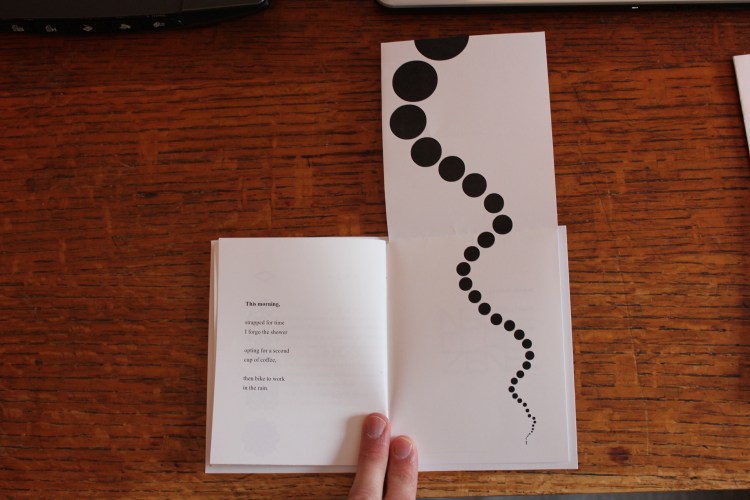
Pearl Pirie’s Phafours began producing tiny chapbooks, almost micro-chapbooks, for the summer installment of the Ottawa small press book fair in 2012 (as far I can tell). These playful little books consist of a single sheet, ingeniously folded to provide eight pages. Pearl’s writing is so consistently varied that it is wonderful to see her tastes and gleeful experimentation extend to her publishing projects (both in material form and in the work she is publishing). At the November book fair I picked up new tiny chapbooks in this series from Pearl, Gary Barwin, and Amanda Earl (to go with titles from Pearl and Gwendolyn Guth acquired in the summer).

IMG_2556

Gary Barwin’s continues his investigations of the letter H, bpNichol’s favourite letter and a regular figure in Barwin’s visual and lyric work. My favourite poem of Gary’s from his 2010 Coach House title, The Porcupinity of the Stars, “Inside H,” ends with these perfect lines:

h

I say

H

because it is a pleasure and a surprise to breathe

The centre poem in his phafours title is my favourite of the bunch here:

IMG_2558

Amanda Earl’s cluster of as continues the experimentation of her own visual leanings, overlaying patterns of the letter ‘a’ into a rich and beautiful abstraction:

IMG_2559

I so often feel I lack the vocabulary to discuss visual poetry with any ability or understanding. These are beautiful poems and beautiful books. They remove these most basic units of compositions, letters, from familiar environments and force them into the rest of our mundane, lived experiences in startling and surprising ways.

—.

Amanda Earl. Of The Body. Kingston ON: Puddles of Sky Press, 2012.

—. Sex First & Then A Sandwich. Ottawa ON: above/ground press, 2012.

More of Amanda’s visual work found publication with Michael e. Casteels Kingston-based Puddles of Sky recently. Of The Body is a suite of elegant visual constructions forging connections between the curves of cursive script and the natural shapes of the human body. Amanda’s visual work has found a fair bit of success recently, also appearing in The Last Vispo Anthology, and appearing on the Paris Review Blog.

IMG_2555

Sex First & Then A Sandwich (a great title!) was launched in August 2012 by above/ground press (Marilyn Irwin, Stephen Brockwell, and I also launched chapbooks in that round). It is an extended excerpt from Amanda’s ghazal manuscript, ghazals against the gradual demise, which is apparently finished. The ghazal is a good form for Amanda, “drunken and amatory” to quote Canada’s greatest ghazal practitioner John Thompson. Amanda’s humour shines through in these poems:

please no more poems of birds. no. more.

or tender flowers tossed about by rain

space

a friend has bedbugs again for the third time

picked up from a public library. the danger of reading

space

soon the Easter eggs will spoil in this heat

all the sweet green icing flowing down

space

on the Waltons yesterday, Elizabeth couldn’t walk

except by the end of the episode she did

space

you can learn a lot from Christian television

how to build, a crucifix, two towers

—.

Puddles of Sky Press.

More on Puddles of Sky. Michael e. Casteels is doing alot of things right with Puddles of Sky. He is producing a ton of stuff, obviously full of the energy and belief that keeps the small press going in Canada. He is experimenting with book forms, stitching and stapling and sizes, fold out pages. He is publishing a range of people, mags and chapbooks, as well as producing a surprisingly large volume of his own work, visual and otherwise. We swapped some chapbooks through the mail recently, and I was overwhelmed by how much he sent me. I feel a bit bad, actually, I should really send him some more once I’ve got more.

IMG_2550

Cave Paintings of the 21st Century includes an afterword in which Casteels discusses hearing sound poetry for the first time at a Paul Dutton performance. He writes, “I was pretty blown away, though not entirely sure what it meant, if it was meant to mean anything . . . [Dutton] said that in what he performs you could find parts of everyday conversation, simply magnified and brought out of context. This description really stuck with me. It made me understand, not only sound poetry, but all poetry (including my own) in a different way.” Casteels’ excitement about finding a new expanded framework within which to understand (and produce) poetry is an experience, I hope, familiar to all writers, but one that all too often seems to be confined to student days, or at least vaguely defined “earlier” days as writers and readers. I’m excited by the work I’ve talked about here because each writer, editor, and publisher seems to still be inhabiting that space of discovery and exploration, of active engagement with the mundane and the familiar in such a way that it continues to provoke and excite.

IMG_2553

—.

It’s been a good year for chapbook and small presses in Canada. Can’t wait to see 2013.

Jim Smith (November/December Reading Miscellany Part Two)

Mansfield Press rolled into Ottawa at the beginning of December with its Fall lineup. Mansfield has developed a consistently exciting list in recent years, balancing young poets (Leigh Nash, Jamie Forsythe) with elder statesmen (David McFadden, Nelson Ball) under the careful editorial stewardship of Stuart Ross and good sense and design sensibility of publisher Denis De Klerck. The most exciting Fall book, for my money, was Jim Smith’s Happy Birthday, Nicanor Parra. I first read Jim’s work after Mansfield published his selected poems, Back Off, Assassin!, in 2009 (actually, Leigh Nash sold it to me at the Ottawa Small Press Book Fair that year). Jim was in town shortly thereafter to launch another Mansfield title, Rogue Stimulus: The Stephen Harper Holiday Anthology for a Prorogued Parliament, on Parliament Hill.  Thereafter, I had the joy of publishing a small chapbook of Jim’s work through Apt. 9 Press in June 2011 (Exit Interviews).
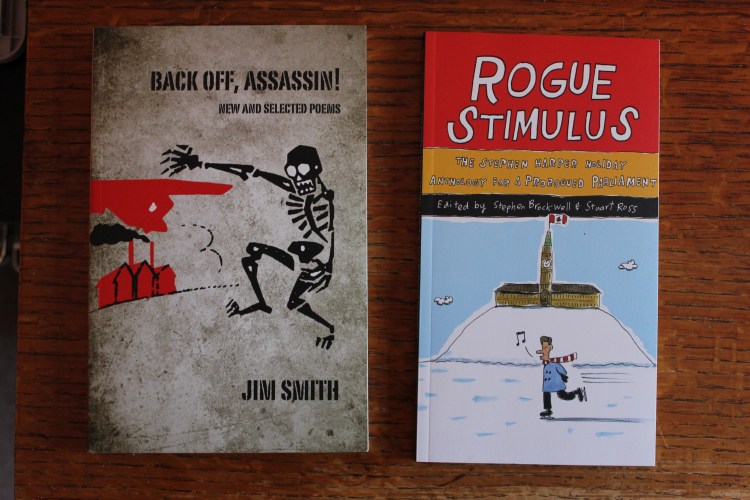
IMG_2531

Jim is a spectacular poet. He is one of a small handful of poets who I find consistently surprise me in their works. Back Off led me to his back catalogue, and it has been a joyful place to explore. He is a connoisseur of the list poem, a personal favourite of mine. In theory, lists sound absurd as poems, but they work, again and again. I think most often of Frank O’Hara and Ted Berrigan, the sort of I-did-this-I-did-that list. Paul Carroll, discussing Frank O’Hara in The Poem In Its Skin, writes “my strong feeling is that ‘The Day Lady Died’ is excellent because of its trivia and ugliness . . . what makes ‘The Day Lady Died’ a poem, it seems to me, is the nerve evident in the very act of writing it” (159-163 emphasis original). There is a nerve to simply recording a catalogue of something, anything, and calling it a poem. At their best, as in O’Hara and Berrigan and Smith, the list balances the mundane and the remarkable, the tension between concision (ie. what to include in the list) and the impulse to be sprawling and messy. They are personal and particular but somehow transcend the apparent ego of writing them.

IMG_2539

My favourite poem by Jim is “One Hundred Most Frightening Things,” from a book of the same title published by blewointment in 1985. The poem is precisely what it sounds like. Here is the first section:

A


Finding, waking, phone off hook

A man forcing her, getting rough

Rosedale ravine leapover impulse

Her crying mouth trembling unsure line

Blood in the toilet, paper red

Her loss of face

Men with suntans all over their bodies

Loss of all her papers I keep—yes

The loss of any sum of money at all

I never want to see you again

Jim balances the comic and the serious. Any one of these lines could stand as a jumping off point for a single poem of its own. The full catalogue is overwhelming. It is disturbing, hilarious, frightening—it feels like every available poem rolled into one. There is anxiety about writing, time, death, relationships, violence, love, the body, insufficiency, decomposition, failure. It is also joyful and affirmative. For all these things, there is the poet, still writing.

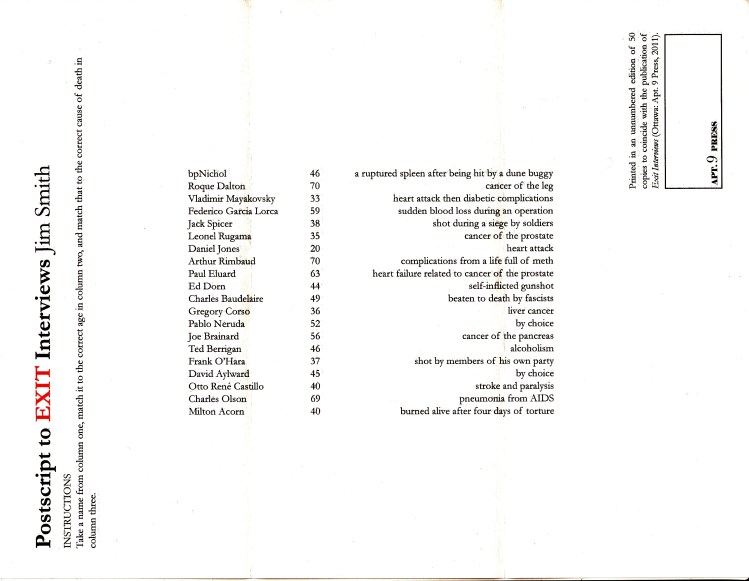
Exit Interviews, our Apt. 9 chapbook, was a joy to work on. The book describes itself as a series of “dictations.” Each poem is an elegy of sorts to dead poet, built from lines drawn from the poet (Exit Interviews has the most extensive set of notes of any Apt. 9 title so far, detailing the books from which each poem was drawn). I love these poems because they so plainly declare the important influences of Jim’s life, as well as show the depth of his own reading of each of these poets. They are careful poems that show understanding, not straight plunder. Jim’s manuscript also included a piece of text called “Postscript to Exit Interviews”, a game of sorts in which the reader was asked to match poets with the age at which they died and the manner of their deaths. We published this as a small leaflet, tucked into the back of the chapbook, surely the darkest game ever published in a book of Canadian poetry. Exit Interviews, though sold out as a chapbook, is included in Happy Birthday, Nicanor Parra, and the postscript is included too (though in a slightly altered form).
Red Carpet

Nicanor Parra also draws attention to Jim’s international and revolutionary bent. He has long been a poet invested in radical, left-wing politics, particularly in Latin America, perhaps most apparently in 1998 collection Leonel Roque, a consideration of Leonel Rugama and Roque Dalton.
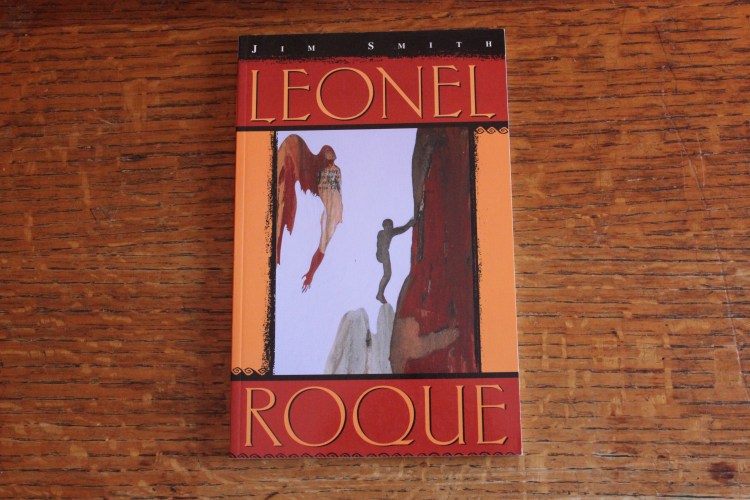
IMG_2546

In 1989 (I believe), Jim took Stuart Ross along on a trip to Nicaragua, where they hosted a Canadian booth at the Sandinistas’ International Book Fair (see Ross’s Dead Cars in Managua for his poetic response to the experience). There is a spiritual, though not necessarily aesthetic, kinship between this bent in Jim’s work and a similar impulse in Stephen Brockwell’s. Brockwell edited Rogue Stimulus with Stuart Ross, and his own ongoing Improbable Books project is a necessary voice of dissent in Canada. Between his tendency to list, his surrealism, his political consciousness, and his genuinely good heart, Jim Smith poems are just what Canada needs.

The Space Opera


Nicanor appears in the southern sky, growing every second.

A coup happens. A coup unhappens.

Deep beneath the Atacama Desert, lair of the rebels.

North America occupies 90% of the sky above Santiago.

The indigenous people are aliens.

The only way out of La Moneda is suicide.

Every night, a gun rises in the east, sets in the west.

A small fishing boat rescues flop-eared Jesus, drunk to the gills.

Jesus is a mercenary with a dark, dark past.

Nicanor points to the eventual heat death of the universe.


Gumby in uniform, clay gun at the ready.

Pinochet flees into old age.

Chile smells itself.

Nicanor sings softly in the nearest cafe.

This was intended to be a review of Happy Birthday, Nicanor Parra, but it has turned into something of a hero-worship blog post. That’s ok. Jim is great, one of our best. Here is the review I intended to write reduced to a single sentence: Happy Birthday, Nicanor Parra is a wonderful book full of poems I wish that I had written and that I wish you would read.

IMG_2548

There is a long and thoughtful interview with and reading by Jim available to listen to here, with Bruce Kauffman. There is an interview at Open Book: Toronto here. Watch him read here. Go buy Jim’s books from Mansfield, and keep your eyes open at used book stores. When you find backlist things, buy them for me (or yourself), just don’t let them languish unread and ignored. Talk to Jim about poems when you get a chance, he’s read a hell of a lot, he knows (and knew) a load of poets, and is a great storyteller.

Thanks for the new poems, Jim, and thanks to Mansfield for doing them up so nicely.

November/December Reading Miscellany (Part One)

Some notes on books acquired at the Ottawa Small Press Book Fair, and other places, during the Fall that I have finally been able to sit down with and give a bit of time. Expect more of these posts over the next couple weeks.

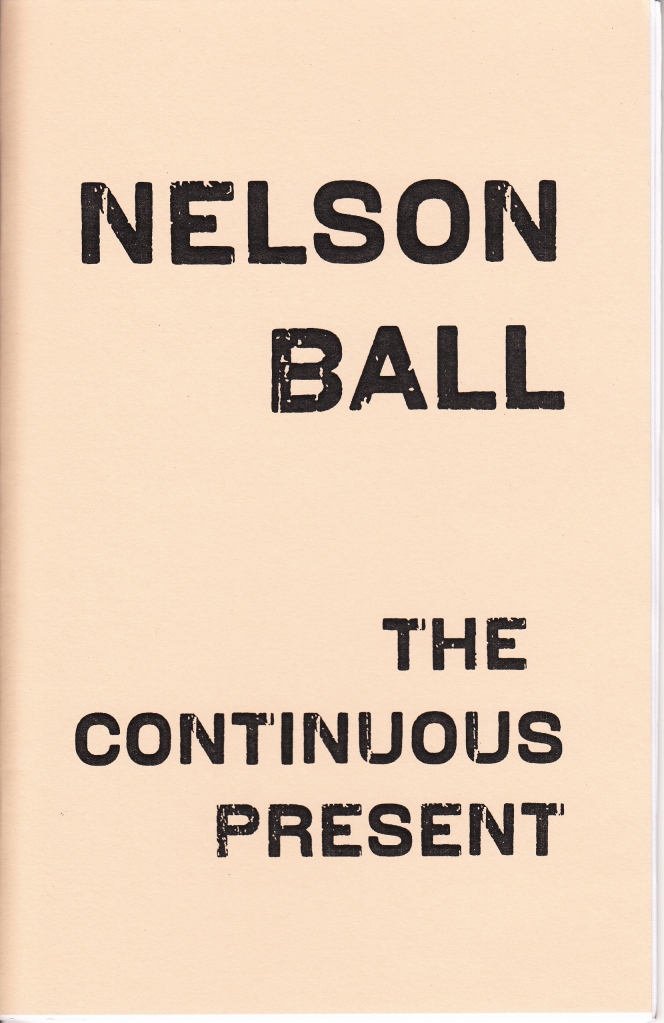
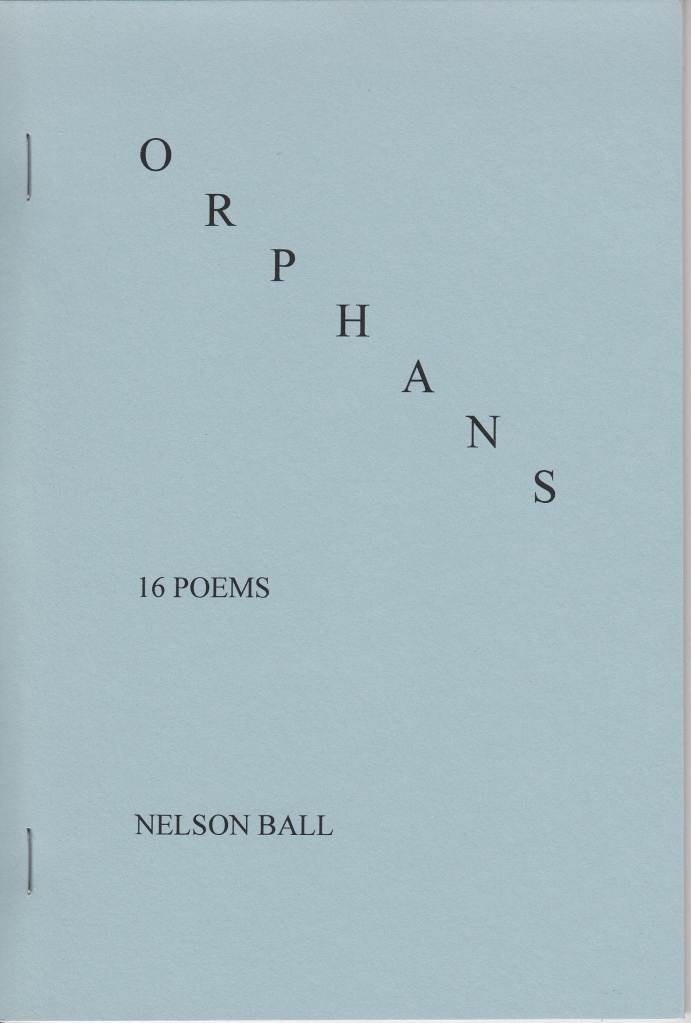
Nelson Ball. Orphans. Paris ON: Rubblestone Press, 2012.

—. The Continuous Present. Cobourg ON: Proper Tales Press, 2012.

Nelson Ball continues to be Canada’s greatest practicing minimalist poet. Part of me feels, sincerely, that it would do a disservice to his work to spend hundreds or thousands of words taking apart his carefully constructed poems that refuse to waste even a syllable. A different part of me feels that he so desperately deserves close attention and reading and wider recognition of his accomplishments. Please, someone with the resources, publish a collected poems of Nelson Ball that gives the poems room to breathe on the page. Though it would run, I would guess, well over a thousand pages, these are poems that deserve to be read one to a page.

The most coherent statement on Nelson Ball’s work I’ve yet read comes from jwcurry, quoted from 1cent on the back of Nelson’s With Issa: Poems 1964-1971: “…his is a highly personal gesture, opening up a world’s worth of nuance with an absolute minimum of referents, Nelson quietly standing in the middle saying ‘see?’”

Red Carpet_0005

I received an unexpected package from Ball recently containing these two chapbooks, one from his own Rubblestone Press and one from Stuart Ross’s stalwart Proper Tales. Both are part of an engaging project wherein Nelson is quietly but steadily excavating his own poetic archive, a sort-or self-archaeology, pre-empting future editors and academics. The Continuous Present is a book of poems “not in any of my previous books and chapbooks.” Orphans collects poems “not chosen for The Continuous Present.” Nelson has done this before, lots. Nine Poems, also from his own Rubblestone, collects poems “omitted from In This Thin Rain” (Mansfield, 2012). With Held (Laurel Reed Books, 2004) collected poems withheld from With Issa (ECW, 1991), Bird Tracks on Hard Snow (ECW, 1994), Concrete Air (Mercury Press, 1996), Almost Spring (Mercury Press, 1999), and At the Edge of the Frog Pond (Mercury Press, 2004).Concrete Air gathered unpublished work from 1971 and 1972. And, well, I think you get the picture. (as an aside, I was just pulling that link to the ECW website for With Issa, and see that both of his ECW titles are in stock and cost only $12.00. Buy them if you don’t have them!).

Orphans comes with a lovely dedication to William Hawkins and Christopher Wells: “With gratitude to Ottawa poet and singer/songwriter Bill Hawkins who, although he probably won’t remember this, directed me towards imagist poetry. And to his friend artist Christ Wells who, with his wife Peg, oversaw with generosity and sensitivity the marriage of Barbara and me that snow January in 1965.” Nelson published Bill’s classic Ottawa Poems in 1966. Orphans, in its production, brings to mind Nelson’s designed work (with wife Barbara) at weed/flower in the 1960s.

Red Carpet_0004

Nelson Ball poems (and chapbooks, and books) are just so refreshing. So much noise is stripped away. He is attentive to both the sounds and the material constructions of letters on a minute scale. He plays between lyric and sound, concrete and found poetry. His love poems are simply the best going. He’s funny and he’s sad and has continued to do all these things for over fifty years now. I’m going to stop talking about his work now, because it really should be read. Here is an absolutely perfect love poem from The Continuous Present.

Residual

To Barbara


I sit on the toilet seat

warmed by your bum


a comfort

this cold winter day

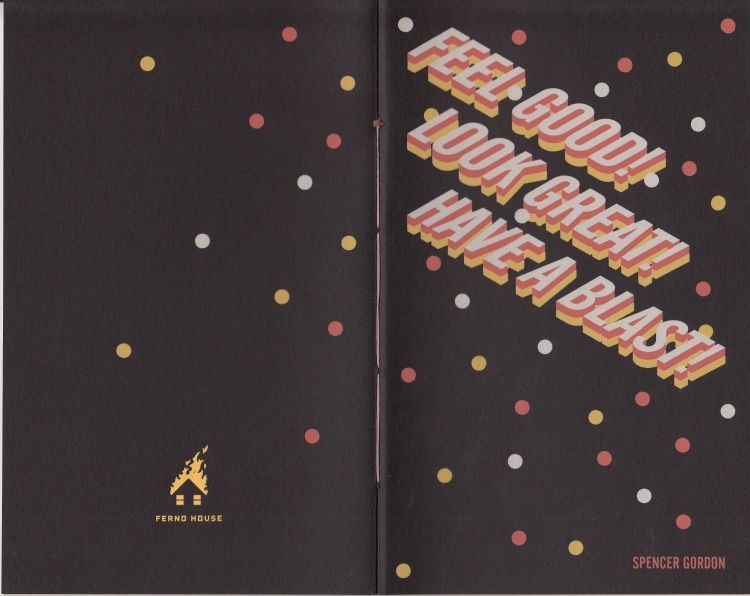
Spencer Gordon. Feel Good! Look Great! Have a Blast! Toronto ON: Ferno House, 2012.

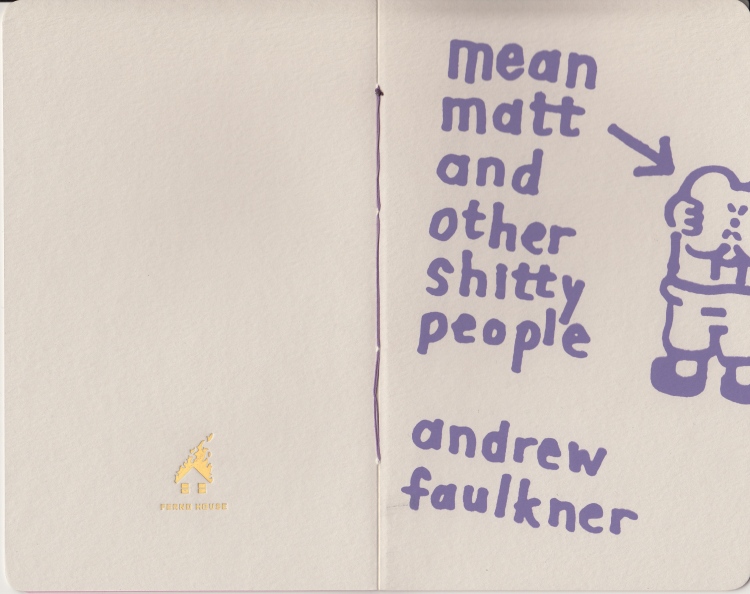
Andrew Faulkner. Mean Matt and Other Shitty People. Toronto ON: Ferno House, 2012.

Toronto’s Ferno House (Editors Spencer Gordon and Mat Laporte, Designer Arnaud Brassard) continues to be infuriating. It is difficult to describe how beautifully produced their books are. I don’t know if there are many chapbook or micro-presses in the country who can keep up with them these days. Their perfect bound (hand bound) efforts are stunning (the For Crying Out Loud anthologies and the wonderfully bizarre Dinosaur Porn). Their chapbooks, as Spencer’s title indicate, look good and feel great (ugh, apologies for that). Pictures of both books below have been scanned with the covers open and flat, so you’re seeing front and back covers plus spine.

Red Carpet_0002

Spencer Gordon is having one hell of a year. Feel Good! was shortlisted for the bpNichol Chapbook Award, while his first trade collection, Cosmo, was published by Coach House. I’m not sure what more you could ask for as a young writer in this country. I’m still working through Cosmo, so I won’t talk about it here, but Feel Good! is an exciting, fast-paced set of poems steeped (as Cosmo is) in contemporary pop culture (Gordon would simply say culture). His acknowledgements point to these influences: “Thanks to the musicians and bands whose song lyrics I’ve cribbed—The Black-Eyed Peas, The Melodians, KISS, Avril Lavigne, Katy Perry, Zwan, and Leonard Cohen—and to those whom I mention or allude too—Lady Gaga, The Goo Goo Dolls, Bon Jovi, Shania Twain, Chantal Kreviazuk, Bob Dylan, Hall and Oates, Toto, and Night Ranger.” These are not wholly ironic and insincere poems, however. Gordon can write lines like  “Life is a long time grieving, especially the first time. / The second time you try, and it’s alright, there’s less tears; / it’s a reunion you never thought would happen.”  These lines hit, they work, they touch that weird little space between humour and sadness that we need more of in our poetry.

These are poems from a young poet wrestling with being a young poet in a cultural moment in which, on the one hand, poetry seems obsolete and unimportant on a national scale, but that at the same time offers more and greater opportunities to publish and be published and construct for oneself a place in Canada’s literary community. Gordon’s Ferno House and The Puritan are perfect examples of a new, young generation embracing the technology available to publish in print and online, and to foster the development of their peers. His energy is admirable, and his writing is good and getting better.

Andrew Faulkner is poised at the same precipice Gordon has just jumped from. He runs, along with partner Leigh Nash, the Toronto based chapbook press The Emergency Response Unit. TERU is as good as Ferno House. These are beautiful books, produced lovingly with respect for the work and the book object. Dinosaur Porn was a co-production between Ferno House and TERU. His 2008 chapbook, Useful Knots and How to Tie Them (TERU), was shortlisted for the bpNichol Chapbook Award. He had a poem in Best Canadian Poetry in English 2011. He has a debut trade collection forthcoming from Coach House in 2013. I think that over the next couple years we’ll be seeing debut collections from a group who will become increasingly important, both as writers and as editors during the next decade. I would add Jeremy Hanson-Finger (of Dragnet Mag), Ben Ladouceur, and Bardia Sinaee (all recent Ottawa ex-pats relocated to Toronto) to this list from my own little community. Leigh Nash is already there with her own writing, TERU, and her work at Coach House. I keep hearing great things about the work Jess Taylor is doing with the Emerging Writers Reading Series in Toronto. Michael e. Casteels in Kingston with his wicked Puddles of Sky Press. Amanda Earl in Ottawa with her vital work at AngelHouse, Bywords, and myriad other projects. Pearl Pirie also with Phafours, her tireless blogging, and her work organizing workshops for the Tree Reading Series in Ottawa (Pearl has had two trade collections published in the last couple years). There are countless others, this could go on all day. And this is only the tiny Ottawa-Toronto corridor. What else is happening around the country?

Red Carpet_0003

Faulkner’s Mean Matt and Other Shitty People, in addition to having an awesome cover and predictably beautiful production values, achieves a similar balance to Gordon’s Feel Good! between pop culture, humour, and sincere emotion. In “Notes on a Theme” Faulkner pulls off these lines that, to my ear, reference Beautiful Losers and The Picture of Dorian Gray: “The theme of this party is the digital age / and I am pleasuring myself with a fiber optic dildo. / The theme of this party is body shots / and as I drank I aged hideously.” The tension between the first three lines and the final sustain this fairly long poem, and speak to the strengths of the chapbook as a whole. I can’t wait to see what Faulkner does with a trade collection.

When you get a chance, buy books from Ferno House and TERU. Maybe it isn’t too late to buy them as Christmas gifts?

Friday Morning Special Blend

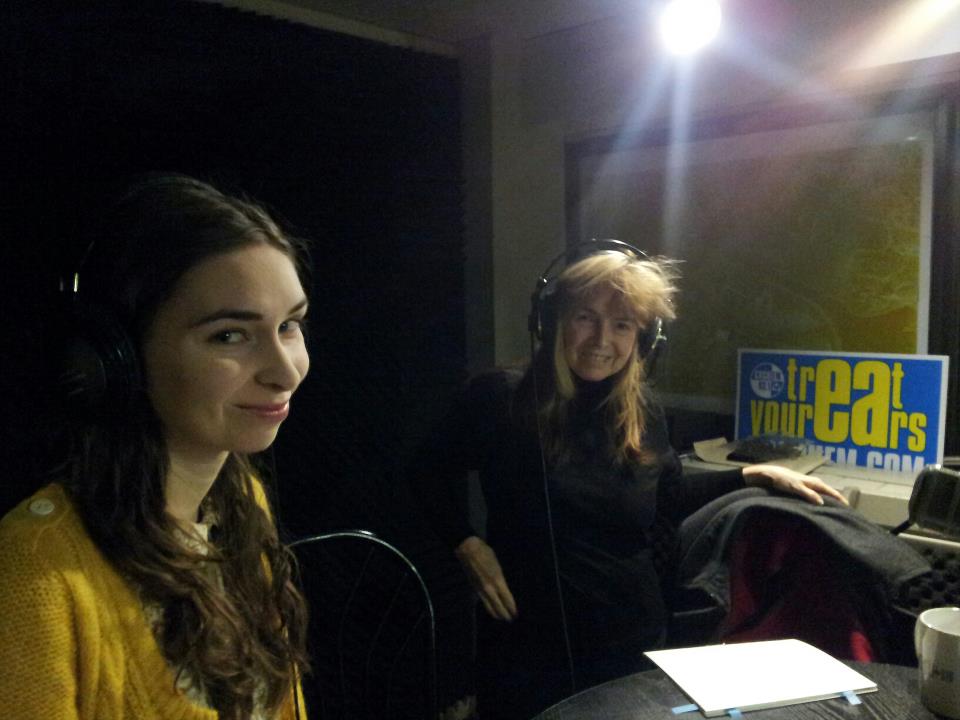
In the build up to tomorrow’s reading and book launch for Apt. 9 (Phil Hall! Rachael Simpson! Claudia Coutu Radmore!), Susan Johnston interviewed the lot of us on Friday Morning Special Blend on CKCU 93.1. You can listen to the interview below.

23 November 2012 | Apt. 9 Press on  Friday Morning Special Blend with Susan Johnston

Rachael Simpson and Claudia Coutu Radmore in studio.