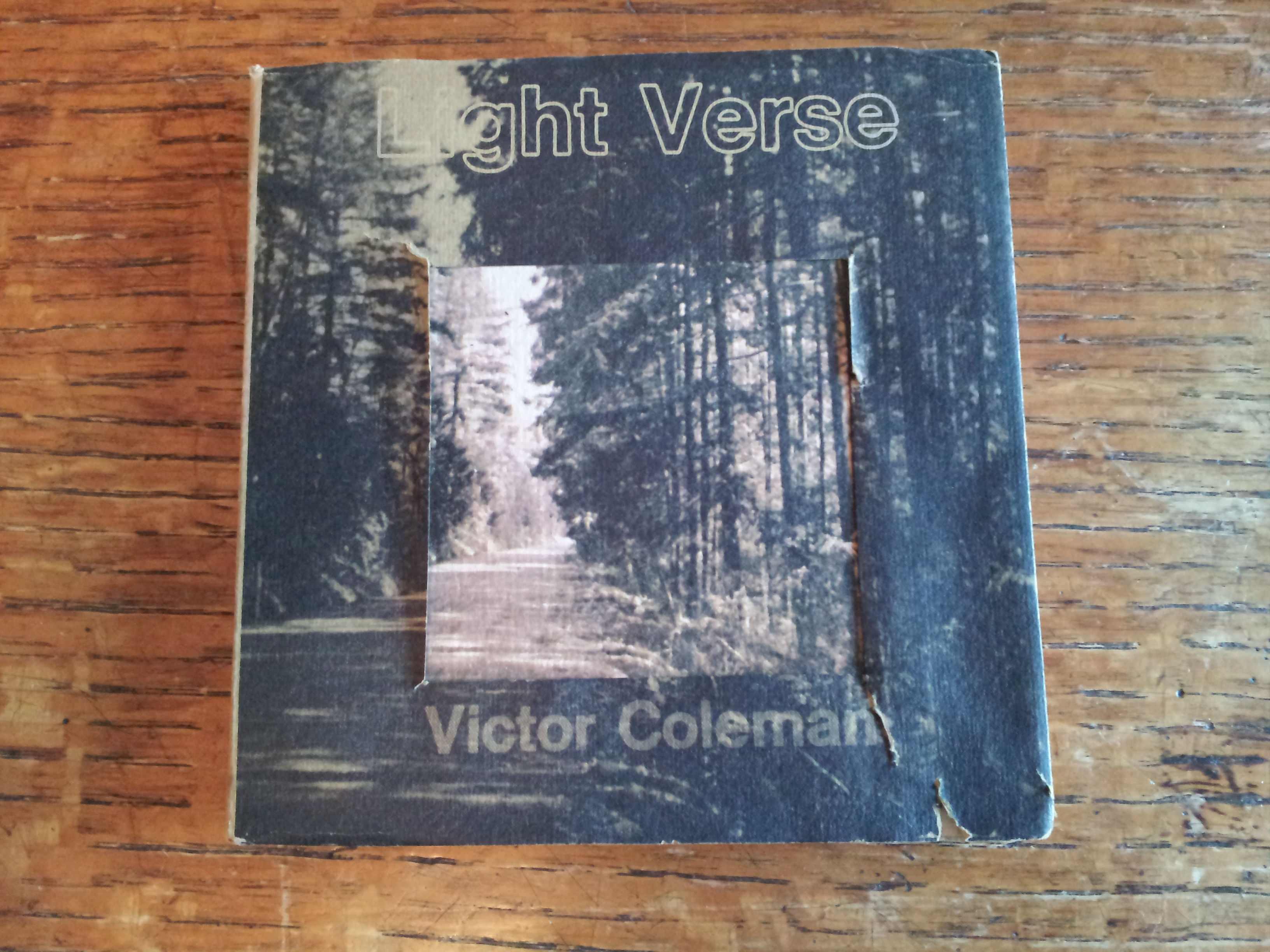
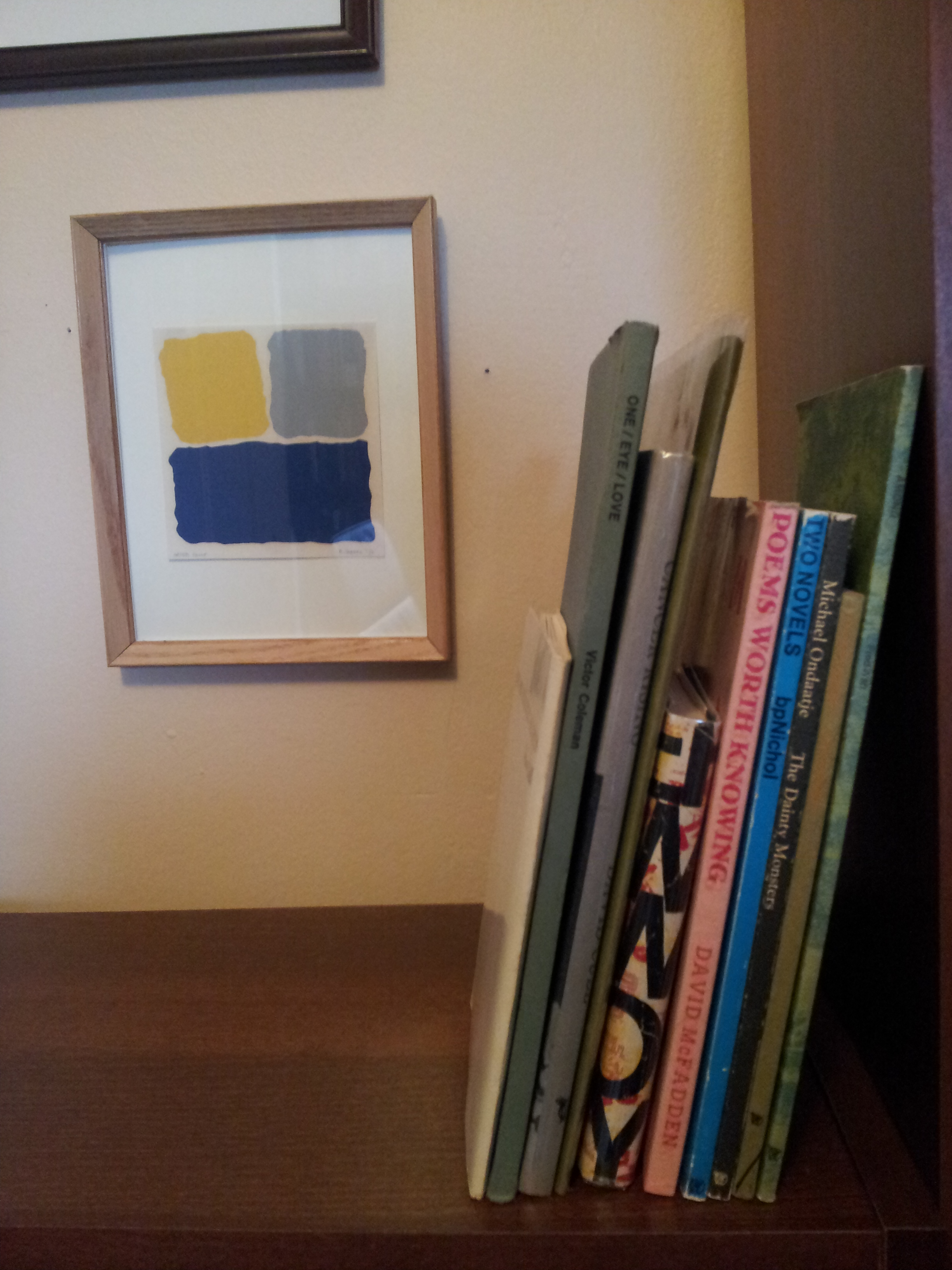
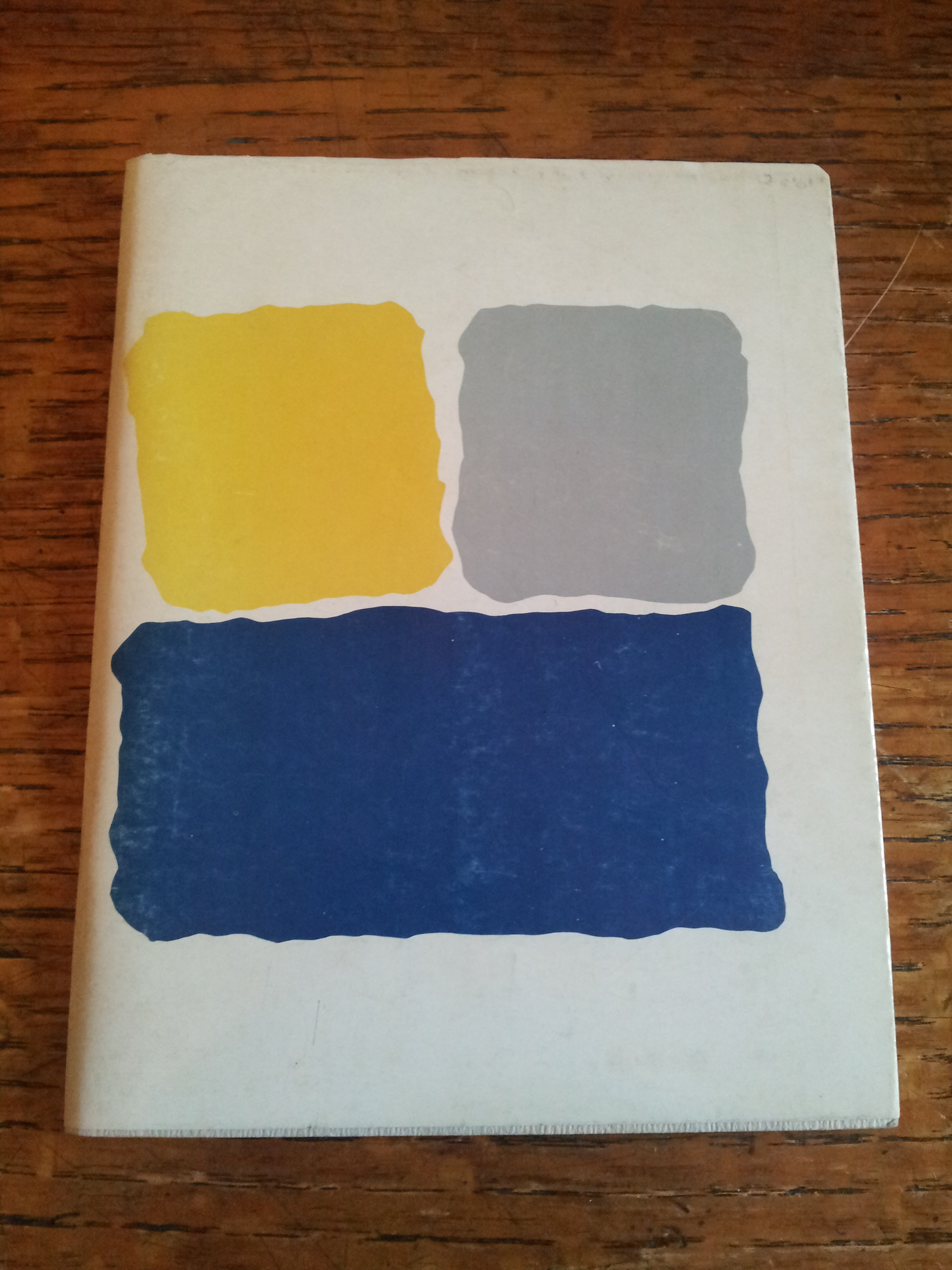
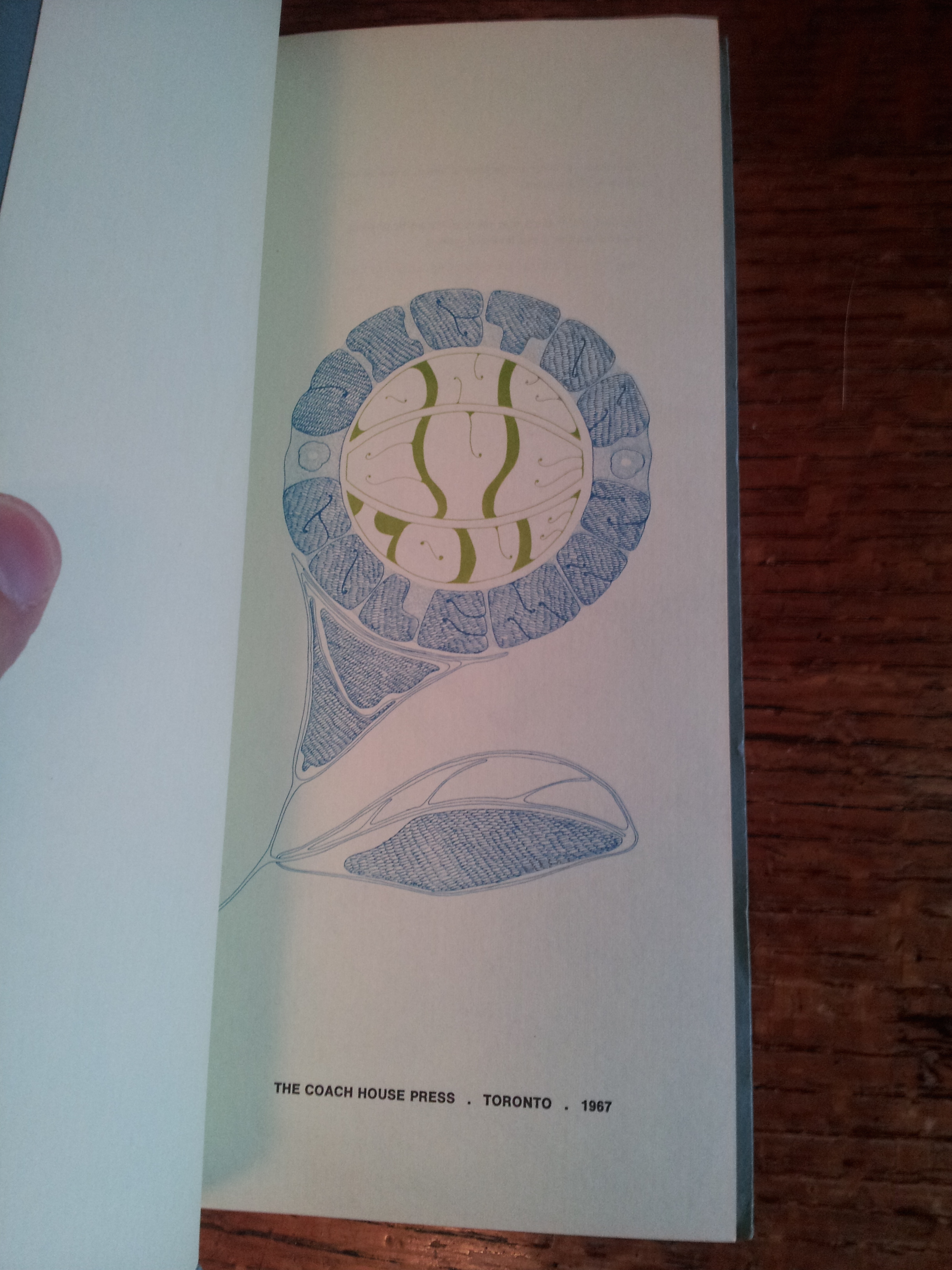
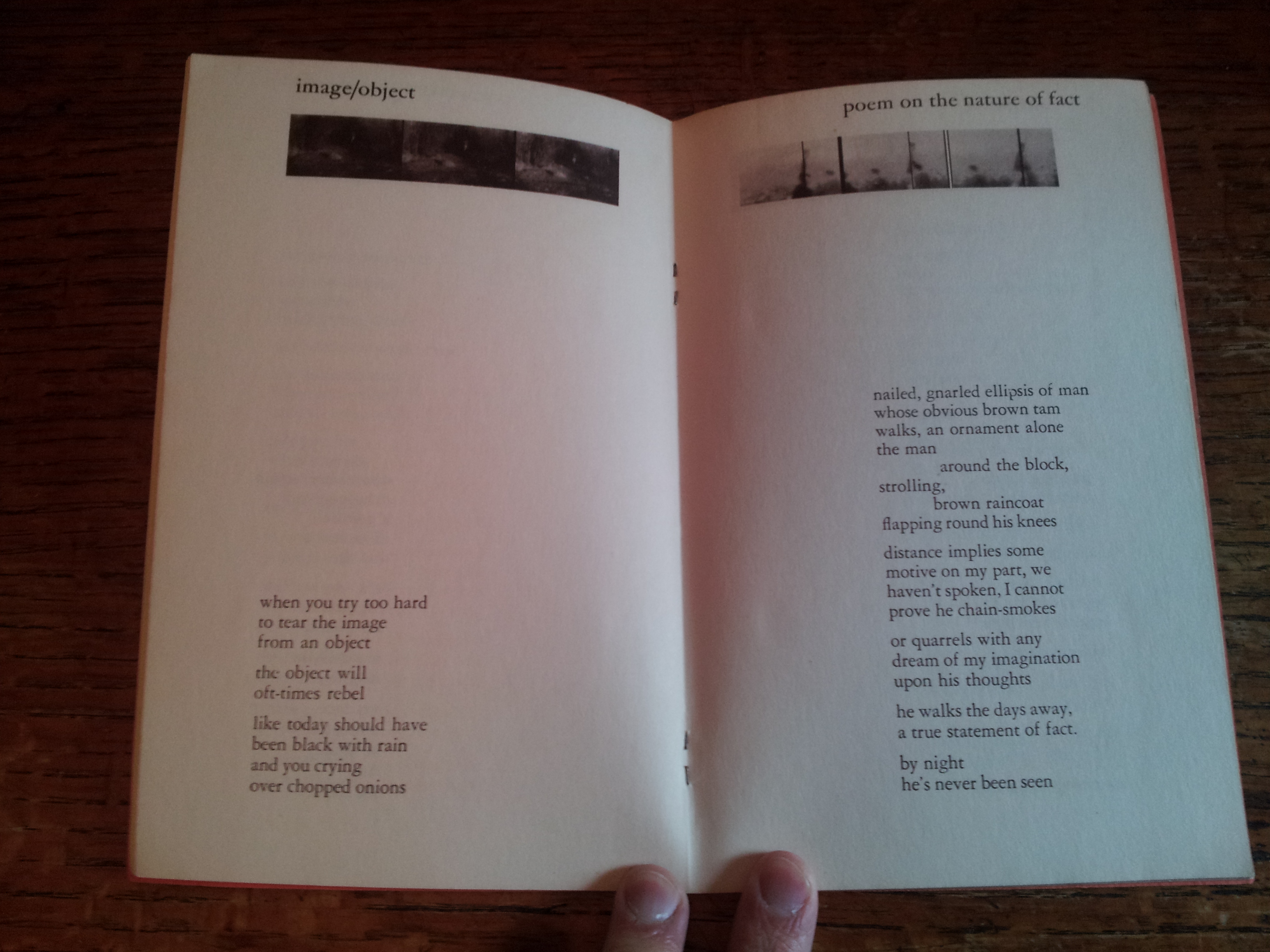
Coleman, Victor. Light Verse. Toronto: The Coach House Press, 1969.
Colour photographs tipped in throughout.
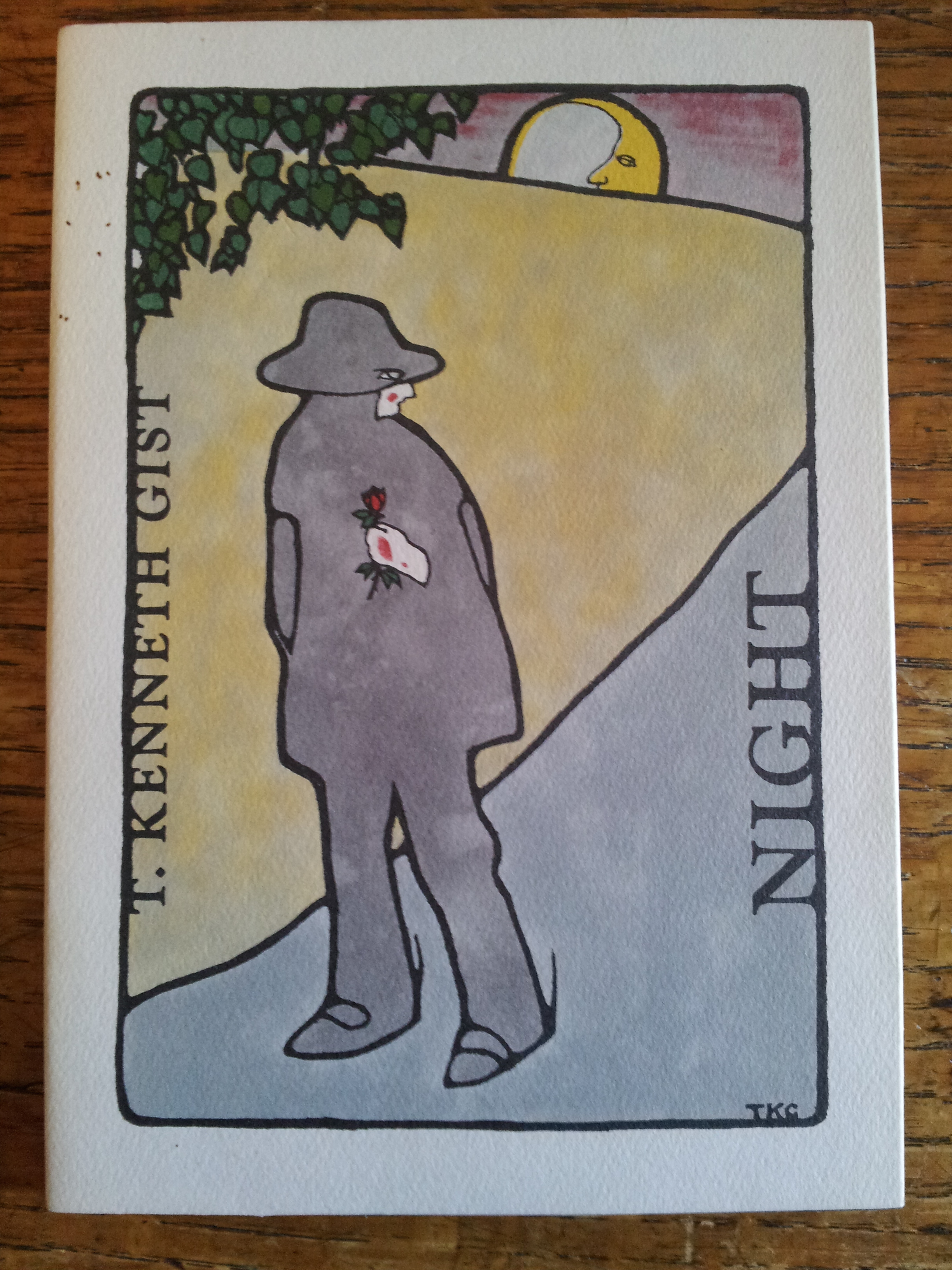
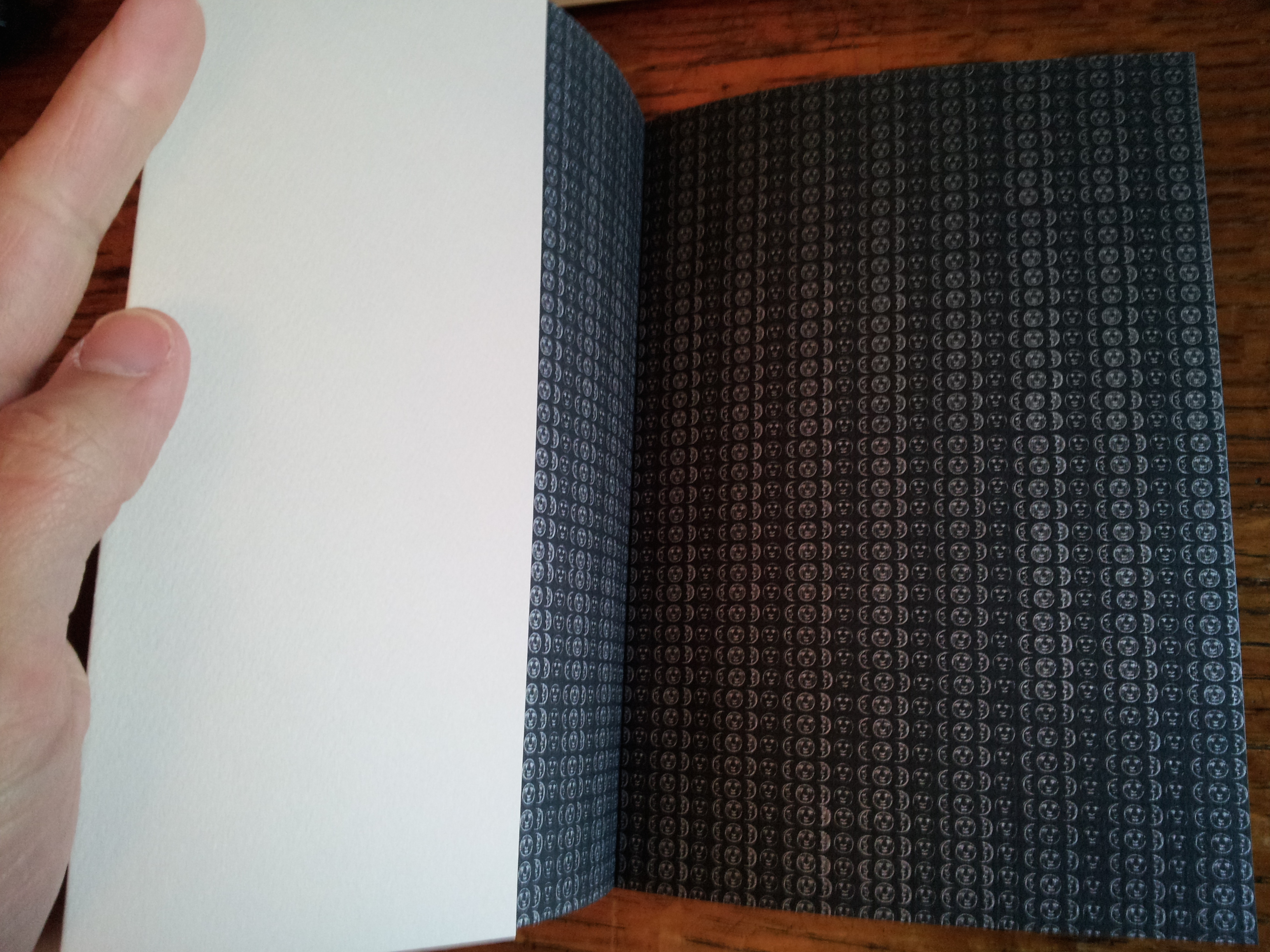
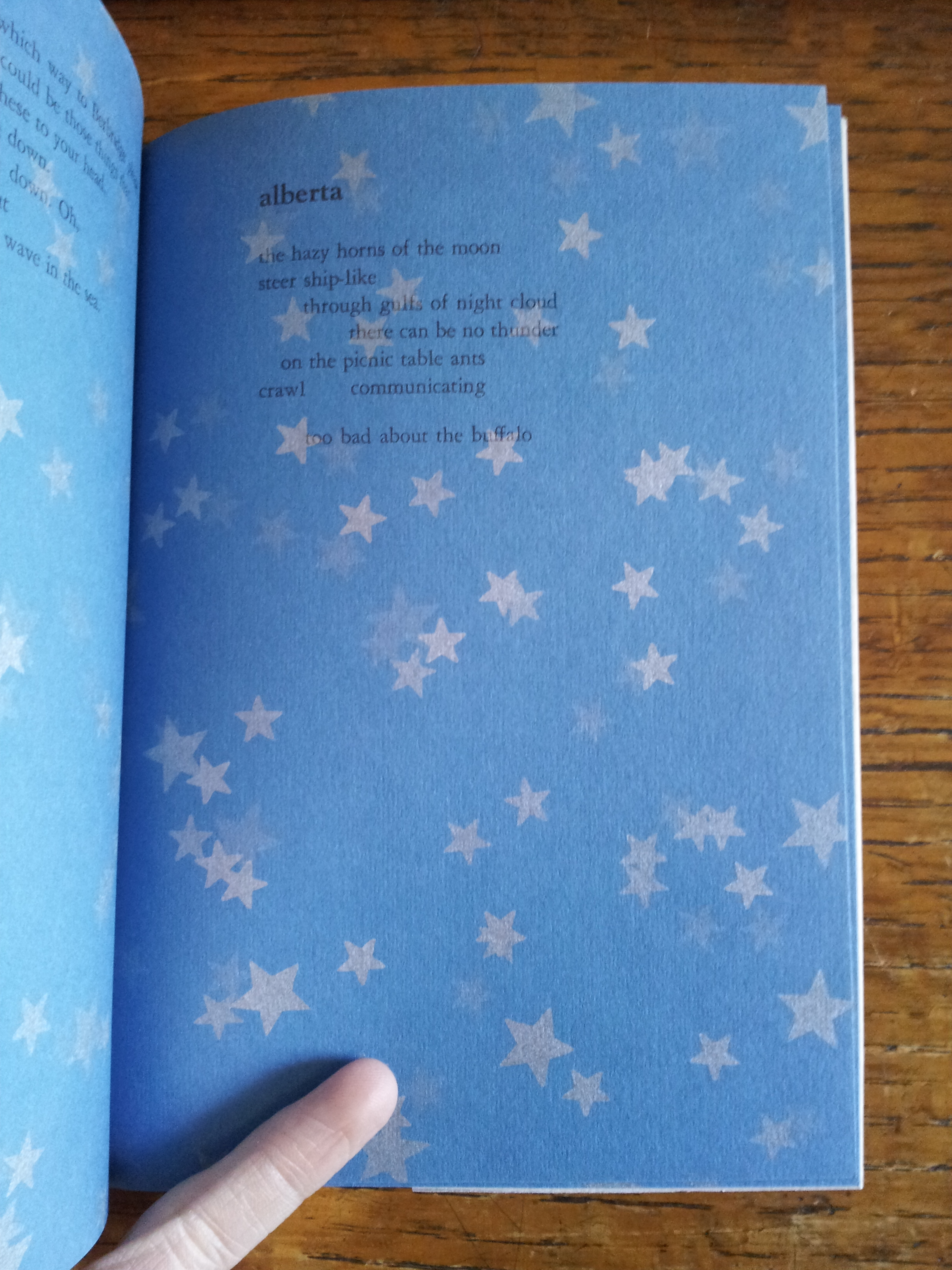
Gist, T. Kenneth. Night. Toronto: The Coach House Press, 1972.
“Printed in Canada on Canadian Paper.”
Nations, Opal L. Stabbed to Death with Artificial Respiration. Toronto: The Coach House Press, 1977.
“A Surrealist Detective Story.”
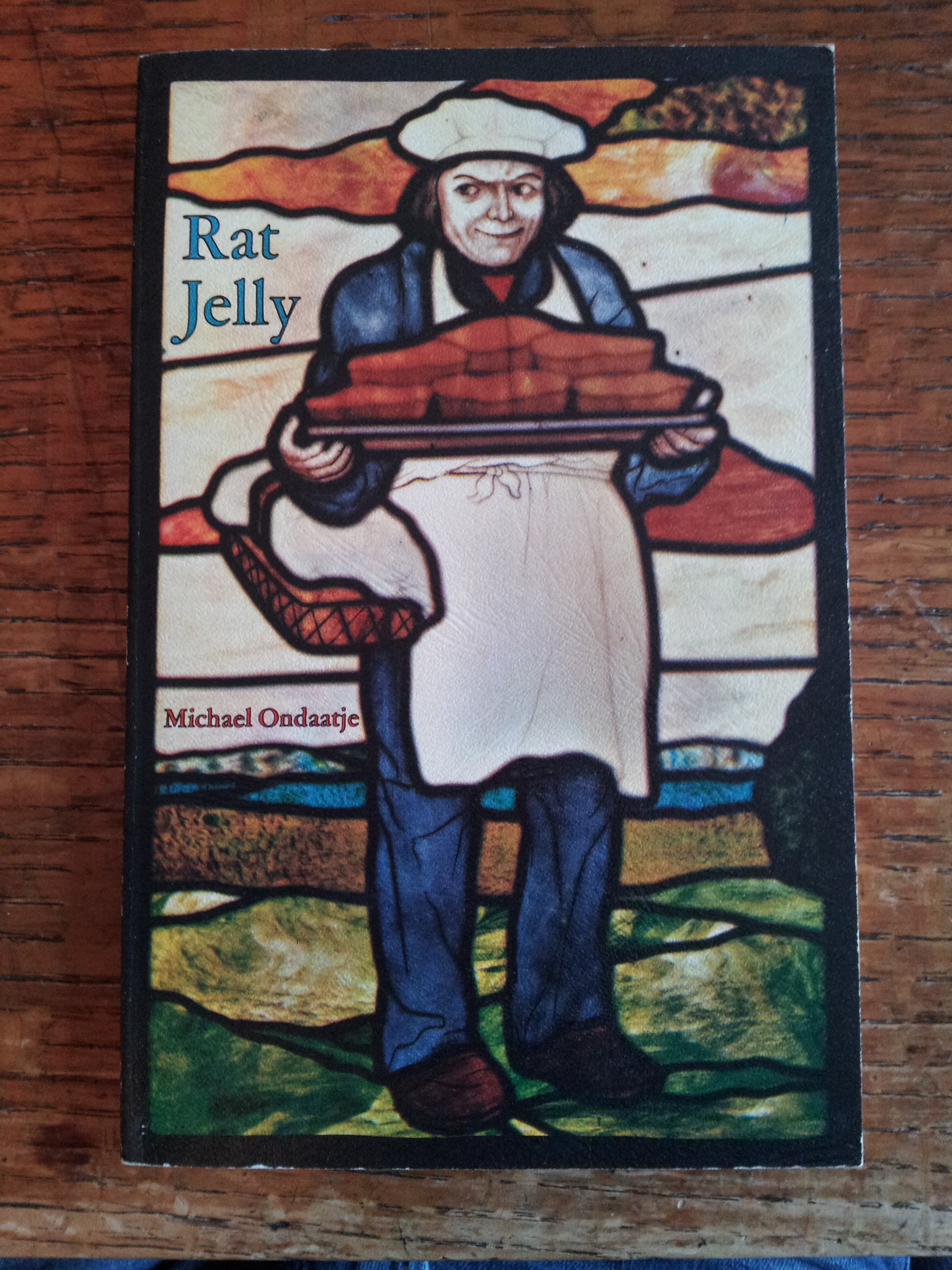
Ondaatje, Michael. Rat Jelly. Toronto: The Coach House Press, 1973.
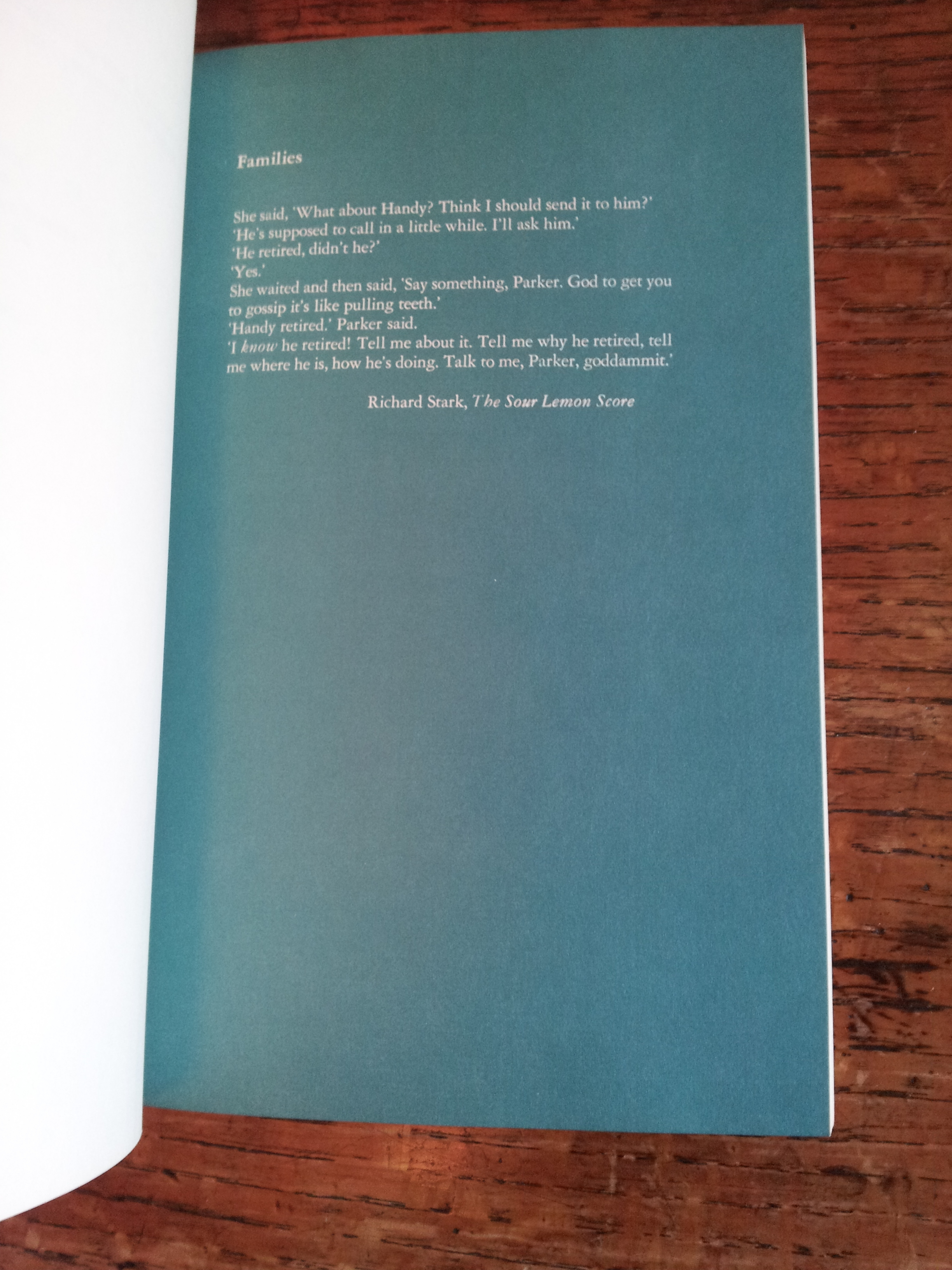
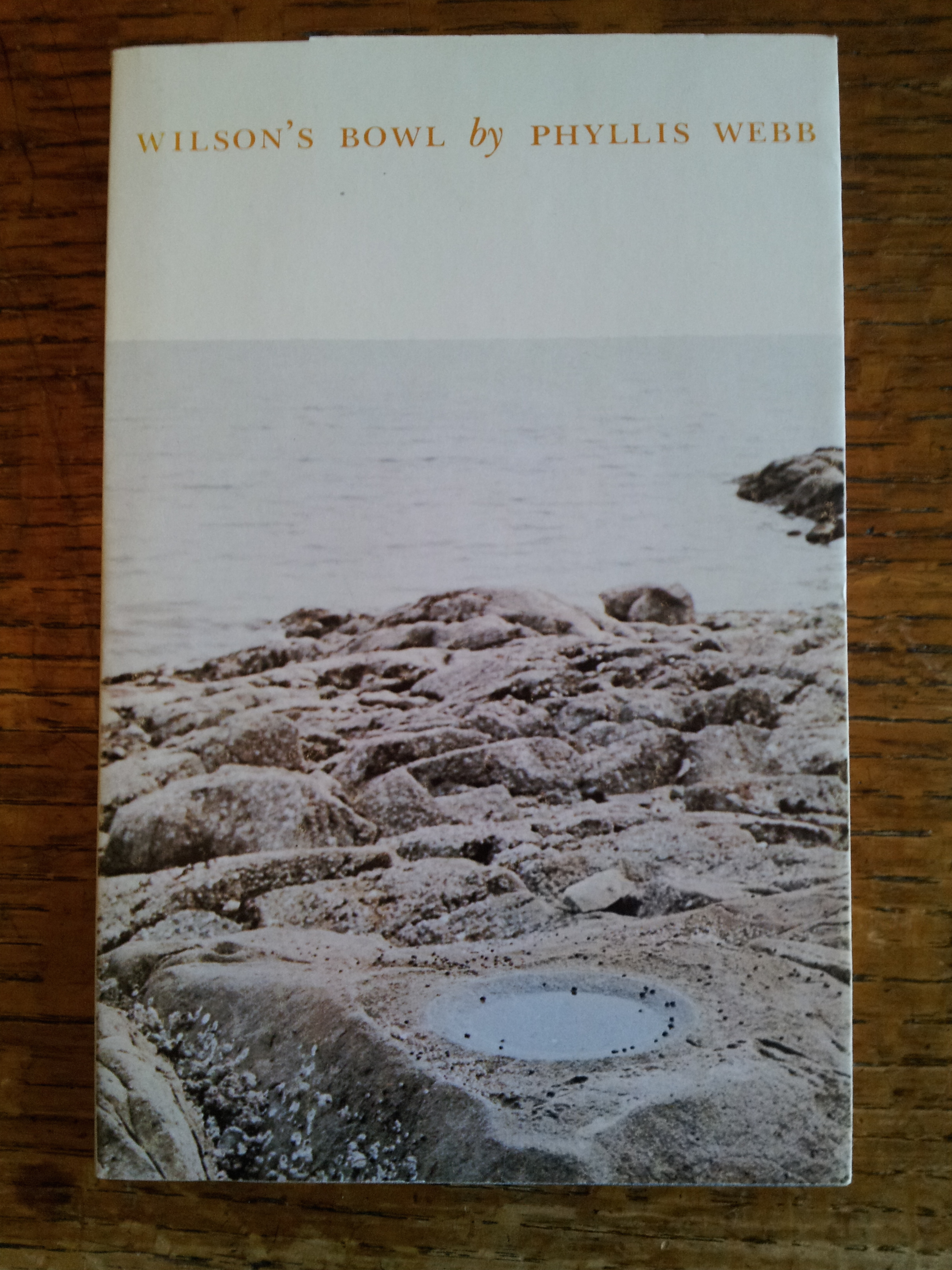
Webb, Phyllis. Wilson’s Bowl. Toronto: The Coach House Press, 1980.
This one is less radical in terms of design (and we’re into 1980 now), but I love the blue wrappers hidden under the dust jacket repeating the image from the cover.
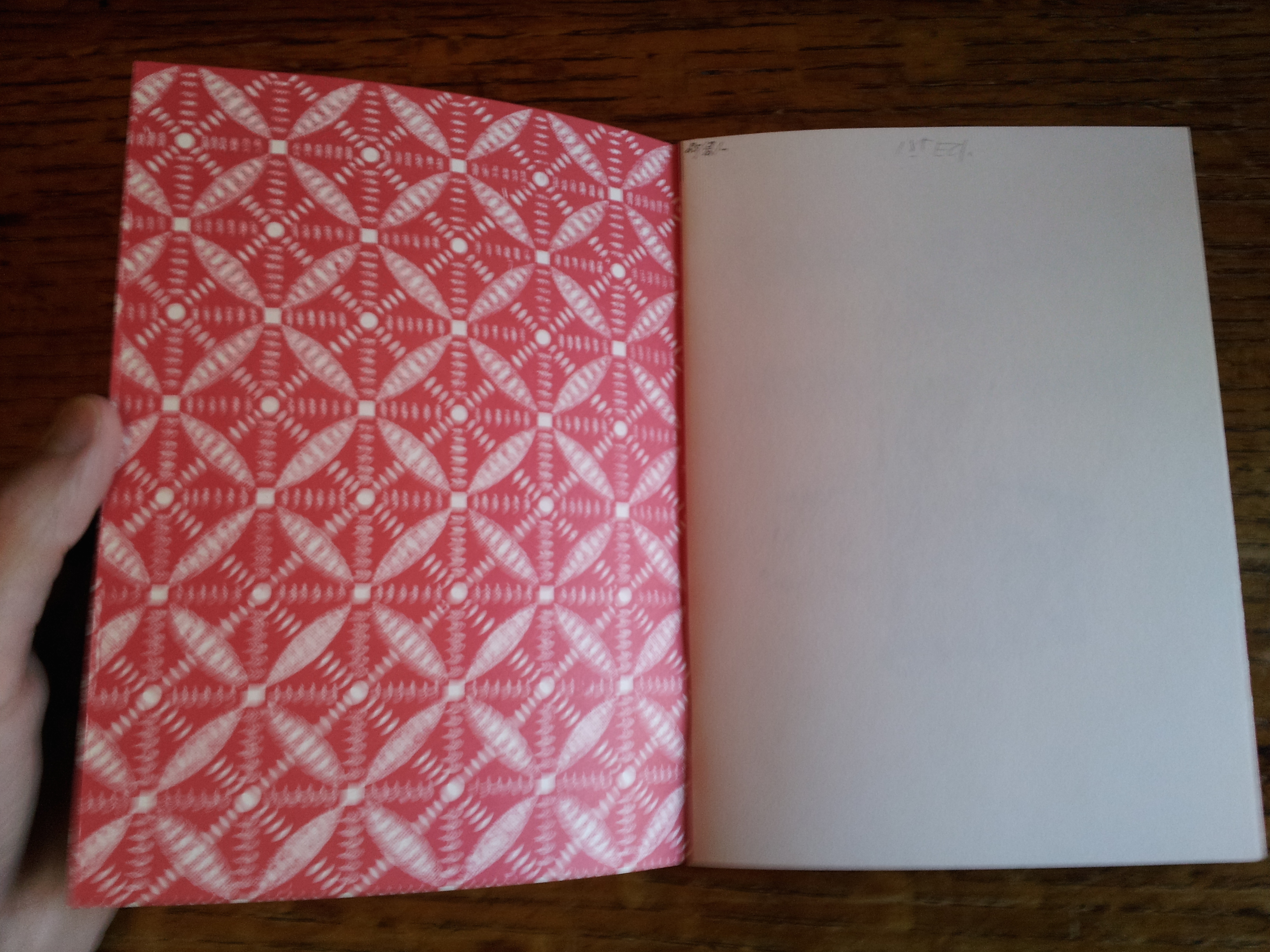
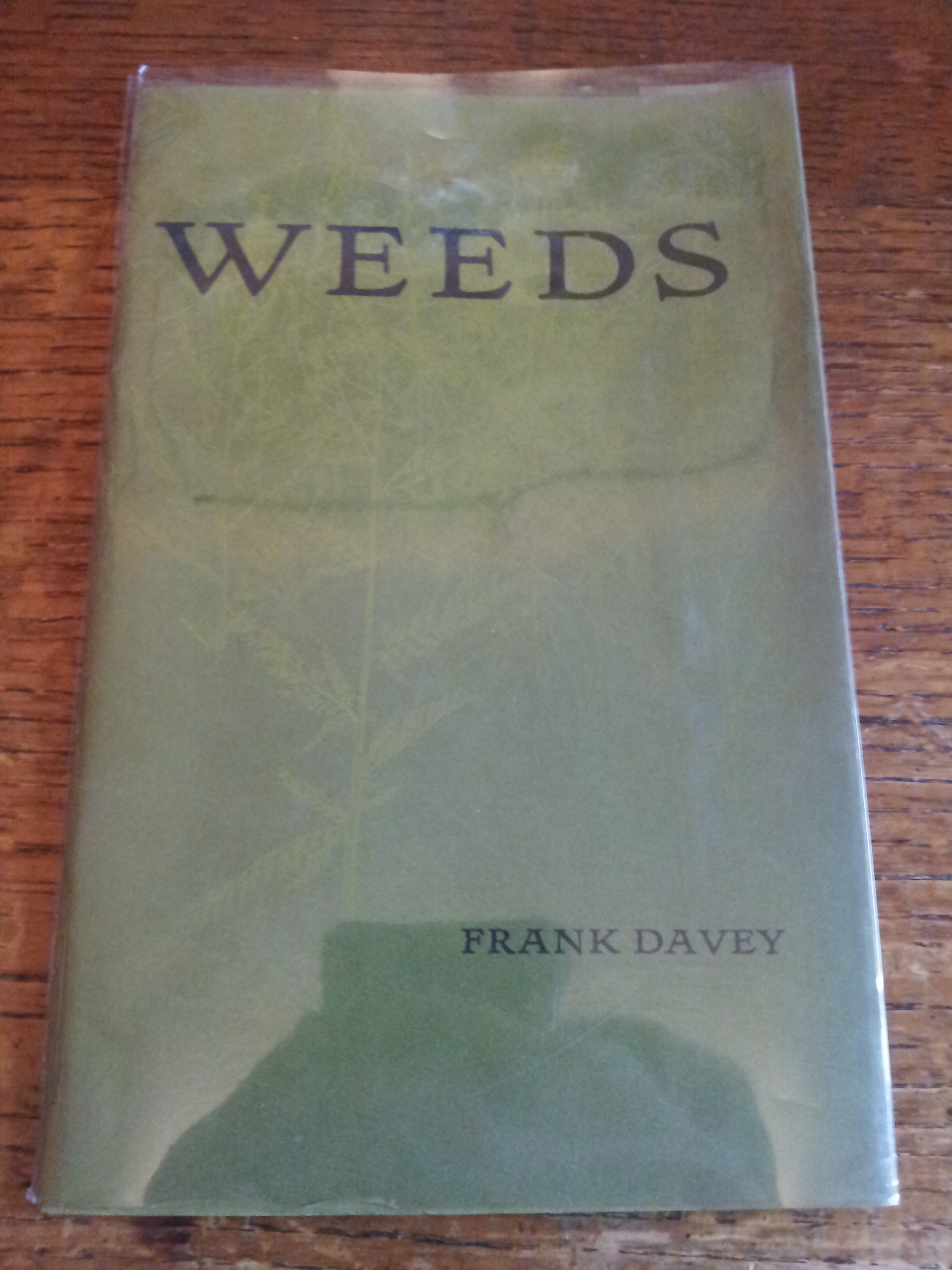
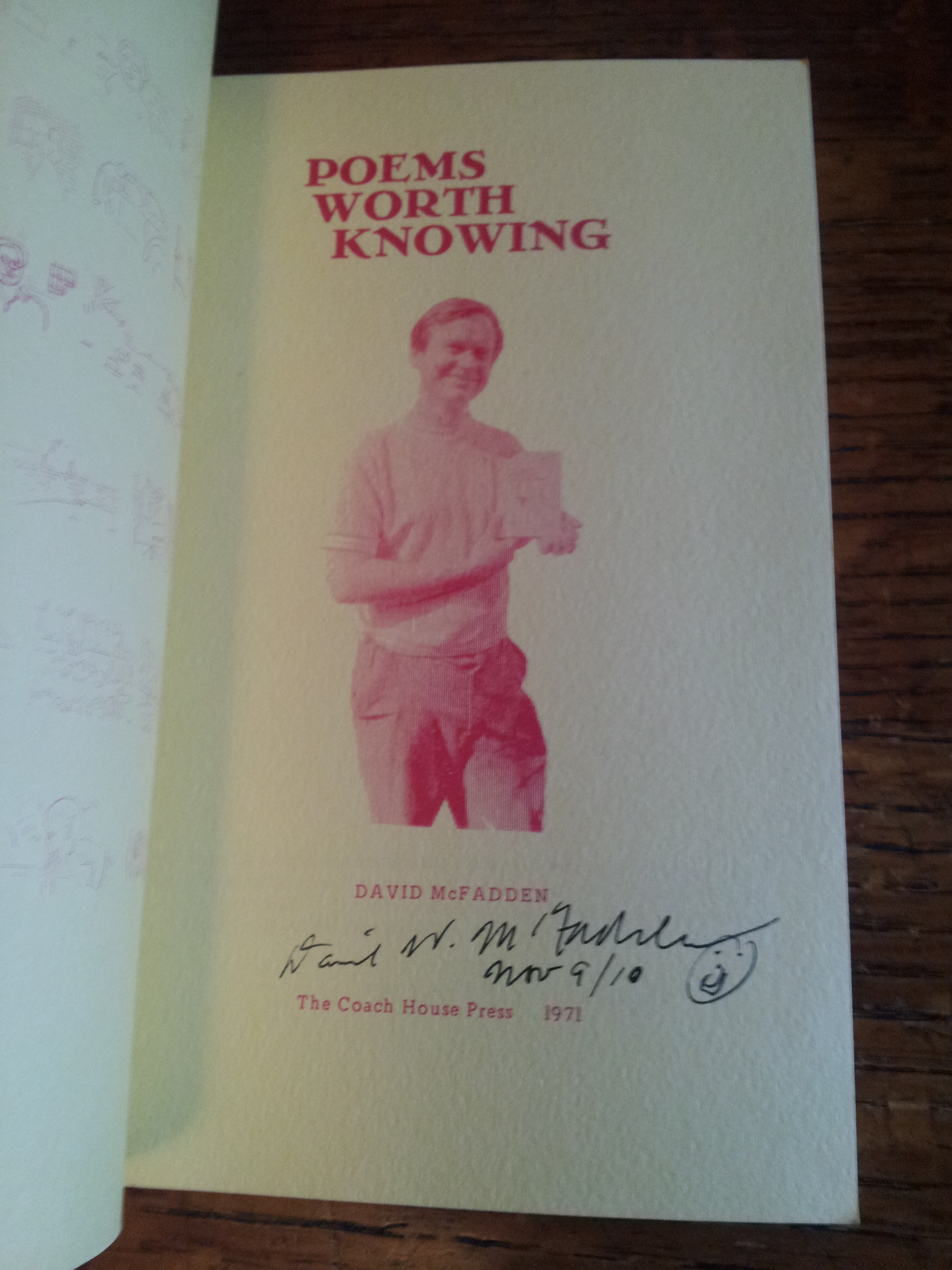
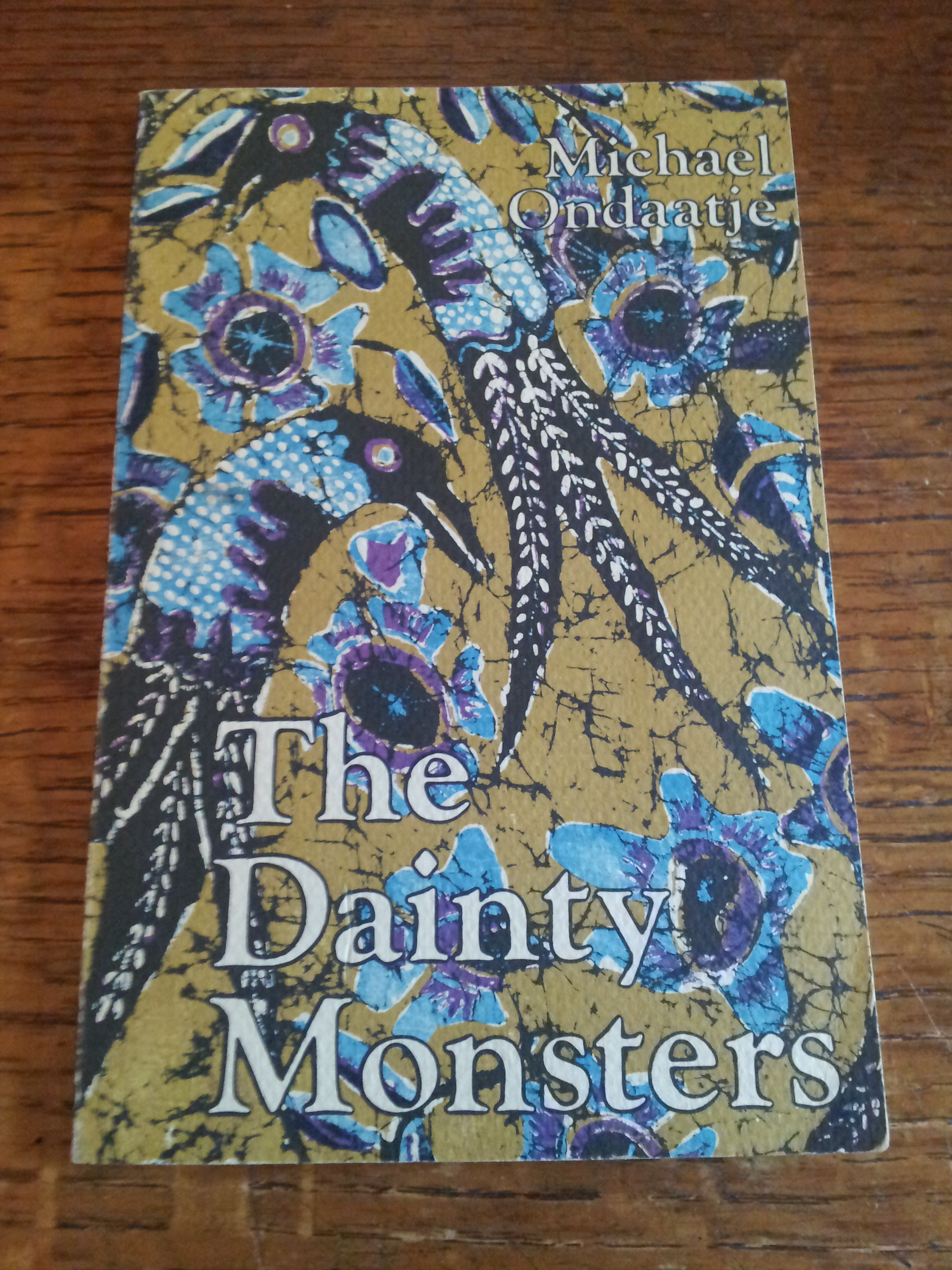
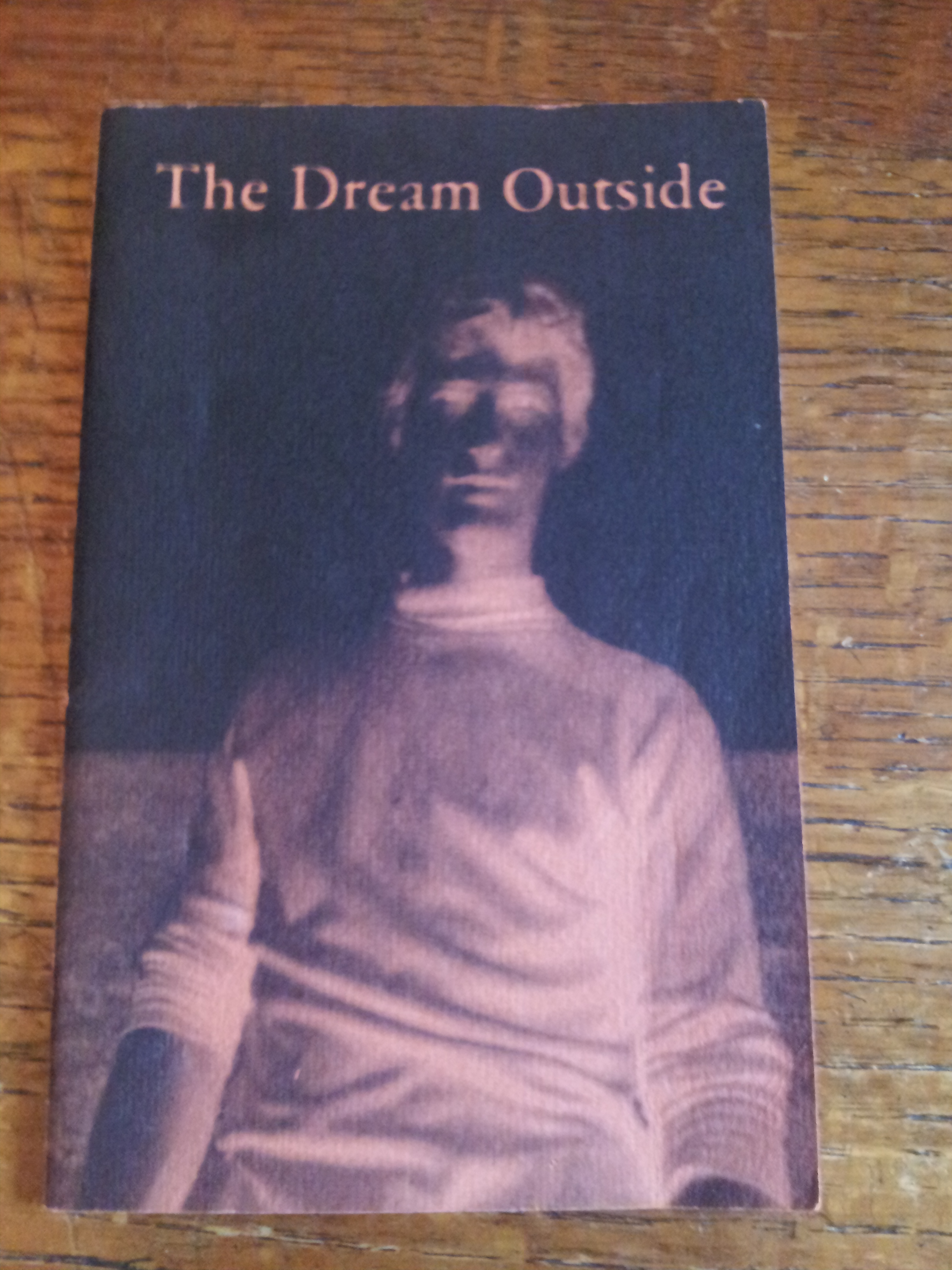
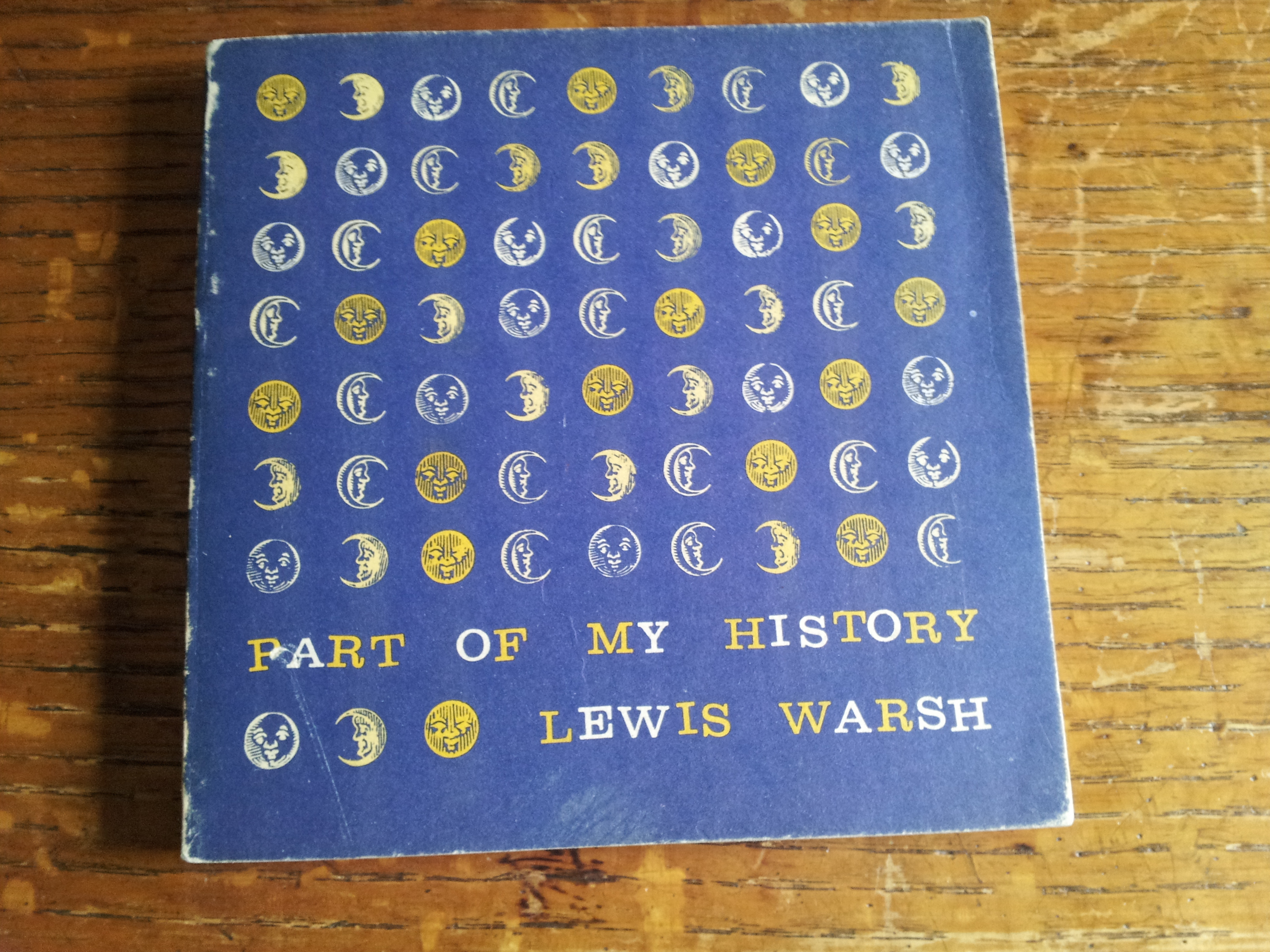
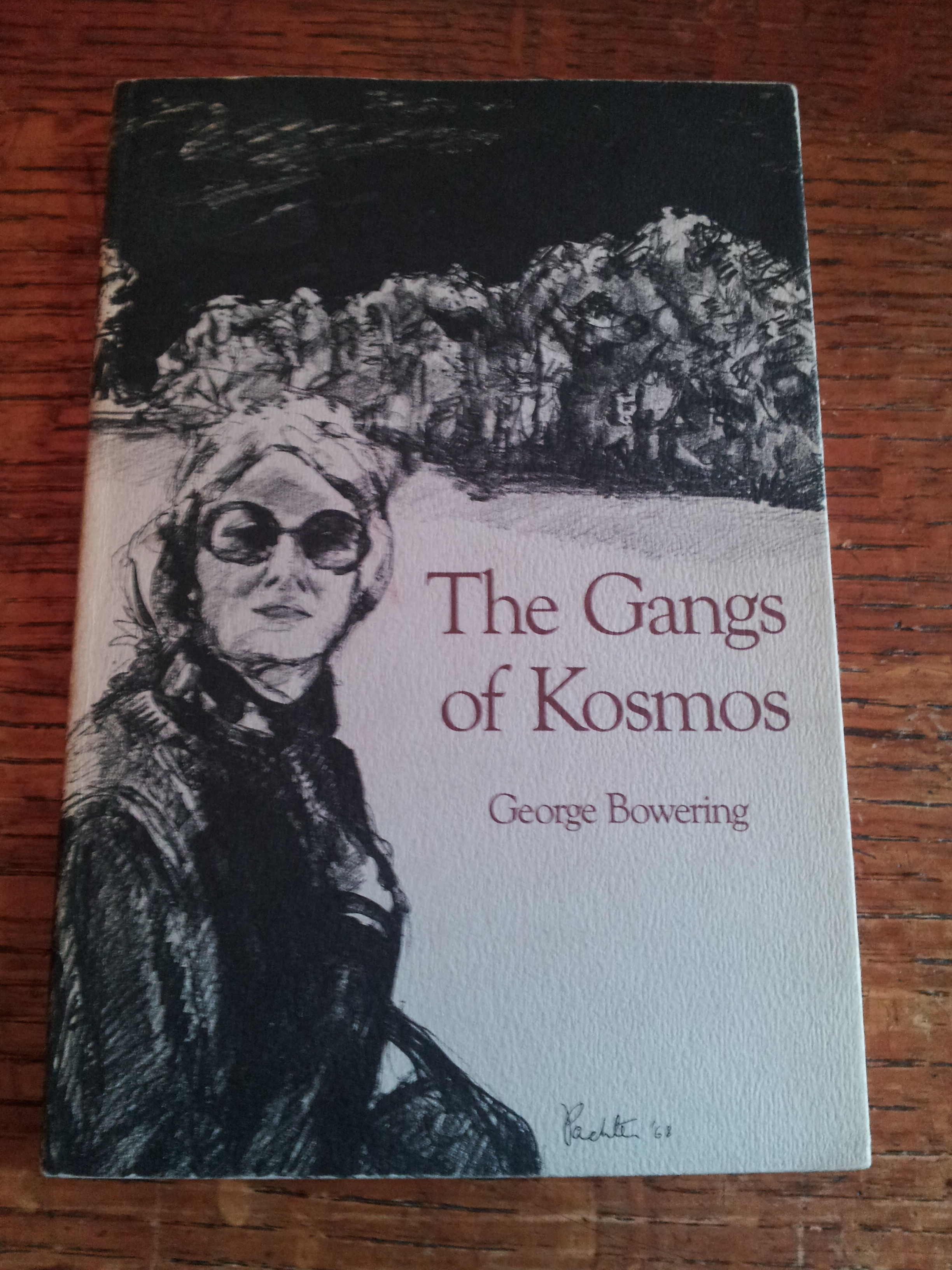
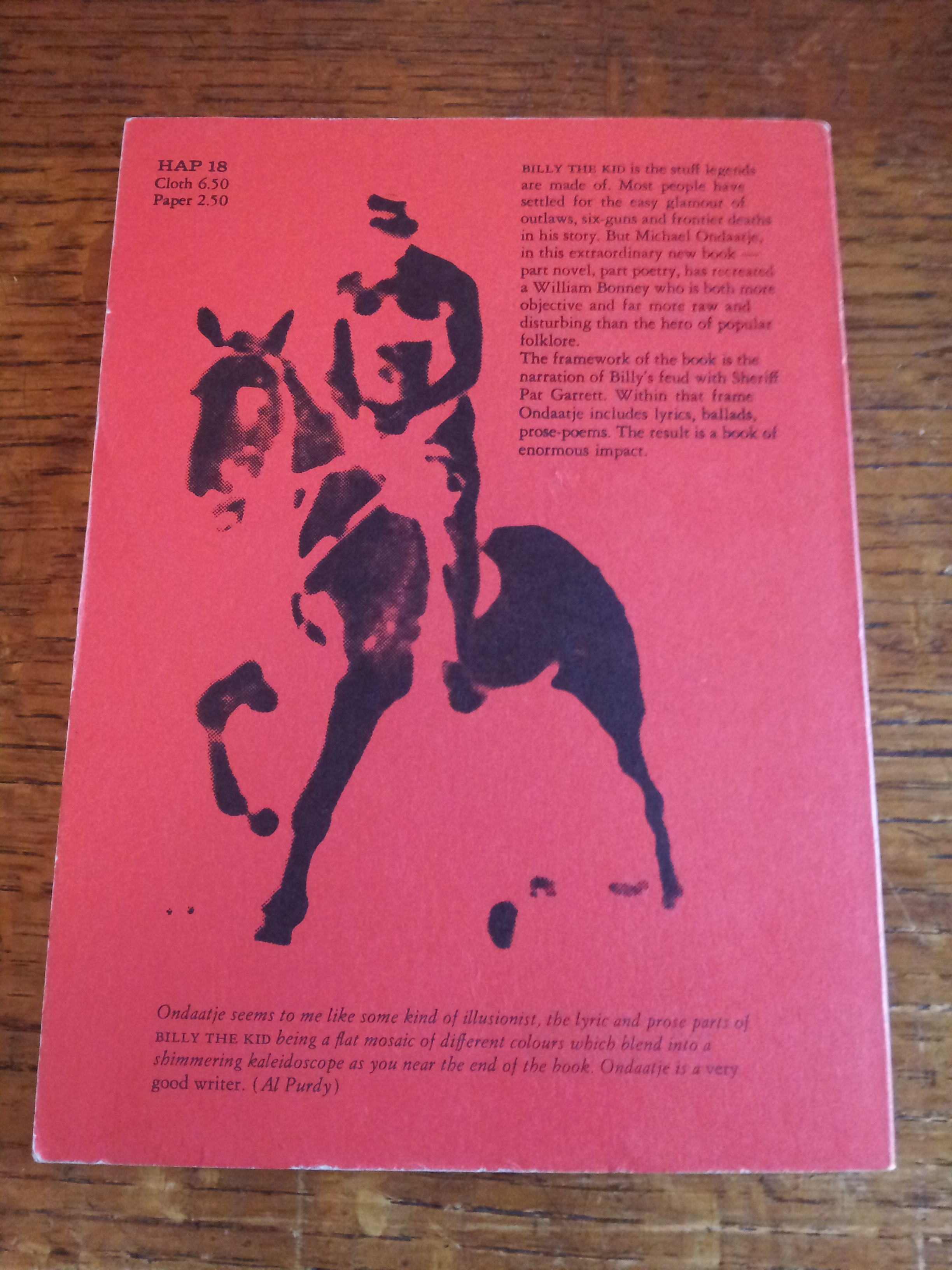
Photos of a selection of visually-interesting Coach House items from the first decade or so of the life of the press that I am lucky enough to have copies of, in alphabetical order.
Proof of Barbara Caruso print from the cover of Nelson Ball’s The Pre-Linguistic Heights in the background.
Some history of the renowned press can be found here, including a video tour of the space with Stan Bevington. There is little I can say about the accomplishments of Coach House in terms of the aesthetic book-objects that they produced in the early years that hasn’t already been said by someone more articulate than I. This post is a simple visual acknowledgement of the beauty of the work they brought into the world of Canadian small press.
Ball, Nelson. The Pre-Linguistic Heights. Toronto: The Coach House Press, 1970.
Coleman, Victor. One Eye Love. Toronto: The Coach House Press, 1967.
“PRINTED IN CANADA BY MINDLESS ACID FREAKS”
Cull, David. Cancer Rising. Toronto: The Coach House Press, 1970.
Drawings by Elizabeth Cull.
Davey, Frank. Weeds. Toronto: The Coach House Press, 1970.
McCaffery, Steve. Ow’s Waif. Toronto: The Coach House Press, 1975.
Endpapers.
McFadden, David. Poems Worth Knowing. Toronto: The Coach House Press, 1971.
bpNichol. Two Novels. Toronto: The Coach House Press, 1969. [Second Edition Pictured].
Ondaatje, Michael. The Dainty Monsters. Toronto: The Coach House Press, 1967.
Phillips, David. The Dream Outside. Toronto: The Coach House Press, 1967.
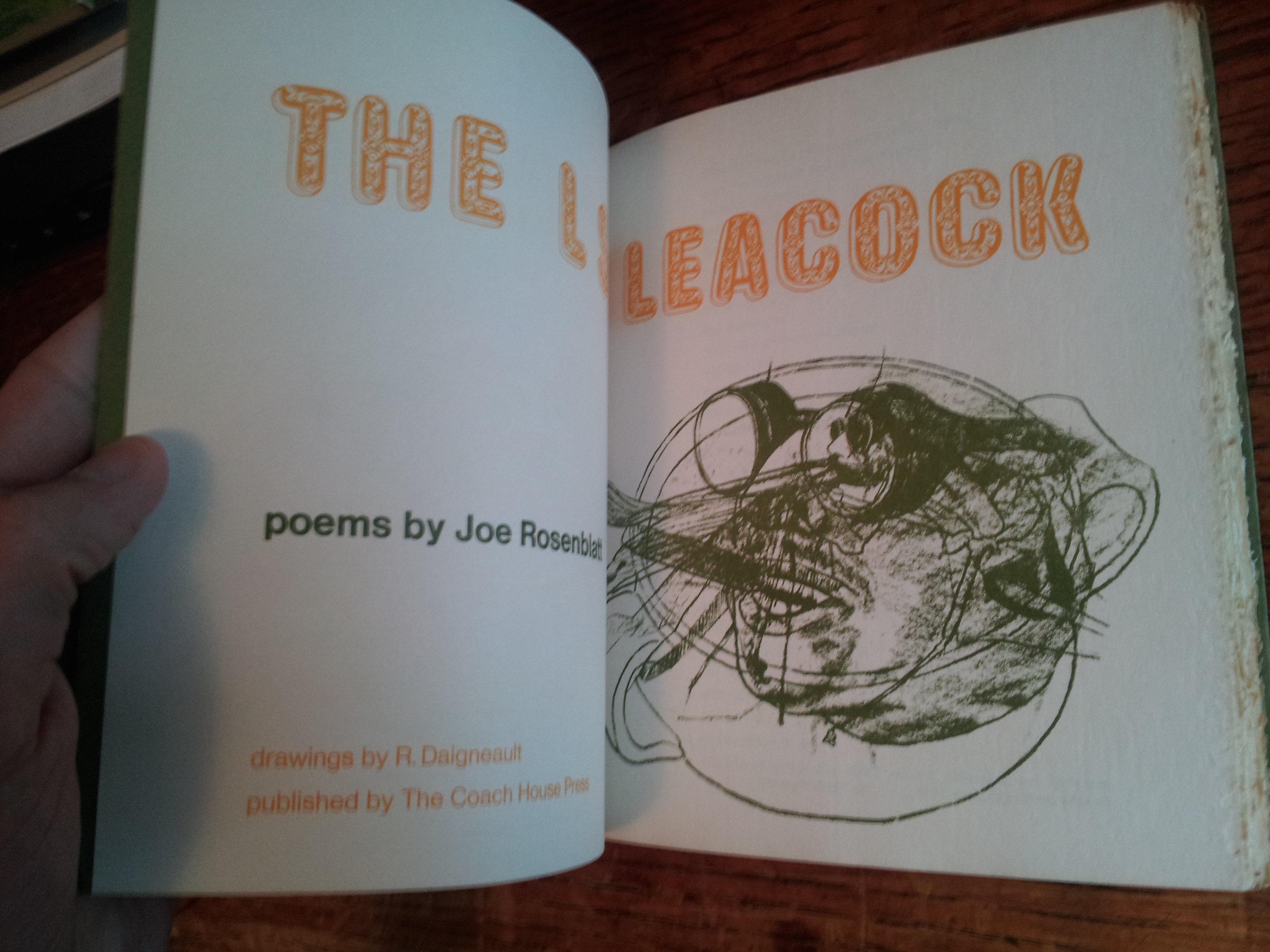
Rosenblatt, Joe. The LSD Leacock. Toronto: The Coach House Press, 1966. [Second Printing pictured]
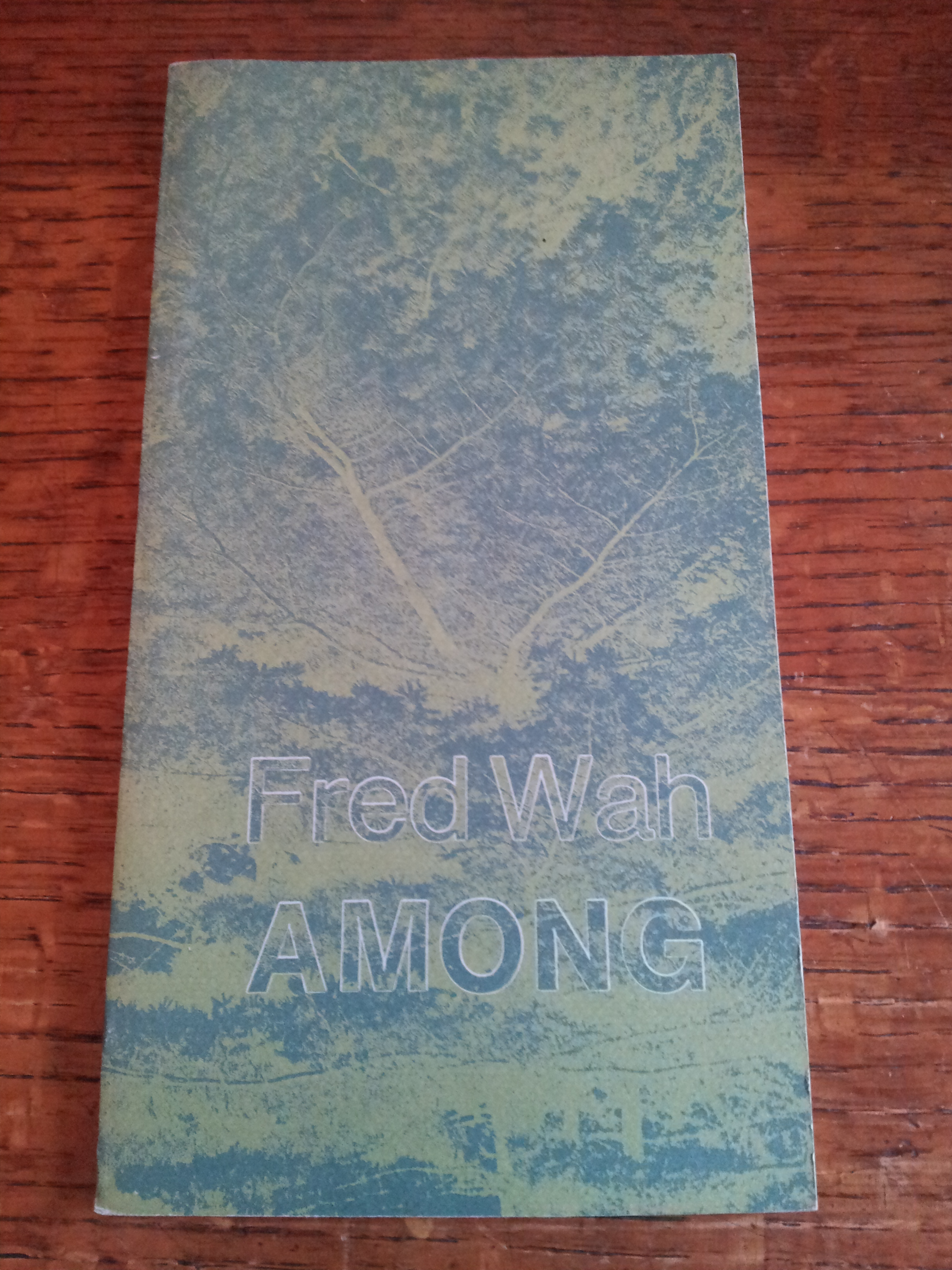
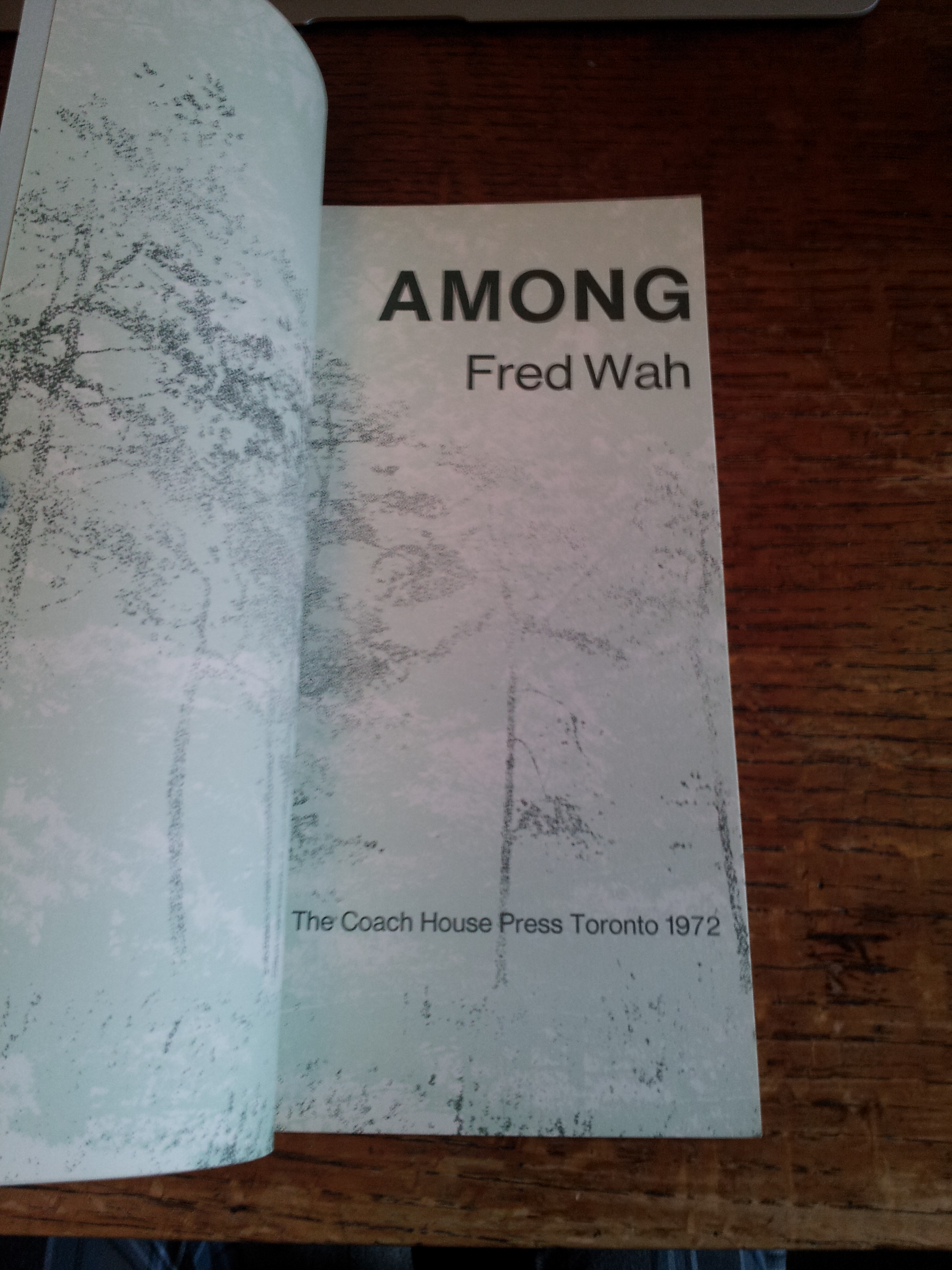
Wah, Fred. Among. Toronto: The Coach House Press, 1972.
A pair of international writers:
cobbing, bob. bill jubobe: selected texts of bob cobbing 1942-1975. Toronto: The Coach House Press, 1976.
Warsh, Lewis. Part of My History. Toronto: The Coach House Press, 1972.
Cover by Joe Brainard.
And as a little bonus, two House of Anansi titles (both of which one the Governor General’s Award) that were designed and printed at Coach House (see Stephen Cain’s dissertation, “Imprinting Identities: An Examination of the Emergence and Developing Identities of Coach House Press and House of Anansi Press (1967-1982) for further discussion of the relation between the two operations).
Bowering, George. The Gangs of Cosmos. Toronto: House of Anansi, 1969.
Ondaatje, Michael. The Collected Works of Billy the Kid: Left-Handed Poems. Toronto: House of Anansi, 1970.
Like many, I buy these when I see them. It is striking today, pulling them down from the shelves all together, to note that each of these titles is by a male writer. I don’t see too many women listed in the early years from Coach House in Tweny/20. I’m not sure how Anansi fared along these lines.
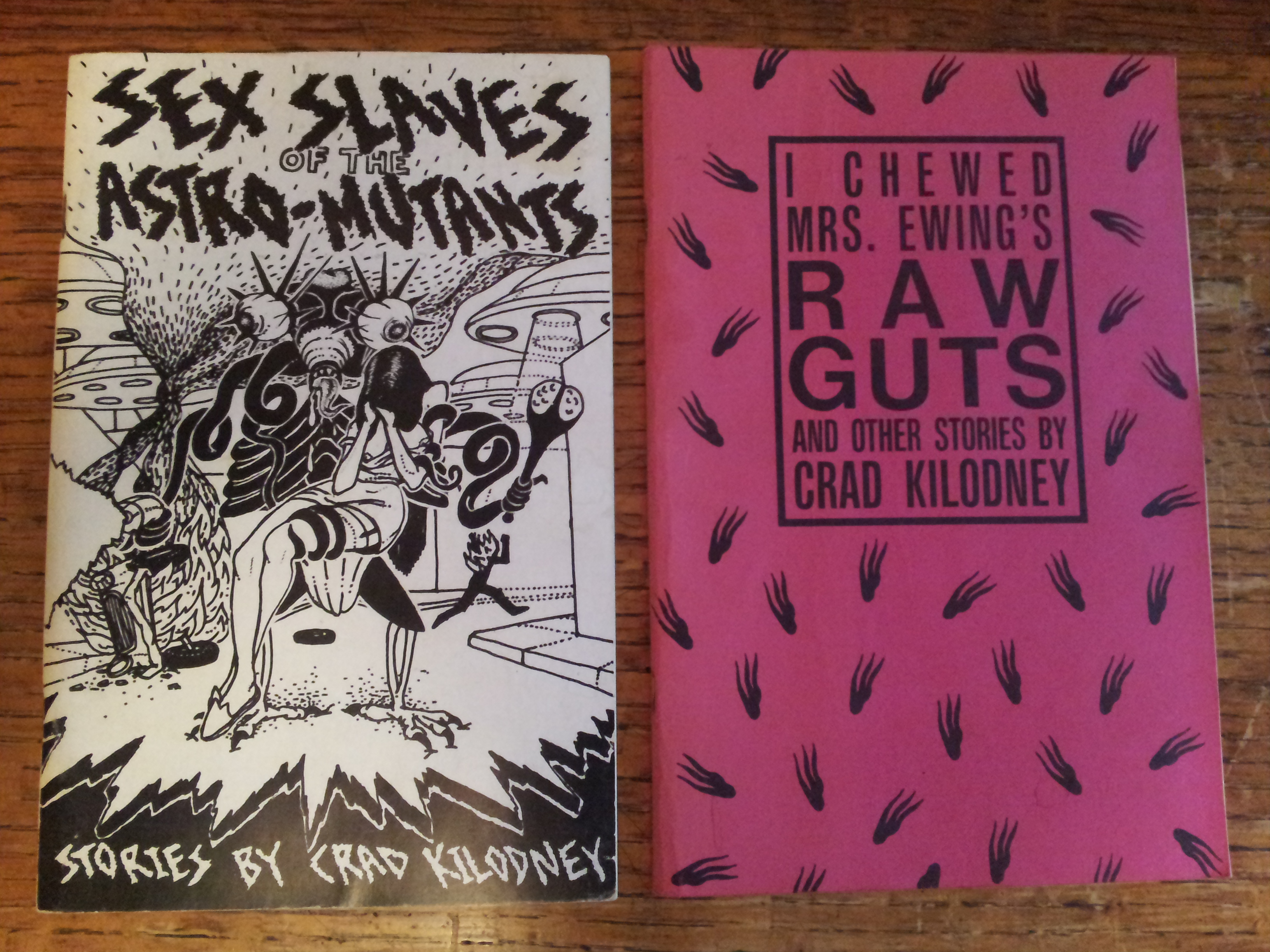
Crad Kilodney, (in)famous Canadian fiction writer and street-bookseller, died yesterday. I know Crad’s work, and I know stories about Crad, but I never knew him personally and never made direct contact with him.
Like many of my generation (I suspect), I first encountered his name in Stuart Ross’s Confessions of a Small Press Racketeer. While describing his own adventures selling self-published books on the streets of Toronto, Ross invoked Crad: “Crad Kilodney, the grandfather of literary street vendors, got me into this. During his 15 years on a the street, he sold 35,000 books of his demented fiction, making him one of Canada’s top-selling literary writers. A misanthrope to begin with, he became increasingly bitter and angry over those years” (34).
News that Crad was unwell spread over the past few months, and some that knew him well began posting short memoirs of Crad. Stuart Ross and Jay MillAr posted two that were particularly thoughtful and honest about Crad’s influence and legacy. [Update: There is now a new post by Lorette C. Luzajic who was with Crad at the end. Lorette is responsible for The Crad Kilodney Literary Foundation and has written on him in two of her books.]
In December, a story was posted on Crad’s website, announced on his Facebook page with the following note: “”Thank you to all my readers, old and new, for your support. This is the last piece I will publish in my lifetime.” The story, “Dreaming With Kay”, is touching and sad and deeply moving.
I am in the process of planning my dissertation chapters. When all is said and done, Crad will make an appearance in chapter five. It is very possible that Crad would have disapproved of this. I can’t find the passage at the moment, but somewhere in one of his books on my shelf Crad wonders if someday an academic will attempt to make a name for him or herself off of his work, while he suffers and dies in poverty. This is a contradiction I will confront when I arrive at it.
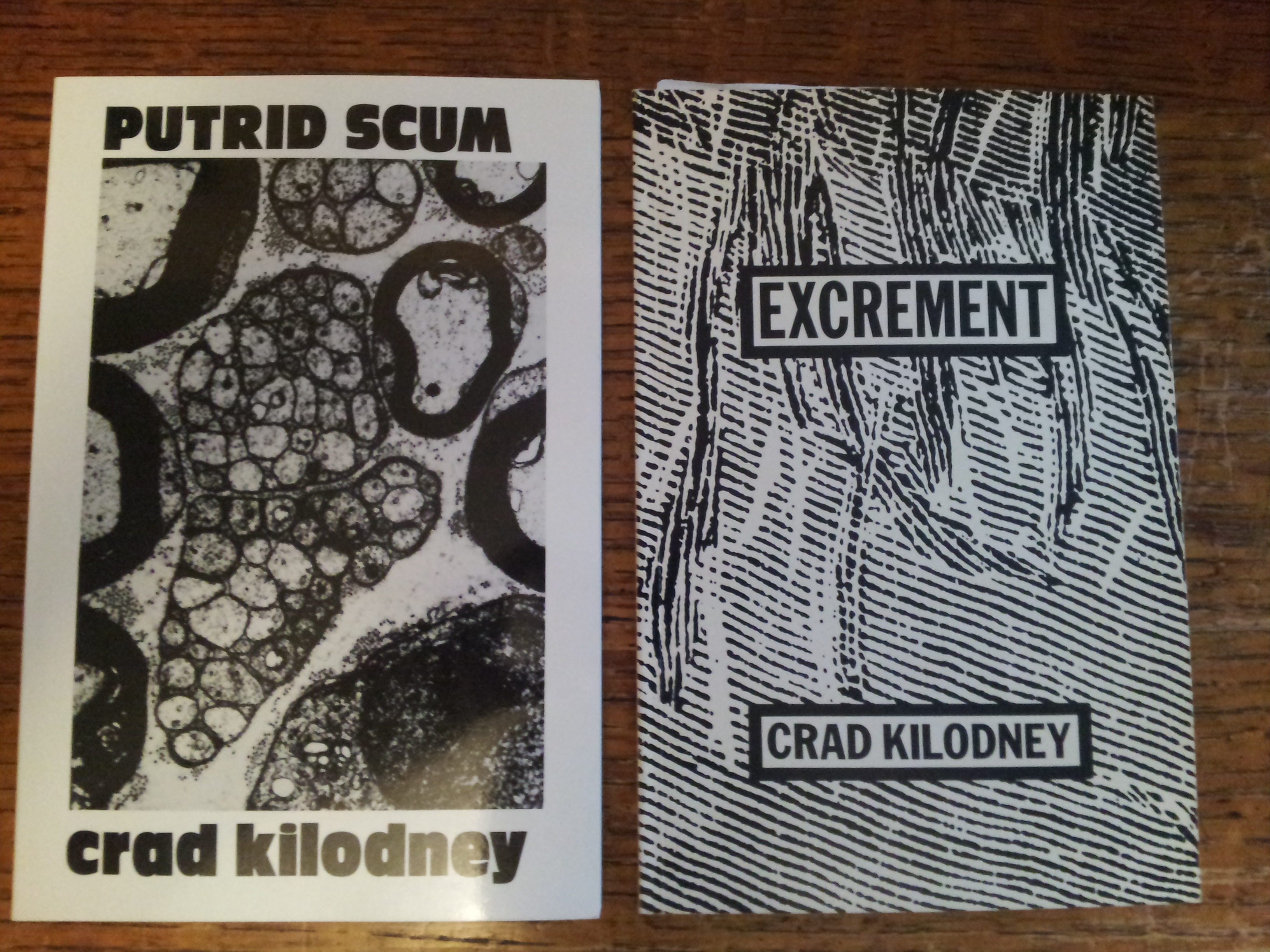
What I do know is that Crad did something remarkable standing on the street with his books and with his placards. His critical gesture was emphatically public. For close to two decades he subsisted on a minuscule income garnered from selling a handful of his own books each day. In Putrid Scum, one of his two novels based on his street-bookselling experiences, he writes, “The whole premise of standing on the street was to be accessible to anyone who was interested, and to find my readers one at a time by letting them find me” (148). There is an openness and generosity and courage embodied in this, even though the experience itself often gave way to bitterness and frustration. In Excrement, the other novel about his experiences, he describes standing with his books in public, “bodily before a passing population of nitwits, illiterates, snobs, degenerates, mental cases, stiffs, creeps, assholes, phones, scumbags, cheapskates, and self-styled critics [understanding] my true position in the world, as well as the inconsequentiality of the poor little bundle of wood pulp into which [I had] poured all that I was humanly capable of!” (44).
The small press in Canada is richer for Crad Kilodney’s contributions to it.
“This American and Canadian literature course, with its minimal attention to Canadian literature, remained on the [University of Toronto] English curriculum for thirty years until finally, in 1954, Robert McDougall convinced the department to offer a full course in Canadian literature. In spite of McDougall’s efforts, however, the course was open only to students not majoring in English.” (164)
King, Sarah D. “An Uncomfortable Match: Canadian Literature and English Departments in Canada, 1919-1965.” Diss. University of Western Ontario, 2003.
I’ve got a handful of very short poems in the brand new issue of ottawater. Amazingly, the annual journal is now in its tenth year! I feel very lucky to have been in it a number of times, and am particularly proud to be among such fine company this time around. Thanks to editor rob mclennan, and designer Tanya Sprowl.
Inside you’ll find poems from Sylvia Adams, Cameron Anstee, John Barton, Stephanie Bolster, Frances Boyle, Heather Brunet, Sara Cassidy, George Elliott Clarke, Stewart Cole, Anita Dolman, JM Francheteau, Richard Froude, Elisabeth Harvor, Jenna Jarvis, Nicholas Lea, Michael Lithgow, N.L. Lea, Anne Le Dressay, Sneha Madhavan-Reese, Karen Massey, Justin Million, Colin Morton, Andrew Oliveira, Roland Prevost, Adrienne Ho Rose, Armand Garnet Ruffo, Tim Mook Sang, jesslyn delia smith, D.S. Stymeist, Priscila Uppal, Will Vallières, Gabriel Wainio-Théberge, Matthew Walsh and Deanna Young, as well as artwork by Anthony Tremmaglia, Ariane Beauchamp, Arpi, Fall Down Gallery, Marisa Gallemit, Mat Dubé, Patti Normand, Sarah Hatton and Scott Fairchild.
ottawater will be launching this coming Friday, January 24, upstairs at the Carleton Tavern, readings at 7:30pm. Full details here.
There are posts forthcoming on other things, but in the meantime, I wanted to gather together some recent activity before I lost track of it all together.
Ground Rules: the best of the second decade of above/ground press 2003-2013 has begun to receive some reviews. My piece in the book, the chapbook Frank St. (2010), gets a nice mention at the end of Ryan Pratt’s review here. Less nice is the mention that I get at the end of Catherine Owen’s review here, but hey, so it goes. I am unbelievably proud to be in this book.
I was on the radio last week. Dave Currie invited me onto his monthly installment of Literary Landscapes on CKCU (93.1FM, Ottawa). You can listen to it here. We speak about Ottawa, knee injuries, and Apt. 9, before the show turns to its esteemed panel to discuss a number of other things. I truly enjoy listening to Dave’s half-hour of gonzo-radio every month, and it was very cool to be on the inside of it.
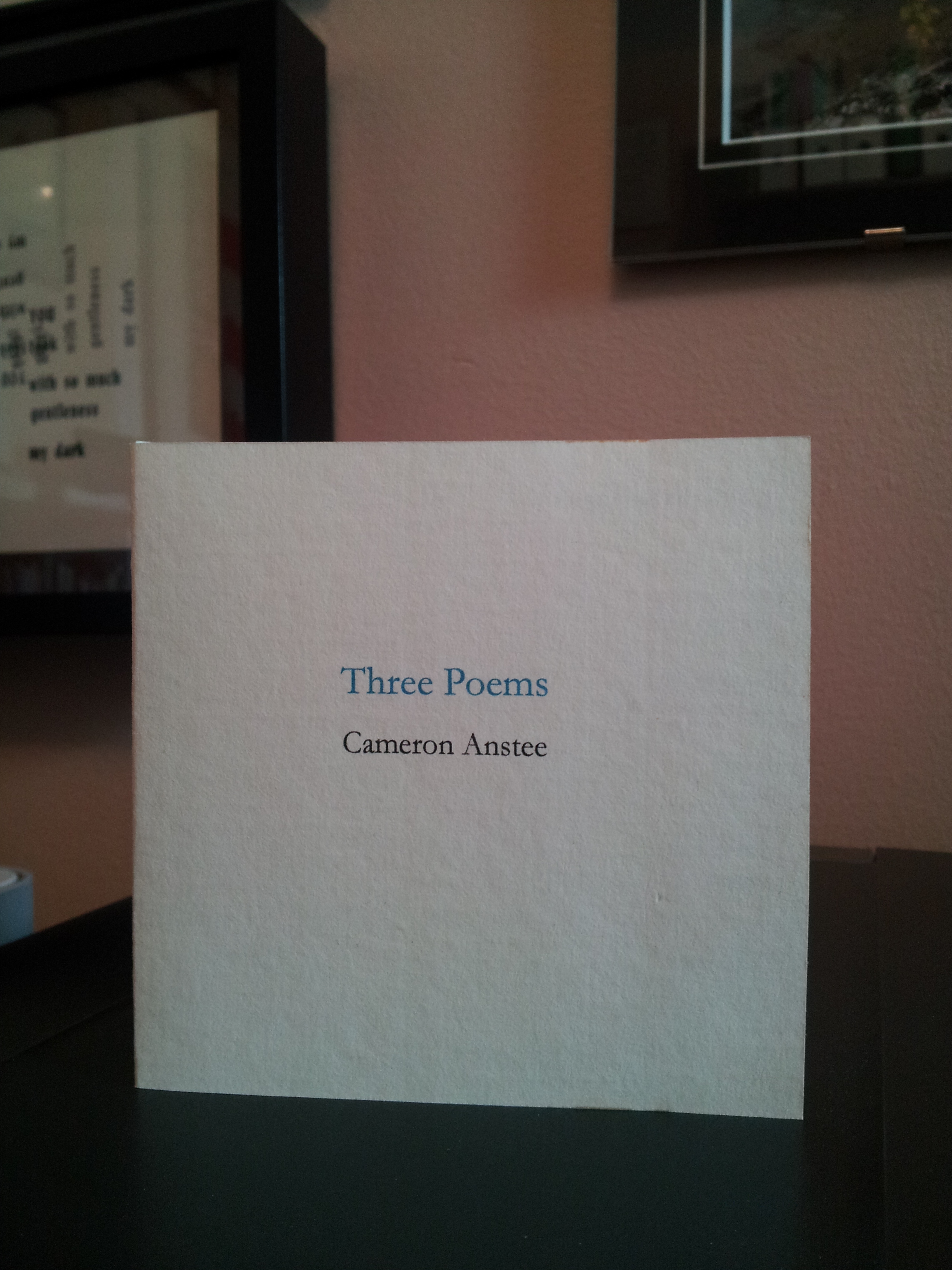
rob mclennan also wrote a short review of a small publication I made to give out at my In/Words reading last October, Three Poems. rob continues to be kind to and supportive of my work, and I appreciate it. As I work slowly, I’m quite happy with rob’s “optimistic and impatient” stance regarding my writing. I’ve got a small number of these still available as a freebie if anyone out there is interested.
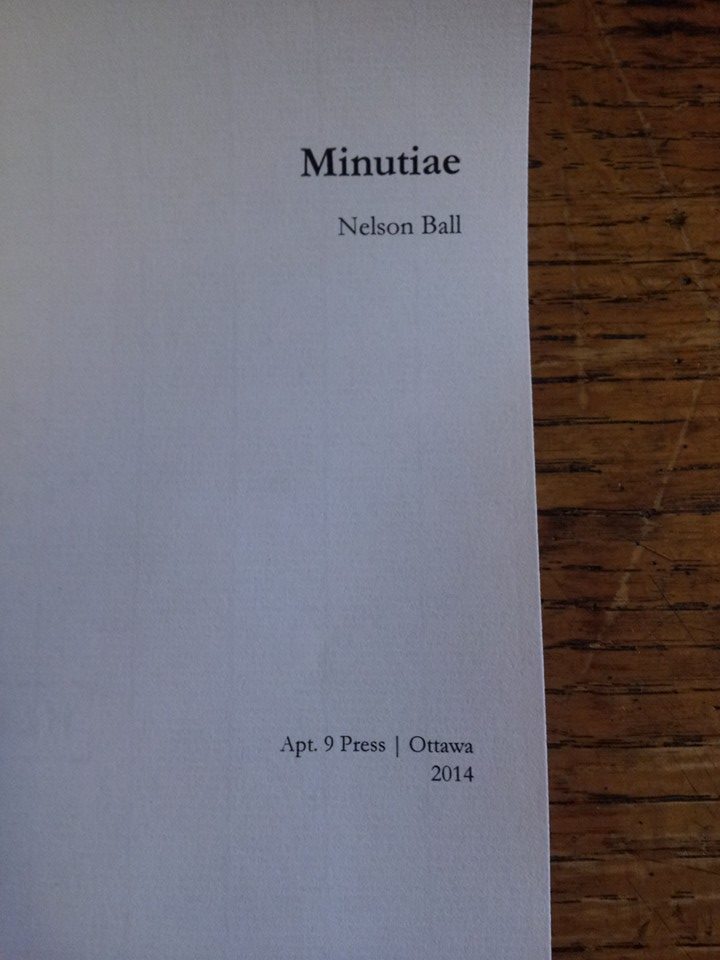
Apt. 9 is back in production. Printing is mostly done, and binding has begun on Minutiae from Nelson Ball, a hero of mine and the subject of a central chapter in my dissertation-to-be. It has been a real joy working on this book, and I can’t wait for people to read it.
Apologies that it has been so long between updates, there will be more to come.
I’ve written about Robert Rosewarne and Fran Jones on this blog before. Artists, printers, and publishers, the two were a part of Ottawa’s vibrant literary and visual arts community in the early 1960s. Ottawa being Ottawa, though, there is little information available and little research has been performed on their work. This blog is actually one of the few hits when you search Rosewarne or their press, the “Blue R Hand Press”, on Google.
Consequently, I was delighted to come across a reference to their work recently. In Fine Printing: The Private Press in Canada, a catalogue related to a traveling exhibition organized by the Canadian Bookbinders and Book Artists Guild and the Friends of Thomas Fisher Rare Book Library in 1995, the Blue R Hand Press gets a mention. The two books Rosewarne designed and printed for Jay Macpherson’s Emblem Books were included in the exhibition. More interestingly, the book quoted from a publication another private press exhibit, leading to another book that offered further context.
Reader, Lover of Books, Lover of Heaven is “a catalogue based on a exhibition of the book arts in Ontario compiled by David B. Kotin with a checklist of Ontario private presses by Marilyn Reuter.” It was published by the North York Public Library in 1978 to mark the opening of the Canadiana Collection in its new quarters at the library. An exhibition ran from March 21 to April 30, 1977, to celebrate. Frances Rosewarne [Fran Jones], is quoted under “BLUE R PRESS, Ottawa, 1961-1965”:
Bob and I, both printmakers, needed a press of our own. In Westport Bob and an artist friend from the Queen Street Studios finally found the “Blue R” at the Westport [Ont.] Mirror. It was a beauty, with Greek column support for the bed with vestiges of blue and gold paint on the name plate. It was Taylor-Washington, very similar to the one shown as William Lyon Mackenzie’s in one of the Toronto Museum’s publications. One of the uprights had even been smashed which unfortunately made it erratic for printing (smahsed by the Family Compact and reborn as the Blue R, I fancy). Bob bought Carter’s reprint of Moxon and we set to work. Jay Macpherson gave us two Emblem Books to do; Bob did the illustration for both books. Then in May 1965 the studio burnt and the beautiful Blue R Press was damaged too much for our pocket book to repair. The last I hear of the Blue R was that it was in Nesbitt’s Engineering Barns waiting for reconstruction.
One wonders what became of the press…
Blue R also receives a mention in Reader under one other publication–Wrongfount 2: a portfolio of printed pieces issued by the Guild of Hand Printers, Toronto. The listing: “Don Mills, 1963. 12 items. 22.8cmx38cm. 150 copies. Enclosed in a cardboard envelope. Contributions from: Ampersand Press, Blue R Press, Carl Morrison, Donald Duncan, E.J. Mulrooney, Heinrich Heine Press, Leslie and Philip Smart, Village Press, Vincent Rueter, Willow Green Press.” I can only imagine what such an item would go for. If you ever see one, keep me in mind!
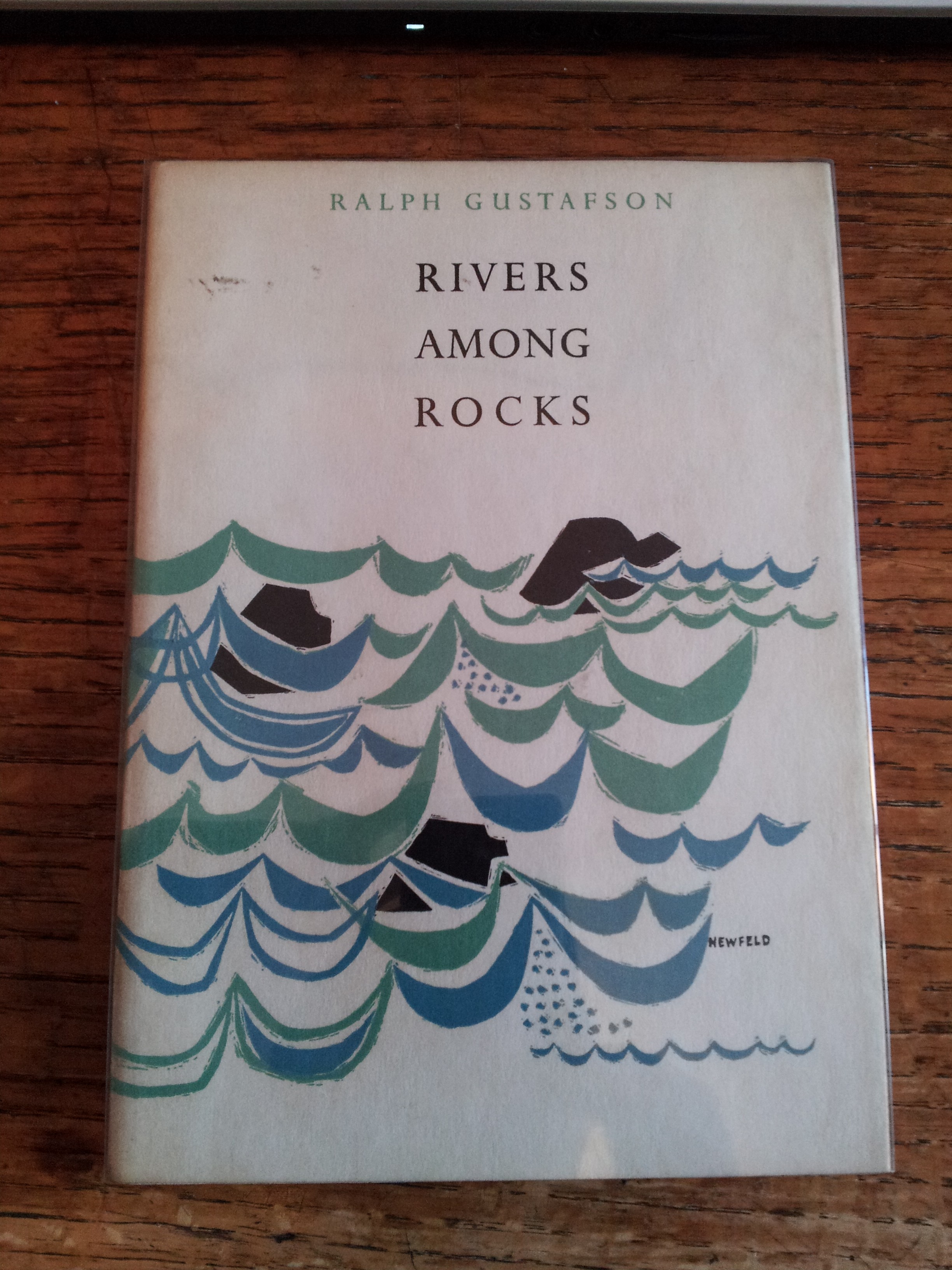
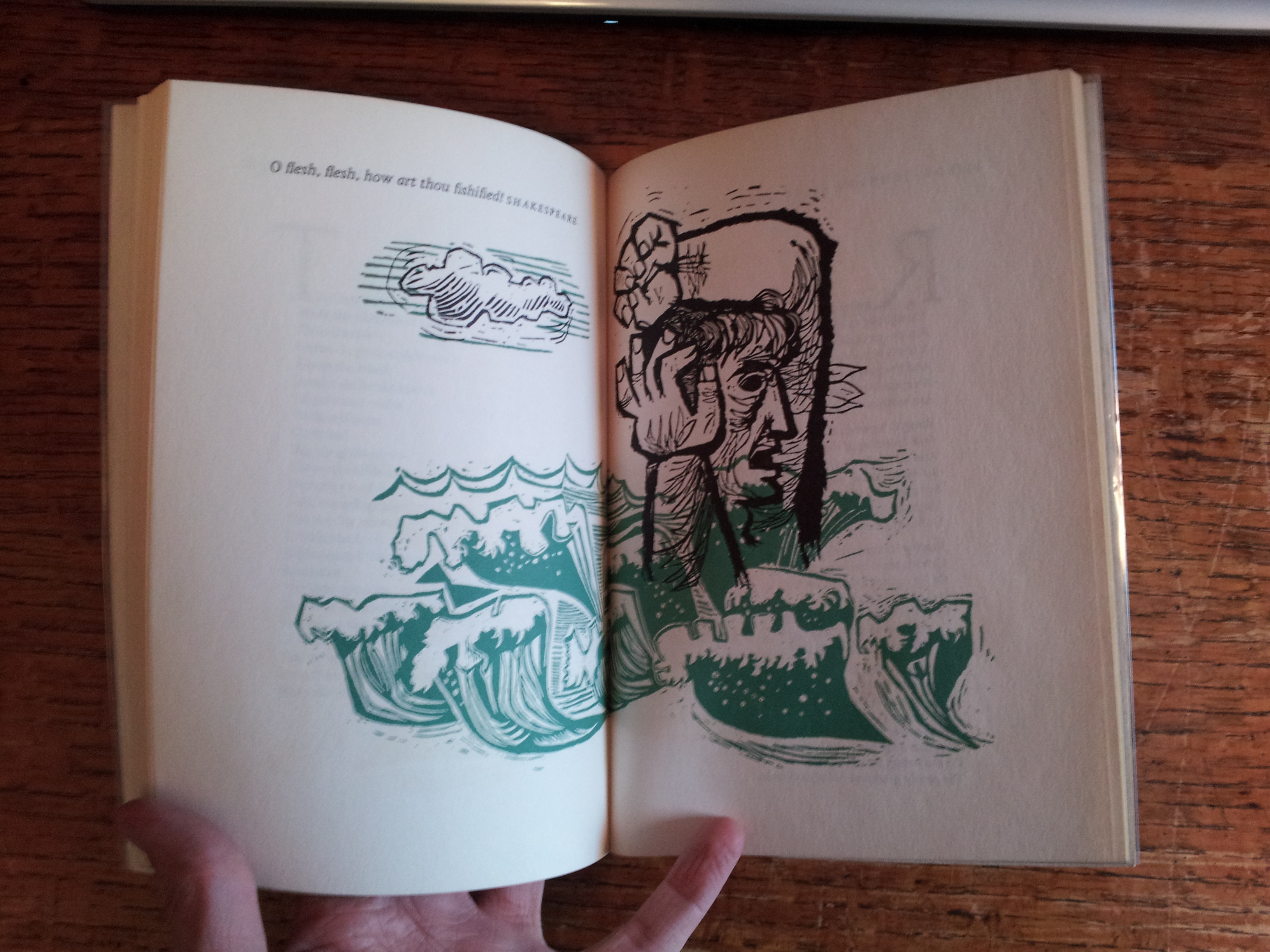
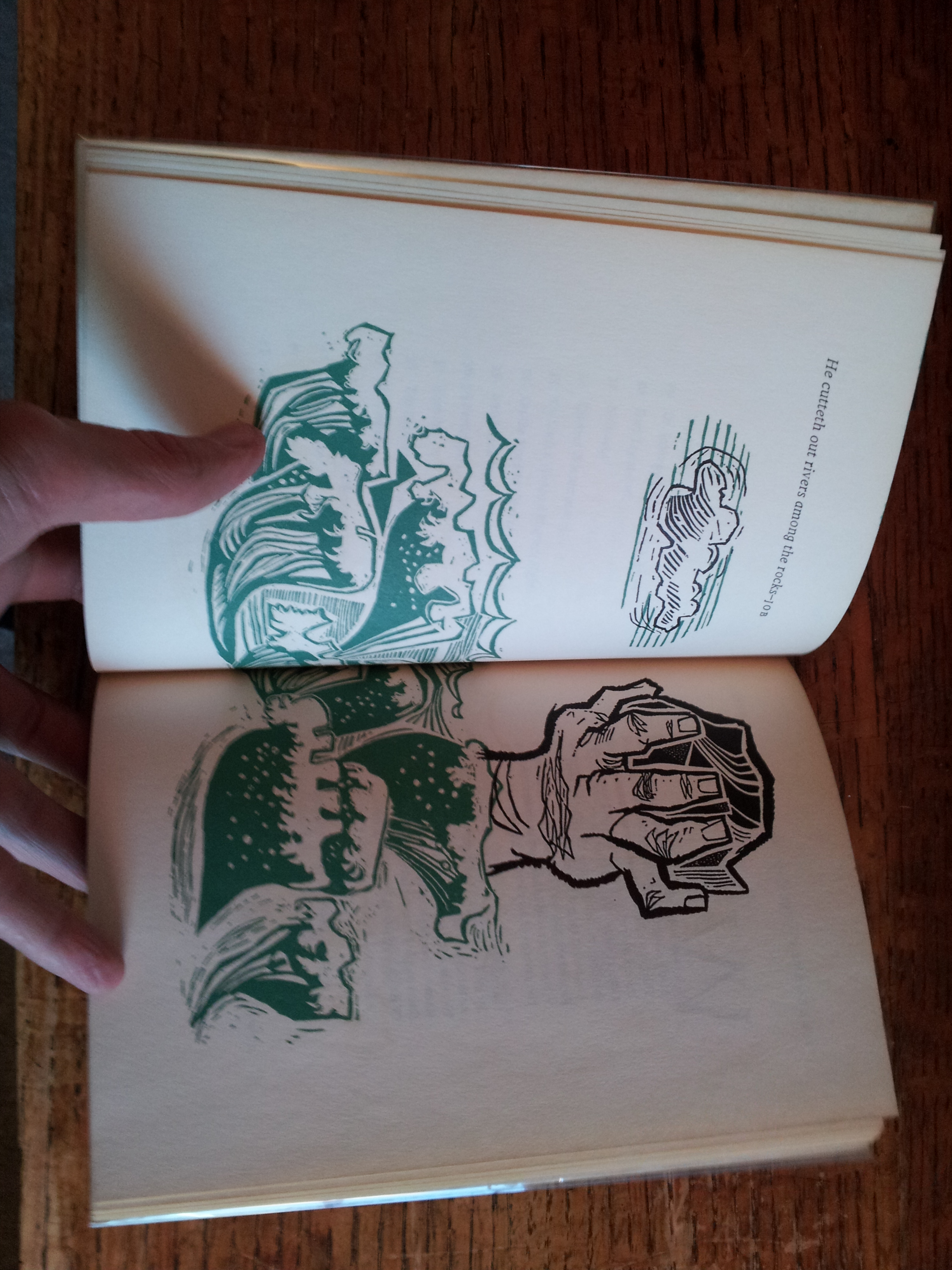
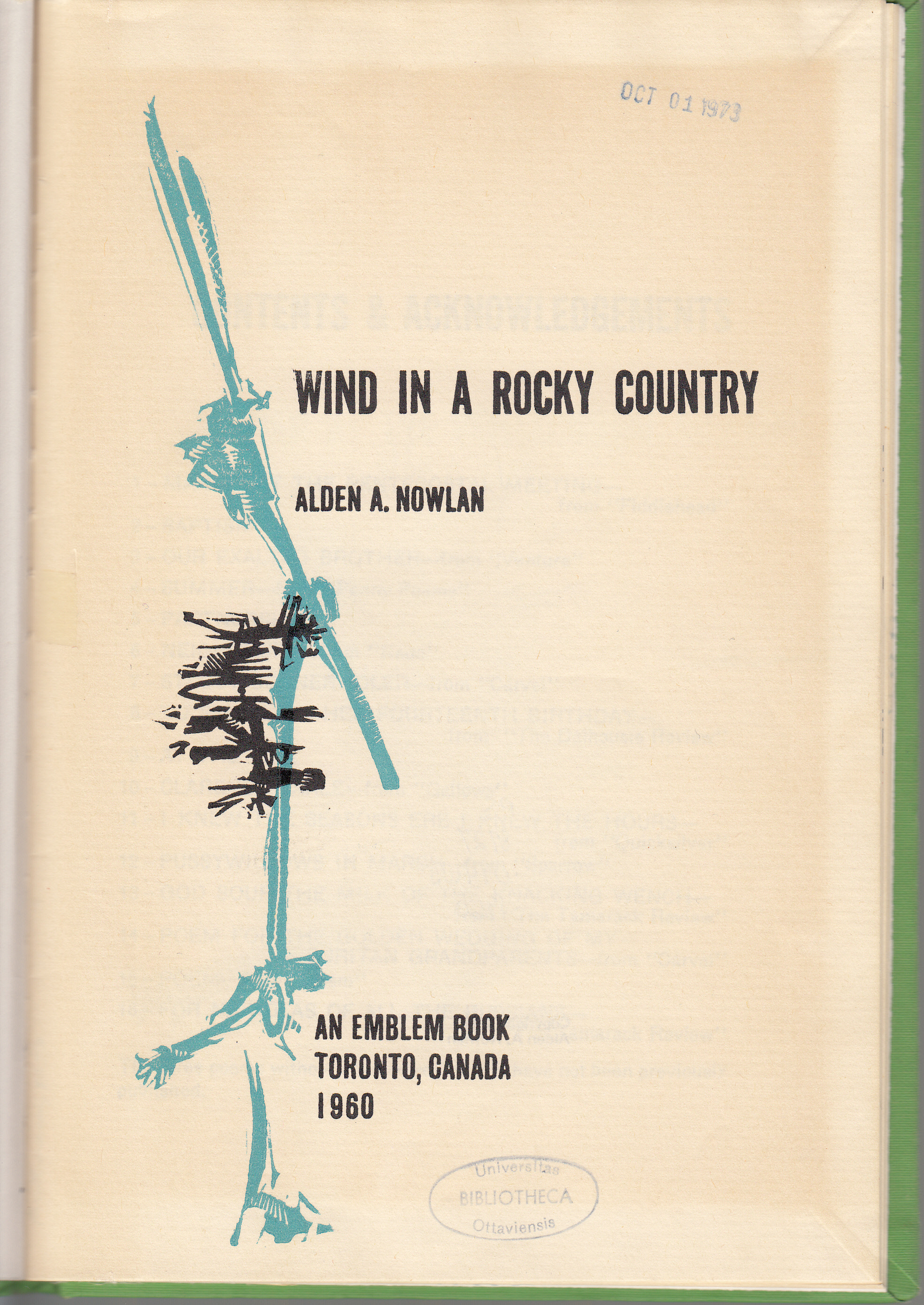
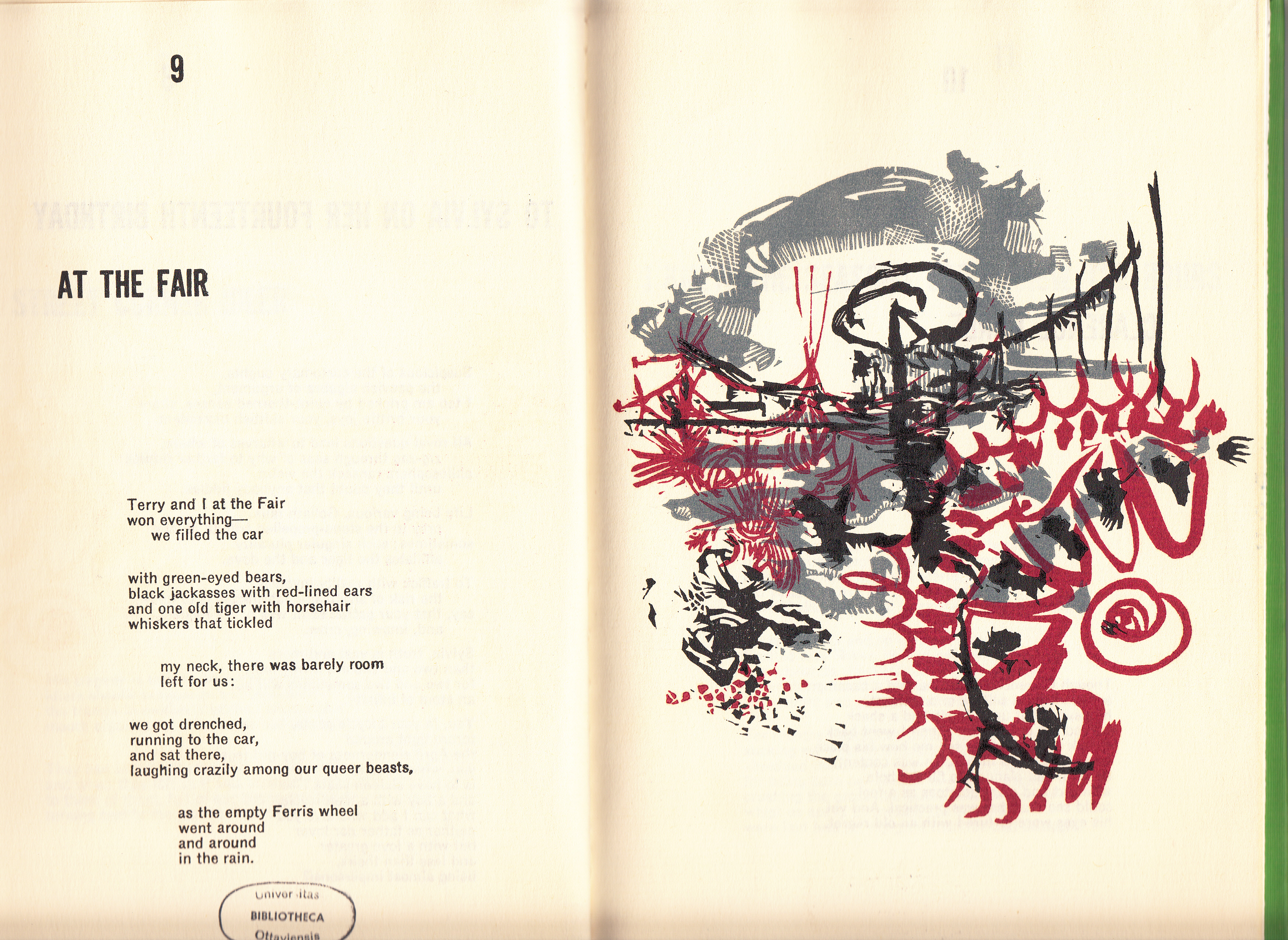
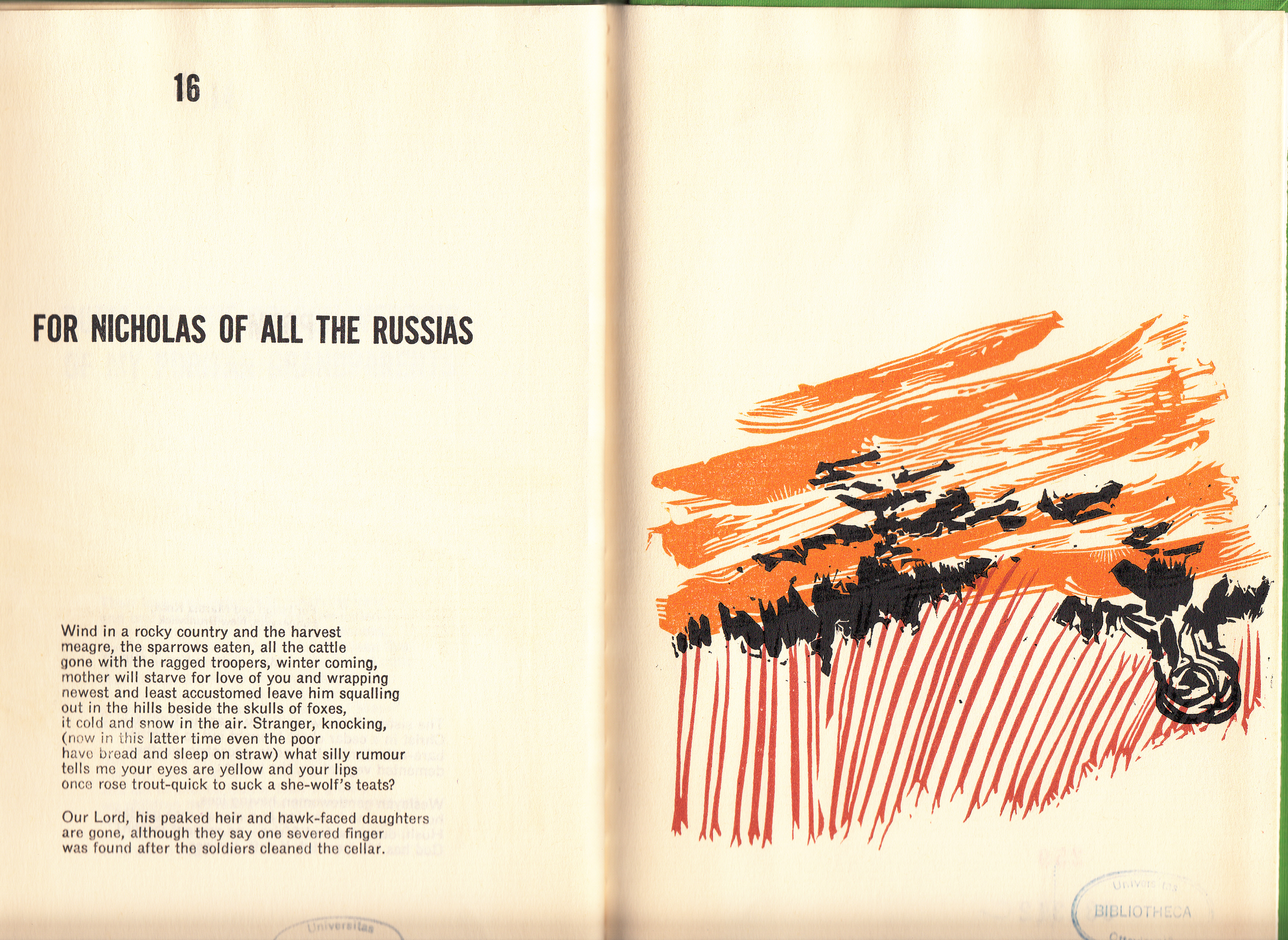
Reading about Blue R again, I was motivated to put some Canadian books from the 60s (and one from more recently), side by side to look (informally) at influence in book design and printing. I cannot make an explicit case for direct influence here, but there are striking similarities in book design aesthetics among certain Canadian publishers of poetry in these years. In any event, these are beautiful productions that speak to one another. My apologies for the poor quality photos–I only own the paperbacks in most cases, and thus can’t lay them flat.
As is often the case with modern Canadian book design, we begin with Frank Newfeld. These are photos from two of the “Design for Poetry” titles: Ralph Gustafson’s Rivers Among Rocks (1960) and Phyllis Gotlieb’s Within the Zodiac (1964), both published by McClelland & Stewart. Read what Randall Speller has to say about the series in his wonderful article from Devil’s Artisan.
Moving chronologically, here are images from the two books that came off of the Blue R Hand Press for Emblem: Wind a Rocky Country by Alden Nowlan (1961) and The Blur in Between by Al Purdy (1962).
Stan Bevington has been explicit regarding his admiration for Frank Newfeld’s design work and it’s influence on what Coach House went on to do. Below are images from one Coach House title (I’ll do another post at some point with images of a number of Coach House books from the late 1960s and early 1970s), Joe Rosenblatt’s The LSD Leacock (1966). Note that this is the second printing from 1968.
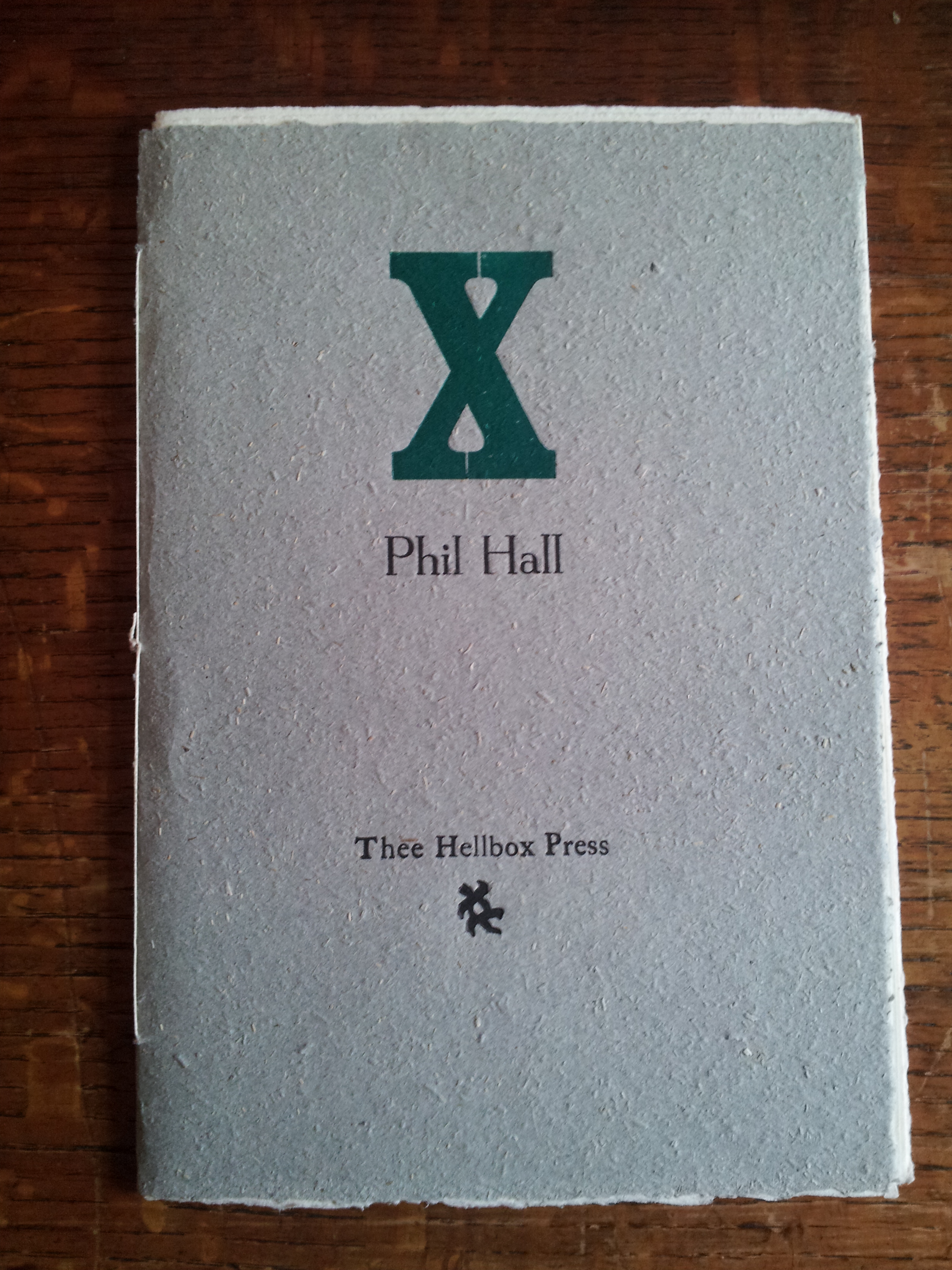
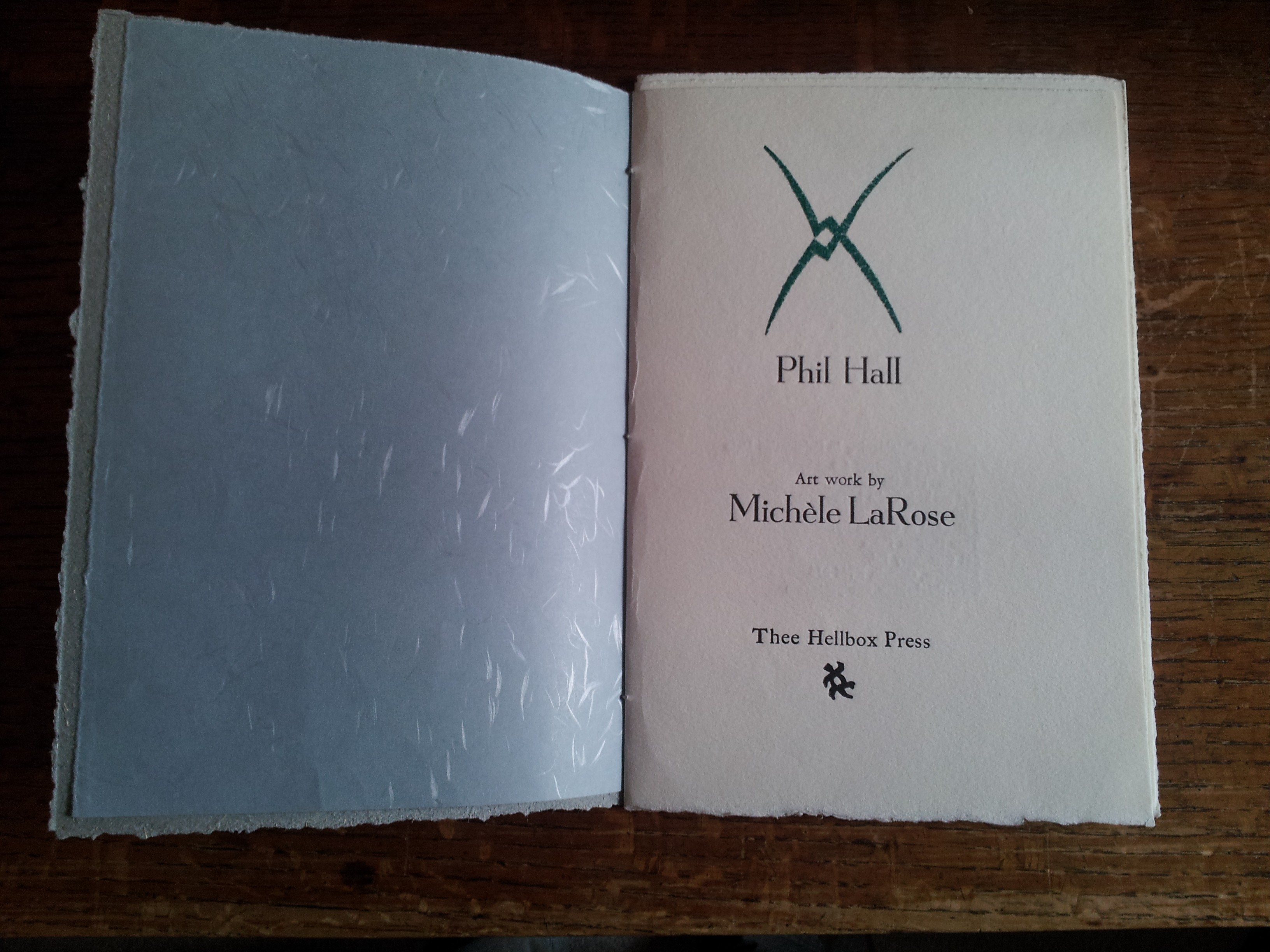
Finally, the last book is brand new. Phil Hall’s X was recently published by Thee Hellbox Press run by Hugh Walter Barclay out of Kingston, Ontario. This book in particular reminds me of Rosewarne’s work on behalf of Emblem. Amazingly, Thee Hellbox is included in the 1995 catalogue Fine Printing. Operating since 1981, Barclay has clearly learned how to get the most out of his printing. I aspire to this work.
There is an awful lot to aspire to. When I someday get the new, more literal press of Apt. 9 Press operating, I hope to begin fumbling my way in their direction. Thanks for all the beautiful books!
[I do not own the rights to any of these books or images. They are reproduced here with respect and admiration. If you want one pulled down, do not hesitate to contact me and I will do so immediately.]
If you’ll indulge me, I’m going to use this space for some blatant self-promotion. My last post focused on work I had published through Apt. 9 by other poets appearing in trade collections. I don’t have a trade collection of my own on the horizon, but I do have work coming out in two trade collection in the next month or so.
First up, I feel honoured to have my 2010 chapbook Frank St. being reprinted in Ground Rules: the best of the second decade of above/ground press 2003-2013. Not only do I have a great deal of respect for what rob has accomplished and sustained over twenty year with the press, but the anthology is being published as part of the re-launch of Ottawa’s Chaudiere Books. The city needs a dedicated trade publisher that is plugged into the local scene. I am feeling super-optimistic about what is going to happen with Chaudiere over the next few years, and it is a joy be there in some form at the start (and among such fine company). Ground Rules is launching on December 7 in Ottawa, 5pm at The Manx with readings from Sharon Harris, Stephen Brockwell, and Marilyn Irwin.
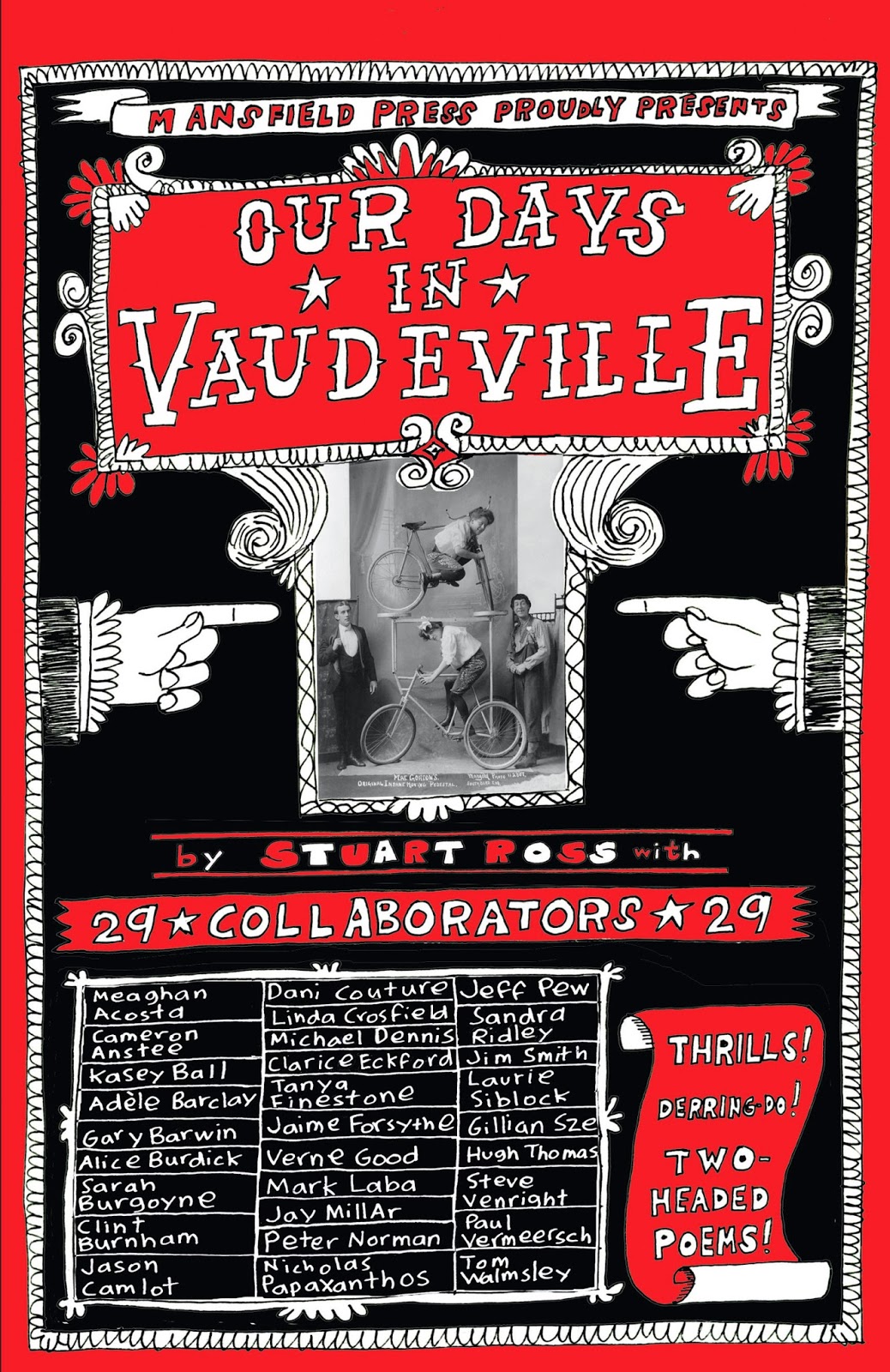
Second, I was lucky enough to collaborate on a poem with Stuart Ross in the last year, the cryptically titled “Melrose 3.” Stuart has gathered collaborations that he wrote with 29 poets over the years and is publishing them under his “a stuart ross book” imprint at the wonderful Mansfield Press. He has some details about the book up at his blog, and also posted this first look at the delightful cover. I’ll share any launch details that I hear as they are revealed.
I love making chapbooks through Apt. 9 Press. It is a great joy to publish work by writers I admire, work I inevitably wish I had written. Due to the time and labour-intensive nature of Apt. 9 productions, print-runs are necessarily limited. Typically 50 copies, with occasional reprints when circumstances call for it. One consequence of this is that this wonderful writing is not permanently available. This can be good or bad depending on your perspective. I love limited editions and finding rare publications by my favourite writers, but I also understand the frustration of just missing out on something. So, I’m always thrilled when a chapbook published by Apt. 9 shows up later in a trade collection, becoming available to a wider audience (and I’m always excited to see Apt. 9 in the acknowledgements).
The press has been active for just over four years now, which is long enough for more than a couple of these publications to have appeared. A new one was launched this past Friday in Ottawa, and this felt like an opportune moment to briefly catalogue these items. Of the twenty five books published by Apt. 9, six have gone on to appear in trade collections to date, or nearly 1/4 of what we’ve published. This is a bit skewed as three chapbooks were launched last week. So let’s say 6/22 is a bit more accurate. These six were published by Pedlar, Mansfield, BookThug, and Anvil, four presses I have great respect for and I couldn’t be happier to see Apt. 9 items hidden away in their bibliographies.
Ridley, Sandra. Rest Cure. Ottawa: Apt. 9 Press, August 2009.
Rest Cure, one of the first three titles published by Apt. 9 Press, was reprinted in Sandra Ridley’s excellent Post-Apothecary, receiving the typically gorgeous Pedlar-treatment. Sandra also published two broadsides with Ottawa operations, “Plunge” (above/ground press poem broadside #286) and “Untether : Unhinge” (AngelHousePress Broadside #002), that appear in the collection. Sandra has a new collection out from BookThug that you should be tracking down to read as well. Three great collections since 2010 have quickly established Sandra across the country.
I Have Come To Talk About Manners was a real joy to publish. Stuart Ross was coming to Ottawa to read in the Tree Reading Series, and I approached him about publishing a chapbook to mark the occasion. True to his generous form, Stuart agreed and we got the book together quickly. 14 or so poems appear in both. The chapbook cover still makes me laugh with its subtly-twisted picture.
Nash, Leigh. Landforms. Ottawa: Apt. 9 Press, May 2010.
Leigh Nash and Andrew Faulkner’s The Emergency Response Unit is a touchstone of design and poetics for Apt. 9. I was motivated when they brought their books to Ottawa in 2008 (or 2007?) and it brought me great joy to publish a book of Leigh’s in 2010. Landforms, a series of eleven excellent minimalist poems, was rewritten in Goodbye, Ukelele, as a single prose-poem. This remains one of the best Apt. 9 covers, in my opinion. I would love to see some new poetry from Leigh, and hope there is something in the works. People-in-the-know: have I missed anything recently from Leigh?
Smith, Jim. Exit Interviews. Ottawa: Apt. 9 Press, June 2011.
I’ve written about Jim on this blog previously. Exit Interviews was enormously fun to produce. I love Jim’s list poems, and a set that so consciously and lovingly worked with the materials of his peers and influences was a very welcome surprise when the manuscript appeared. We even produced a broadside, “Postscript to Exit Interviews,” to tuck into the chapbook that appears in a slightly different form in the trade collection. Everything that is great about Jim as a poet can be found in Happy Birthday, Nicanor Parra.
Hall, Phil. A Rural Pen. Ottawa: Apt. 9 Press, October 2012.
I have long admired Phil Hall as a poet. I first met Phil at the Tree Reading Series in Ottawa. I had been recruited to present the dead poet reading, and chose Kenneth Patchen to focus on. I found out after the reading that Phil and I had an admiration of Patchen in common. When Phil generously provided me with a manuscript, we decided to try to include Patchen in the project somehow. The cover image is a drawing of Patchen’s from his book We Meet (1960). I wrote to New Directions and, much to my surprise, they gave us the rights to use it. I couldn’t be happier with this book.
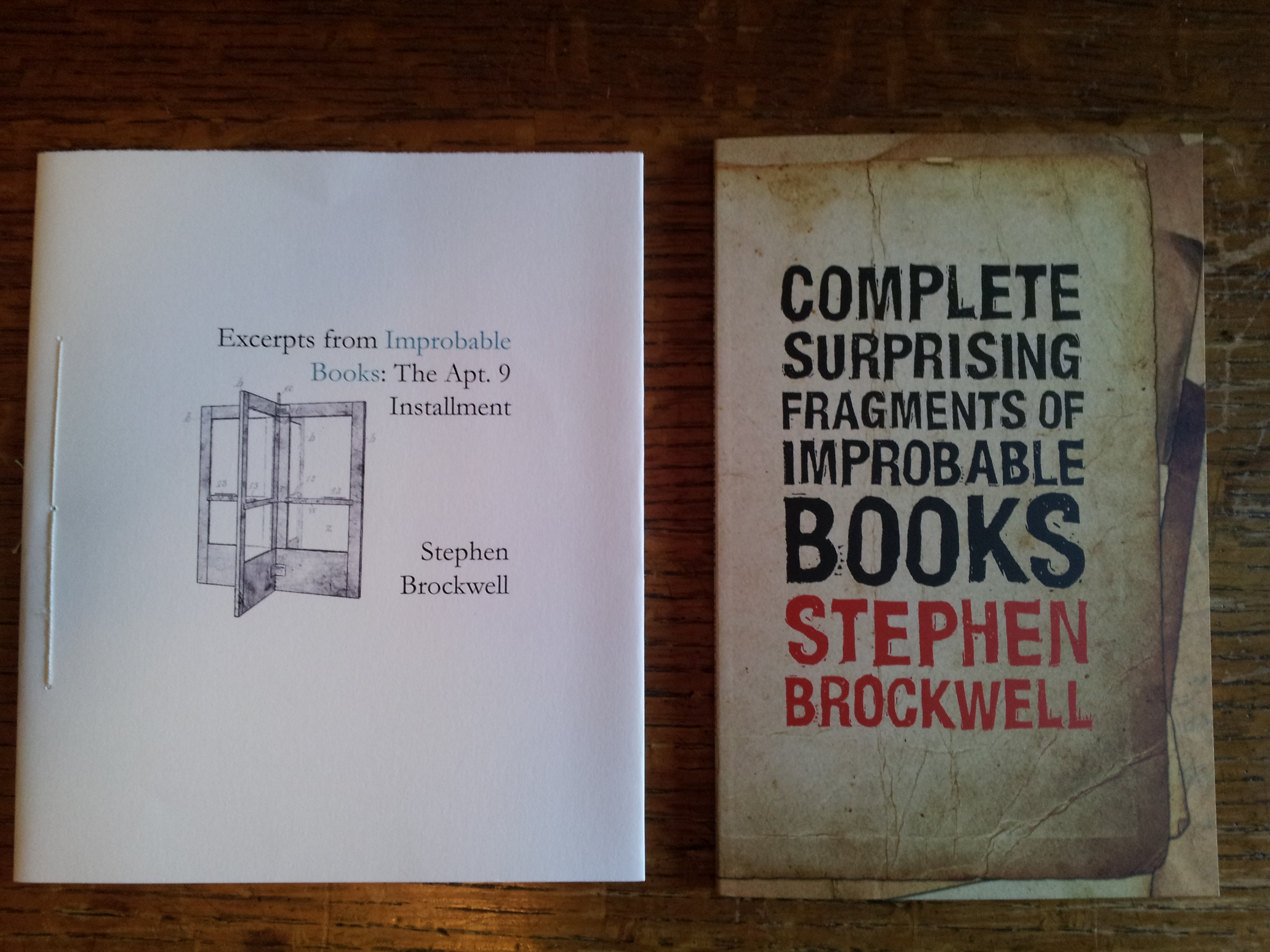
This past Friday, Stephen Brockwell launched his unbelievably good new collection at the Ottawa International Writer’s Festival, the books apparently arriving direct from the printer mere hours before the event (so new, in fact, it doesn’t appear on the publisher’s website yet). I’ve discussed the project before. I think this is an important book, one that deserves to bring Stephen greater respect than he already receives. It’s idea seems to simple and clear now that it exists, but it took someone with Stephen’s combinations of poetic curiosity and scientific/technical knowledge to realize it. I feel very lucky to have helped bring a small part of it into print before the trade collection.
So there you go. If you missed any of these, you can at least track down the writing in these books. You should be buying these six books regardless.