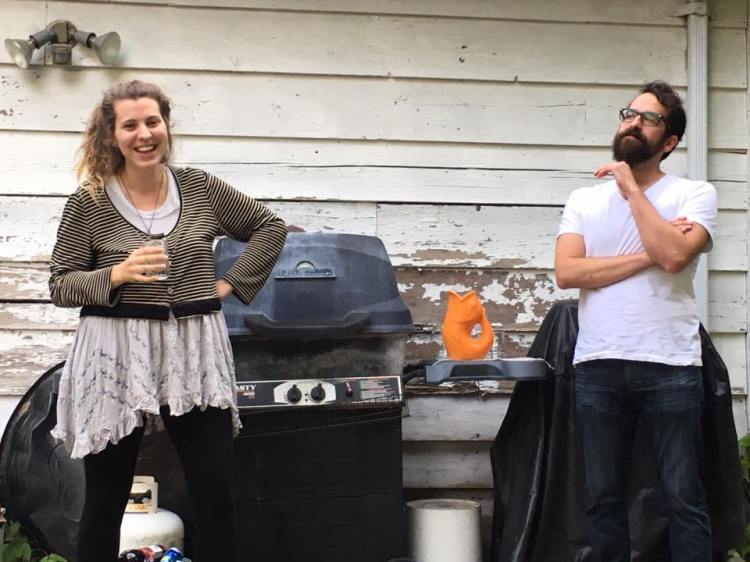
We made the trip to Peterborough to celebrate the first year of the Show and Tell Poetry Series, run by Elisha Rubacha and Justin Million. It was an intimate and compelling reading, performed in their backyard in downtown Peterborough. If you’re nearby, get out to one of the shows, and if you’re not, listen in.
There is a campaign to demonstrate to the CBC that there exists sufficient interest to allow Adrian Jean to republish the 1974 Graphic Standards Manual. There were similar campaigns in the last couple years for NASA and the NYC Transit Authority. I would buy one, and I hope it happens.
Another remembrance and tribute to Bill, this time from rob mclennan. Read it here.
Hawkins’ exploits are as legendary as they are apocryphal, including tales of facilitating Jimi Hendrix’ recording of a Joni Mitchell performance at Le Hibou on his reel-to-reel (later recording Hawkins performing a new song on guitar at the after-party), a run-in with Mexican police at the Mexican-American border involving a pick-up truck of weed (and Trudeau’s subsequent interventions on their behalf), and a day-long reading at the site of a former hotel in Ottawa’s Lowertown. Another story has Hawkins sitting on stage reading quietly to himself in a rocking chair during a performance of The Children at Maple Leaf Gardens, as they opened for The Lovin’ Spoonful.
Alan Neal had Bruce Cockburn and Sneezy Waters on All in a Day to discuss Bill. You can listen to that here.
And the 6pm News on CBC ran a short story on Bill built around an earlier 2008 profile. The 2008 profile can be viewed here, and the newer piece begins at 37:00 here.
And from the Ottawa Sun, a profile from 1997 here.
William Hawkins died yesterday, July 4 2016, at age 76. He spent a short time in the hospital, and his passing was both a surprise and not a surprise–it was expected but not expected quite so soon. It hasn’t yet been 24 hours, but I wanted to try to write something. Apologies for the disorder of these thoughts.
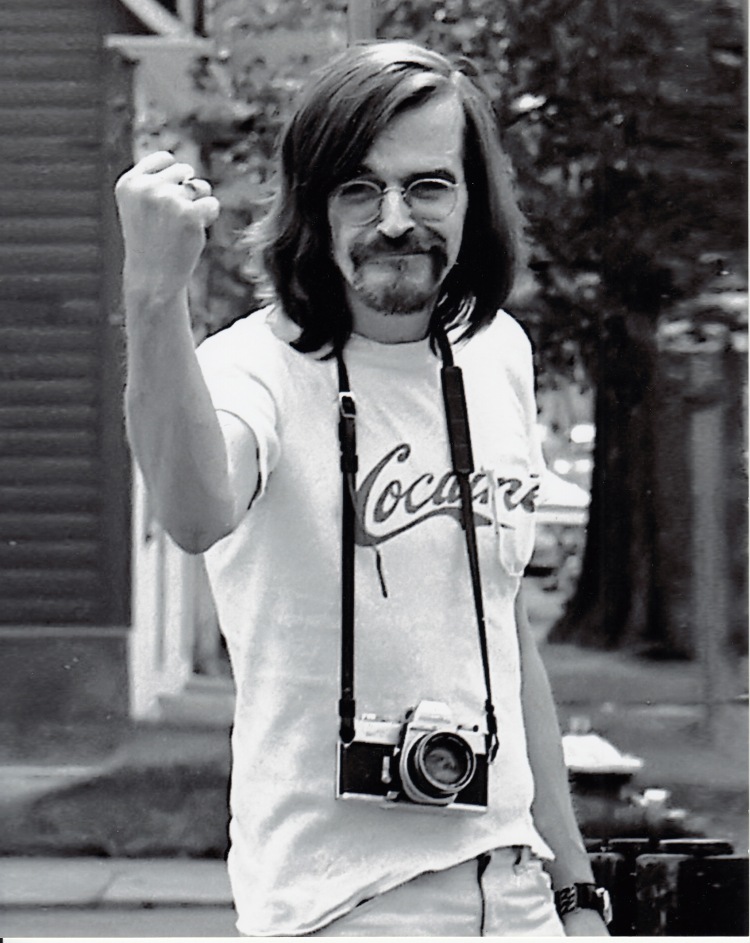
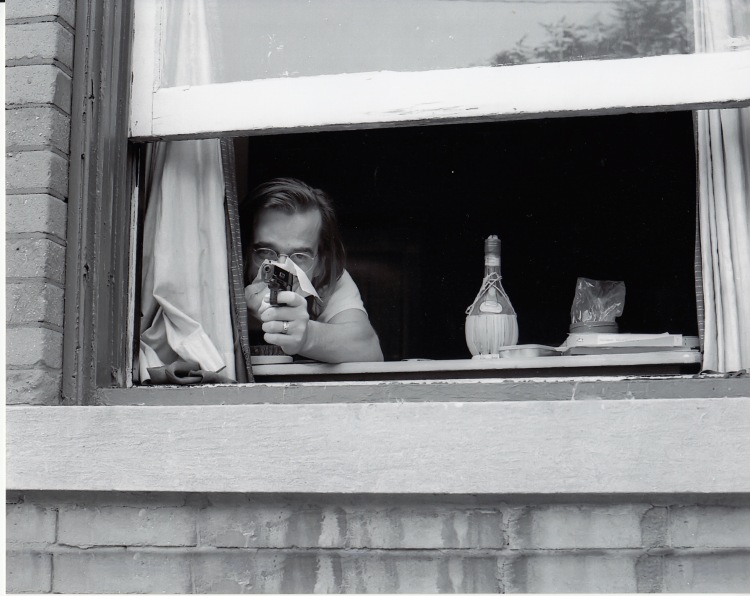
I’m sitting in my office surrounded by Bill and his work. One of the poster poems, “Postage Stamps,” is above my desk. A different poster for a reading at Le Hibou hangs on the adjacent wall above a bookshelf (with a little handout made by jwcurry for Bill’s 65th birthday tucked in containing a Frank Zappa quote with a nod to Bill). All of his books and assorted other ephemera are on the shelves in their right place. Just yesterday a really lovely tribute poem to Bill by Neil Flowers arrived in the mail (Taxi Cab Voice, published this month by above/ground press). The tribute record, Dancing Alone, is running in the background. Only a few weeks ago he passed me a binder full of old photos to scan and put online. He’s everywhere.
I last saw him on Thursday, and had made a plan to visit him again likely today (when he was supposed to be out of the ICU). I was looking forward to talking about the Wimbledon results with him (he’d be delighted that Roger and Milos are still in it, and I know he was happy to get the news that Novak went out on Saturday). I first met Bill while working at Octopus Books in 2009. We had corresponded over email and he swung by the store to say hello. He ordered some books and was as kind and charming as ever. My partner Jenn has known him for much longer. Her father, Mike, met Bill in the 1970s, the two of them working as cab drivers in Ottawa together for four-plus decades. The first barn that Jenn ever got up on a horse at was one owned by Bill’s family. In turn, Jenn’s family turned Bill onto Czech beer and to the end he went back on forth between Pilsner Urquell and Kozel depending on his mood. The first book of Bill’s I got was his 2005 selected, Dancing Alone, that I’m pretty sure Jenn got signed for me by passing it through Mike to Bill.
Photos by Max Middle. Bill, Harvey Glatt, and me at Laurier House in 2010 (?) celebrating the launch of Roy MacSkimming’s “Laurier in Love.”
Bill was a good friend to me, and his work and support meant a great deal to my own writing and sense of being a poet in Ottawa. I’ve written and spoken about Bill’s work a number of times in different places over the years. I don’t want to repeat myself or others here. My favourite piece of writing on Bill is Roy MacSkimming’s introduction to Dancing Alone (followed by rob mclennan’s talk inducting Bill into the Verse Hall of Honour).
It was such a joy to spend some five or six years putting together his Collected Poems, published just last June (read my introduction here). That project followed the publication of a long-lost poem, Sweet & Sour Nothings, as well as a descriptive bibliography that was part of my ongoing attempt to find as much of his work as possible. Bill was always receptive and appreciative of attempts to find and make available his work, if not a little skeptical of the whole thing. He said to me more than once that his Collected probably shouldn’t be done until after he died, but he seemed happy to have it in his hands once it was published and I’m incredibly happy that he got to hold it. He even managed to give one final reading at The Manx last November to celebrate the publication of the book. It was filmed (I can’t remember who by, but thank you!) and you can watch it if you never had the joy of seeing him recite his poems from memory and delight a crowd. I can only imagine what his readings were like in his prime in the 1960s. You can also hear him recite a few poems and answer some questions from Alan Neal for All in a Day here.
The stories of his life and work are well rehearsed these days–the legendary posters stapled to telephone poles and otherwise sold for beer money; driving across the country with Roy MacSkimming to attend the era-defining 1963 summer poetry seminars at UBC (and Robert Creeley paying to have their car fixed when it broke down en route home); appearing in Modern Canadian Verse (edited by A.J.M. Smith) on the strength of his work in the Souster-and-Coleman edited New Wave Canada from Contact Press; the time in Val Tetreau Correctional Institute as a young man; travels through Mexico on a Canada Council grant, and various drug related mishaps; the songs, beloved and recorded by others; his work at Le Hibou, hosting poets and musicians in the heart of the 1960s. Nelson Ball, publisher of Weed/Flower Press (and thus of Bill’s Ottawa Poems), credits Bill with turning him on to imagism. He was in the important mags and anthologies and published by important presses. He played with and inspired important musicians (Bruce Cockburn says that he began writing songs to put music to Bill’s lyrics). His songs were featured in the 1967 NFB documentary Christopher’s Movie Matinee, a film in which cameras were “put in the hands of a few young people [to make] this film about themselves and their world.” His writing anticipated and engaged with the currents of 1960s small press poetry in Canada, moving through free verse experiments, historiographic longer forms, projective verse, 1960s lyric poetry, as well as the concrete and visual experiments of the poster poems, and his efforts as a songwriter.
Bill was a radical force in Ottawa, and despite his occasional travels elsewhere he returned to and remained in Ottawa. His bio in New Wave Canada, ending “Living now in Ottawa,” feels as much like a confession as a statement. He would probably be more well and widely known if he had up-and-moved to Toronto. And for all this, somehow, Ottawa celebrated him, giving him an “Outstanding Young Man Award” in 1966, perhaps not fully aware of Hawkins’s entire lifestyle. This was the same man who only a few years earlier had been institutionalized for “some misdemeanour involving other people’s cars”; the same man whose name was on graphic and obscene posters stapled to the city’s telephone poles; the same man whom collaborator and peer Roy MacSkimming describes as follows: he “took drugs, drank too much, insulted important people. In fact he insulted most people, important or not, more or less on principle.” Years later, in 2012, Bill was inducted into the Verse Ottawa Hall of Honour by rob mclennan, a gesture befitting his importance to poetry in Ottawa, one celebrating the way that his work has resurfaced periodically over the years and found new writers to influence despite his near silence between 1974 and 2005.
And the work really does endure. The poems, like the songs, are funny and sad and sometimes dark and sometimes sweet and (almost) always full of love. I don’t know how to excerpt his life’s work, but here are a few that I particularly love:
1962.
1962.
1966.
1966.
1973.
1974.
2007
The last poem in his Collected is an elegy for a friend that died (“In Memoriam (Sandra Jane Sutcliffe)”) that feels sadly appropriate today, and the next-to-last poem (“Memories Memorial”) feels closest to the Bill that I came to know over the last seven years.
2013.
2008.
I didn’t know wild Bill of the 1960s. I knew Bill later in life, full of memories and regrets and sad stories and happy stories and crazy stories and poems and songs. I know less about his life in music, and sadly never had the joy of hailing a cab and finding Bill at the wheel, though we did spend plenty of time sitting in his car in front of the house. It’s nice to think of the thousands of people that crossed his path in that cab, and at shows, and readings, and in books, or stumbled on a poster in 1962 and were baffled or delighted. If you don’t know Bill’s work, there are lots of places to find it: The Collected Poems of William Hawkins, Dancing Alone: Songs of William Hawkins, Time Capsule: The Unreleased 1960s Masters by The Children, or spend some time looking through his website. I’ve also got two copies of Sweet & Sour Nothings left that I’ll happily give to anyone interested, just send me a note [both have since been claimed–sorry!].
Stories are being shared over Facebook, and the media are taking notice, and I’m sure there will be a public celebration or two before long. I’ll share those details once I have them.
Thank you for everything, Bill. I can’t believe you’re gone, King Kong-ing off to whatever-comes-next. Send us back a poem. I love you and I miss you.
A post-script of sorts to the Contact Press post yesterday. Below you’ll find a small handful of Louis Dudek-related items from my shelves that overlap with Contact Press (1952-1967), and below those, a couple related little magazines.
Louis Dudek edited Delta from 1957-1965, during the life of Contact Press and co-incident with Souster’s editing of Combustion.
Delta contained regular ads for the latest titles from Contact Press. Here Ellenbogen’s entry in the McGill Poetry Series is announced as “A New Contact Press Book.”
Dudek’s Delta Canada Press was begun while Contact Press was still Active. Atlantis was published in 1967. According to Nicky Drumbolis, it was “repeatedly intended for publication by Contact Press.”
Glen Siebrasse’s The Regeneration of an Athlete, published by Delta Canada in 1965.
CIV/n, of course, edited by Aileen Collins from 1953-1955 (along with Jackie Gallagher, Wanda Staniszewska, and Stan Rozynski). Dudek and Irving Layton served as readers and contributed to discussion of submissions. Jennifer Macquarrie’s 2006 MA Thesis on CIV/n is an excellent discussion of Aileen Collins’s importance as an editor.
In his introductory note to Michael Gnarowski’s index of CIV/n, Dudek writes: “[I]t led to a realization on my own part, when the magazine ended, that I wanted to edit a magazine single-handed, so that CIV/n prepared the way for Delta, just as First Statement had prepared for CIV/n.
Related Little Magazines:
Contemporary Verse, edited for 39 issues by Alan Crawley from 1941-1952. A precedent for and spiritual contemporary of Contact magazine. According to Tim McIntyre, “in 1941, West-coast poets Dorothy Livesay and Floris McLaren, with help from Doris Ferne and Anne Marriott, decided to start a modern poetry magazine and asked Alan Crawley to be its editor.”
Northern Review (1945-1956), edited primarily by John Sutherland following the merger of Preview and First Statement. An important link between the ferment of the 1940s and the establishment of Contact Press in the 1950s. Dudek and Souster’s correspondence surrounding their increasingly frustration with Sutherland’s editing practices demonstrate one reason that Souster launched Contact magazine in January 1952.
Yes, edited primarily by Michael Gnarowski from 1957-1970 (with help along the way from Glen Siebrasse, John Lachs, Donald Winkleman, Hugh Hood, and, informally, Louis Dudek).
Peter Gibbon’s MA thesis in the history of YES is sadly not widely available, but can be found in a rare issue of his magazine, Conduit, published as a double issue (Conduit 1/YES 20, Fall/Spring 2012).
After acquiring a copy of Trio yesterday from Richard Coxford (formerly Bytown Bookshop, Ottawa) and George Ellenbogen’s Mcgill Poetry Series entry Winds of Unreason from Liam at Patrick McGahern’s (Ottawa), I decided to take stock of my small but growing Contact Press collection. Below you’ll find photos and some small notes on what I’ve currently got on my shelves, both Contact Press itself and a few related things. There are 15 Contact Press titles, 2 from the McGill Poetry Series, one from First Statement Press, an issue of Combustion, two of Michael Gnarowski’s bibliographic works, three books related to the Contact Poetry Reading Series, two Anansi reprints of Contact titles, a couple broadsides, and a small ad.
Only a few dozen Contact titles to go! Michael Gnarowski’s checklist puts the total at 49. Peter Miller cites 61 titles. Or, for the more ambitious, Nicky Drumbolis’s Contact checklist of official titles, variants, and related materials run to 355 items. It has some repeat items with signatures and associations, but it shows how much material can be gathered under the Contact name.
Donations welcome! Haha.
Contact Press (click through the photos for notes):
1952. The first title from Contact Press. Someone inexplicably wrote “Negro” on this copy.
1952.
1954. Eli Mandel’s name was misspelled on the cover, the title page, and before his poems. It was spelled correctly for his biographical statement. Corrected by hand with whiteout throughout at the time of publication.
1956. Inscribed by Contact editor Peter Miller in June 1960 while on a trip to Paris (he sold Contact titles while travelling). See Miller’s Sonata for Frog and Man later in this slideshow for another inscribed copy.
“Ray Souster is a very good friend of mine, and a good poet–the poet of Toronto.” Peter Miller.
1958.
1958.
Illustrations in En Mexico.
1959.
Another Miller inscription. “Remember that I am divided into boxed, but that each box holds things valid in themselves.”
1960. Louis Dudek. Literature and the Press. Sadly without the amazing dust jacket.
Co-published with The Ryerson Press.
1962.
1964.
1965.
1967.
Table of contents for New Wave Canada. Gradually accumulating signatures.
1967. The final title from the original run of Contact Press.
Raymond Souster’s final poems, published by posthumously by his literary executor (Donna Dunlop) under the Contact Press name (as per Souster’s wishes).
Related Titles:
Michael Gnarowski’s Checklist
Michael Gnarowski’s index of Souster’s Contact Magazine. Contact released its first issue in January 1952, three months before Cerberus would appear as the first title under Contact Press.
Combustion, edited by Souster, ran from 1957 to 1960, with this final issue (number 15) published in early 1966 as a shared number with Victor Coleman’s Island Magazine (number 6).
Published by Padraig O Broin’s Clo Chluain Tairbh Press to coincide with Spiecker’s appearance in the Contact Poetry Reading Series.
Kenneth McRobbie’s Eyes Without a Face, published by Gallery Editions in 1960. Gallery Editions, edited by Avrom Isaacs, was one of the tangible products of the Contact Readings (hosted at Isaacs’s Greenwich Gallery and then Isaacs Gallery) from 1957-1962.
Souster’s Place of Meeting, also published by Gallery Editions (1962).
One side of a broadside presenting this list of readers in the Contact Poetry Reading Series on one side, and a poem by Souster (“Charles Olson at the Ford Hotel”) on the other. Text at the bottom: “Information Courtesy of LETTERS BOOKSHOP.”
A broadside index of authors published by Contact Press, prepared by Nicky Drumbolis (who else?). “CONTACT” as the top is printed by the same linocut used for Contact magazine. Signed by the seven poets that read at Harbourfront on January 28, 1986 at a Contact retrospective.
Bottom of the same Contact-index broadside: “Good writing provides CONTACT between words and the locality that breeds them.”
Other Canadians (1947), published by John Sutherland’s First Statement Press, a spiritual forerunner and practical working model to Contact Press.
Al Purdy’s Poems for all the Annettes, published by Contact Press in 1962 and reprinted by House of Anansi in 1968. This is, obviously, the reprint.
Margaret Atwood’s The Circle Game, published by Contact Press in 1966 and reprinted by House of Anansi in 1967.
A small advertisement for Contact Press titles. I do not know the source of this one.
Published in the McGill Poetry Series, Number 9 (1965).
Published in the McGill Poetry Series, Number 3 (1957).
Ellenbogen’s Winds of Unreason contains drawings by Peter Daglish throughout.
New Wave Canada Portfolio, issued as an insert for Island 7/8 in 1967. From Nicky Drumbolis, in his inventory to Contact Press: “including a poem from 14 of the 17 contributors to the anthology [New Wave Canada] […] each poem is here included in the poet’s holograph facsimile. [Victor] Coleman produced this collection as a testament to his uncredited involvement in organizing a list of potential contributors to the anthology.”
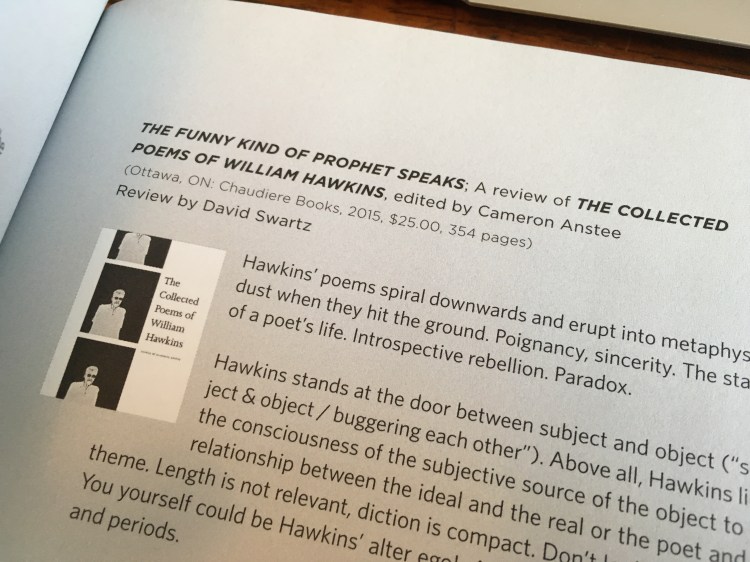
The fine people at Vallum saw fit to publish an 8-page review of The Collected Poems of William Hawkins in their latest issue (13:1, “Open Theme”). David Swartz wrote the review, and I was delighted to see how much time he spent thinking about Louis Riel, which is almost certainly the book of Bill’s that has received the least attention over the years, critical or otherwise (none of it was included in his first selected poems, The Gift of Space, in 1971). Swartz is a good reader of Bill’s work. I couldn’t be happier. Thanks, Vallum, and thanks David!
What gives Hawkins’ poems depth is their immense weight and beauty, their intricacy of thought, luminosity, and comprehensibility. (David Swartz)
The timing is great, as the book just celebrated 1-year in the world (though we launched the book in June 2015, it arrived from the printers in April). I remain immensely proud to have edited it, and I hope that it keeps finding new readers for Bill. Go buy a copy if you haven’t already!
The idea behind the Poets Series is to paint portraits of living poets and let each poet pick the next as a practice of praco-poesis. More simply put, I hoped to create a round robin of poets. I began this work by crowd sourcing poets to begin each branch. I asked the poets who were picked if I could paint a portrait of them, and if they wouldn’t mind selecting the next poet to add to the series. The response has been astounding. As the beginning poets included other poets, and the archive began to grow, branch by branch into an amazing narrative of contemporary poetry. The Poets Series is a celebration of the complex tangle of living poets that belong to a loose archive.
She has just set up a website with information about the series, images of completed and in-progress paintings, as well as giclee prints for sale. My portrait is based on a photograph that my partner Jenn took while we were in New York City in Spring 2014. I’m really astonished by the whole thing. What a strange thing to have a portrait, and even stranger to see it in the company of the people it is in the company of (I must be the only poet in the bunch without a trade book). Thanks to Melanie, and thanks to Nelson Ball for adding my name to the archive! I can’t wait to see it grow.
Two new minimalist poems of mine appeared in the world in the last 24 hours (Happy National Poetry Month!). The first, “Refrain”, was done up in a beautiful little single-poem chapbook by Michael e. Casteels through his Puddles of Sky Press (Kingston ON). It is available on its own for $2.00, but you will get it for free if you place an order of $15.00 or more for other Puddles of Sky stuff (spend $30.00 and you’ll also get chapbook-poems by Marilyn Irwin and Stuart Ross!). I’m a huge fan of Michael’s publishing work (and writing), and can’t say enough how happy I am to be a part of this series. You can and should spend $15.00 to support what he does, so take a look around. If you don’t already have them, I would recommend buying back issues of his mag illiterature.
The other poem, “Thrum”, is on page 9 of the brand new issue 11 of NOON: journal of the short poem. I always love to read NOON when it appears, and I’m really delighted to finally have a little poem in its pages.





![In his introductory note to Michael Gnarowski's index of CIV/n, Dudek writes: "[I]t led to a realization on my own part, when the magazine ended, that I wanted to edit a magazine single-handed, so that CIV/n prepared the way for Delta, just as First Statement had prepared for CIV/n.](https://i0.wp.com/cameronanstee.com/wp-content/uploads/2016/05/img_0414.jpg?w=746&h=995&ssl=1 "IMG_0414")


![New Wave Canada Portfolio, issued as an insert for Island 7/8 in 1967. From Nicky Drumbolis, in his inventory to Contact Press: "including a poem from 14 of the 17 contributors to the anthology [New Wave Canada] [...] each poem is here included in the poet's holograph facsimile. [Victor] Coleman produced this collection as a testament to his uncredited involvement in organizing a list of potential contributors to the anthology."](https://i0.wp.com/cameronanstee.com/wp-content/uploads/2016/05/13254291_10156920054680475_6668384217024791154_n.jpg?w=371&h=495&ssl=1 "13254291_10156920054680475_6668384217024791154_n")


 Cameron Anstee